

How does substrate material influence the oven temperature settings during the powder coating process?
Substrate material influences oven settings because different metals absorb and transfer heat at different rates. The oven profile must therefore be based on the component reaching the powder manufacturer’s required curing temperature, with adjustments to temperature or dwell time for the part’s material, thickness and thermal mass.
Substrate material influences powder coating oven settings mainly by changing how heat reaches the coated surface and how the component behaves during heating. The powder’s specified curing schedule remains the starting point, but the oven setpoint, dwell period, loading arrangement and heating rate may need to be assessed against the substrate’s thermal behaviour and temperature limits.
Steel and stainless steel are commonly processed because they tolerate the temperatures used by many powder systems and provide a relatively stable base during curing. However, a thin pressed panel and a heavy fabricated assembly should not automatically be treated as the same load. Sections with substantial mass, enclosed spaces or overlapping plates can heat more slowly than exposed surfaces. If the oven is controlled only by its air temperature, the coating may appear cured on the outside while colder areas have not received the required heat exposure.
Aluminium needs particular attention because it conducts heat efficiently and is often used in lightweight sections with relatively thin walls. It can reach oven temperature quickly, while complex extrusions, folded sections and assemblies with heavier joints may still produce uneven heating. Aluminium can also be more vulnerable to distortion or dimensional movement if a component is heated too aggressively. The process should therefore be checked against the part’s shape, temper, assembly method and any dimensional tolerances that must be retained.
Zinc-coated and galvanised steel can present a different set of considerations. The metallic coating may release gases or moisture during heating, particularly if the surface preparation, storage or pre-treatment has allowed contaminants to remain. This can cause pinholes, bubbles or other surface defects that may be mistaken for an incorrect oven temperature. Temperature settings should not be used to compensate for poor preparation; cleaning, drying, suitable pre-treatment and, where appropriate, a compatible powder system are essential parts of the process.
Castings and porous components may also release trapped air, oil or moisture when heated. A gradual heating approach, appropriate pre-treatment and a coating system suited to the substrate can reduce the risk of outgassing defects. If a part requires a special outgassing procedure, that stage should be considered separately from the final curing cycle, since simply increasing the cure temperature can damage the finish or exceed the substrate’s acceptable limit.
Material composition can also affect the permissible process window. Some substrates, inserts, seals, adhesives, bearings or other attached items may have lower temperature limits than the main metal body. In these cases, the oven cycle must be designed around the complete component rather than the most heat-resistant material present. Parts that combine metals should be assessed for different expansion rates, contact points and the possibility of uneven heat distribution.
For reliable settings, the oven air temperature should be distinguished from the temperature actually reached by the coated metal. A practical validation process includes:
- Reviewing the powder manufacturer’s cure requirements and identifying whether they are specified by metal temperature and time rather than by oven-air temperature alone.
- Selecting representative test parts, including the thickest, heaviest, most enclosed and most thermally isolated areas in the normal production range.
- Measuring the component temperature at several relevant points, rather than relying solely on the oven display.
- Checking that the coldest areas receive sufficient curing exposure without overheating thin sections or heat-sensitive attached materials.
- Inspecting the finished coating for signs of under-cure, over-cure, outgassing, loss of gloss, colour change, blistering or poor adhesion.
Mixed-metal loads require additional care. A thin aluminium part, a heavy steel bracket and a galvanised assembly may reach their required temperatures at different rates even when placed in the same oven. Separating dissimilar loads, using consistent racking and avoiding blocked airflow can make the process easier to control. If mixed loading is unavoidable, the cycle should be validated against the component most difficult to heat correctly, while confirming that faster-heating parts are not exposed beyond their limits.
The substrate therefore affects the way a curing cycle is applied, rather than replacing the powder manufacturer’s requirements. Oven settings should be established through representative trials, measured part temperatures and inspection of the cured finish. This approach is particularly important for large fabricated items, batch work and specialist coatings, where differences in metal type, section thickness and component design can have a greater effect than the nominal oven setting itself.
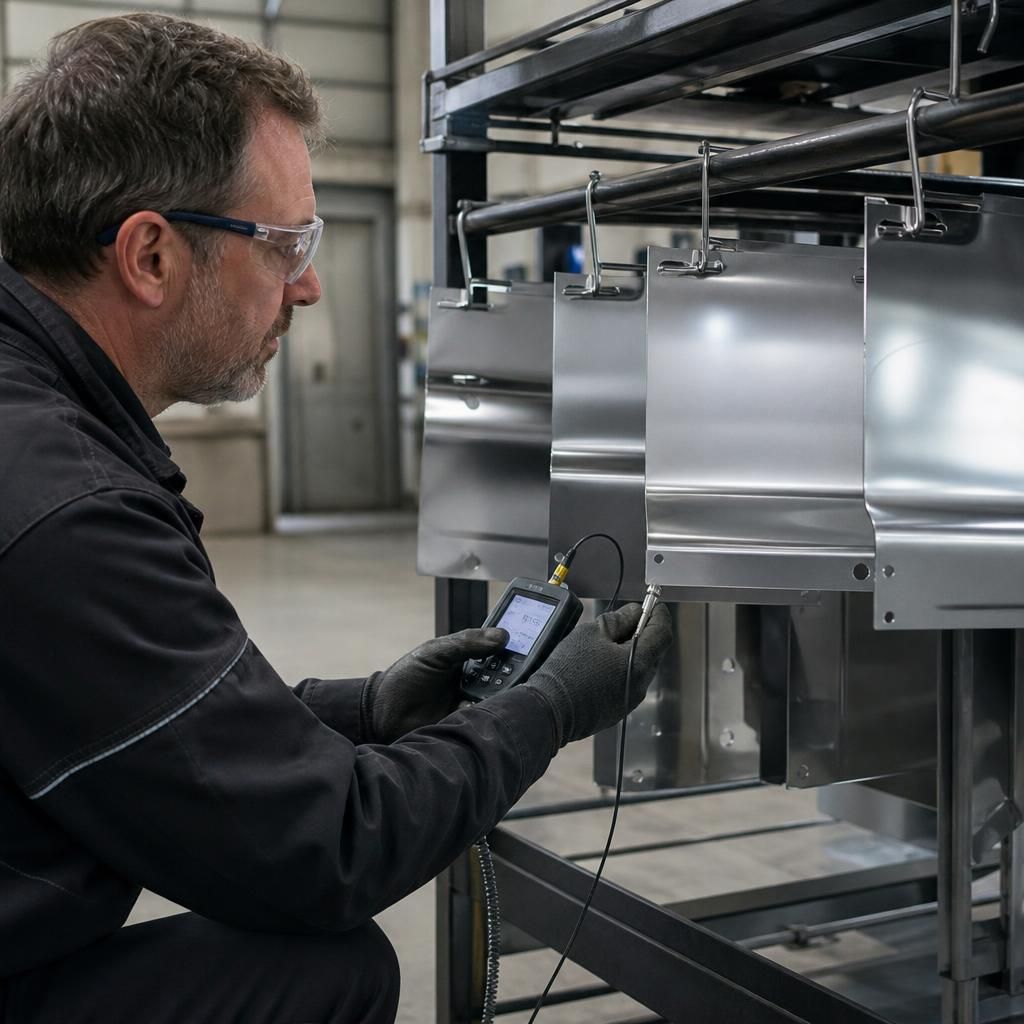
A substrate’s surface emissivity can affect how its temperature is measured, particularly with bright or reflective metals such as polished aluminium and stainless steel. Infrared devices may under-read or fluctuate when aimed at reflective surfaces, making the oven appear cooler than the component actually is and leading to unsuitable changes to the setpoint.
For process validation, use securely attached contact thermocouples at representative points on the coated part, especially where the surface finish or geometry makes optical measurement unreliable. If infrared measurement is used, the instrument must be suitable for the material and correctly adjusted for its surface characteristics. Reliable readings help distinguish a genuine substrate-related heating issue from a measurement error, so temperature settings can be based on the component’s actual curing conditions rather than an inaccurate surface reading.