

How do specialist powders, like nylon or copper-coloured, impact the overall cost and performance in high temp powder coating?
Specialist powders can increase high temperature powder coating costs because they may require more careful specification, preparation and application, while their performance depends on temperature resistance, adhesion, chemical exposure and the required finish. Nylon offers different wear and impact properties but may not suit every high-temperature environment, whereas a copper-coloured powder is primarily a decorative choice and does not automatically provide greater heat resistance.
Specialist powders affect high-temperature powder coating costs mainly through material selection, application control and testing requirements. Their effect on performance depends on whether the powder is genuinely formulated for elevated service temperatures, how the coated component is used, and whether the finish is functional or primarily decorative. Nylon can add wear, impact and chemical-resistance benefits in suitable conditions, while a copper-coloured finish normally changes appearance rather than heat resistance.
It is important to distinguish the temperature used during curing from the temperature the finished coating will withstand in service. A powder may cure in a conventional oven yet be unsuitable for prolonged exposure to high operating temperatures. Conversely, a specialist formulation may be selected for thermal cycling, where the component repeatedly heats and cools. The specification should therefore identify the expected continuous temperature, peak temperature, exposure duration and number of thermal cycles.
How nylon powder changes the specification
Nylon coatings are often selected where the surface needs more than corrosion protection. Depending on the grade and application, they can provide useful resistance to abrasion, impact, friction and certain chemicals. This can make nylon appropriate for components that rub against other parts, experience mechanical contact or require a more substantial protective layer.
Those benefits do not make every nylon coating suitable for a high-temperature application. Nylon has its own temperature range and can be affected by prolonged heat, thermal cycling, moisture and the chemicals present in the working environment. The relevant grade must be checked against the actual service conditions rather than selected solely because it is described as a specialist or heavy-duty powder.
Nylon can also affect the process cost. The applicator may need to control substrate preparation, film build, masking and curing more carefully. Part geometry and the required coating thickness can influence material consumption and the time needed to achieve an even finish. If the component has close tolerances, threaded areas, bearings or moving interfaces, these may need protection from excess coating, adding preparation and inspection work.
How a copper-coloured powder changes the specification
Copper-coloured powder is generally an appearance choice. It can reproduce a copper-like tone or metallic effect without being a copper coating, so the colour itself should not be treated as evidence of improved heat resistance, conductivity or corrosion performance. Those properties come from the powder chemistry, the cured film and the service environment, not from the name of the colour.
Metallic and effect finishes can require closer control than a straightforward solid colour. The visual result may be influenced by film thickness, spray direction, application settings, substrate condition and curing consistency. Parts intended to sit together may need to be processed in a consistent batch to reduce visible variation. Repairs or later additions can also be more noticeable where the finish contains a metallic effect.
The colour can therefore increase cost through specification and quality-control requirements rather than through any automatic improvement in technical performance. If the component needs high-temperature resistance as well as a copper appearance, both requirements should be stated separately. The chosen technical powder must meet the thermal duty, while the colour system must provide the required visual result.
Where the additional cost usually comes from
- Powder selection: specialist chemistries or less commonly used finishes may cost more than standard powders and may need to be sourced to a precise technical specification.
- Preparation: contamination, existing coatings, weld residues, corrosion and surface irregularities can affect adhesion and appearance. More demanding finishes make defects harder to disguise.
- Application control: complex shapes, recesses and required film thicknesses can increase spraying time and powder usage.
- Masking and racking: high-temperature parts often include mating faces, threads, electrical contact points or dimensional interfaces that must remain free of coating.
- Process validation: a new powder or unusual substrate may justify test panels, sample parts or checks after curing and thermal exposure before full production.
- Inspection and segregation: decorative metallic finishes and specialist functional coatings may need separate handling to maintain consistency and prevent mix-ups.
For batch work, these costs should be considered alongside the number and size of parts. A specialist finish may be more economical when the same powder, colour and process can be used consistently across a suitable batch. Small or irregular jobs can carry a higher proportion of preparation, set-up and cleaning work, particularly where the powder cannot be treated as a routine production finish.
Performance factors beyond temperature
Heat resistance is only one part of the assessment. The coating may also need to withstand:
- abrasion from handling or contact with other components;
- impact during installation or use;
- oils, fuels, solvents, detergents or process chemicals;
- humidity, condensation and outdoor exposure;
- repeated expansion and contraction of the metal substrate;
- cleaning methods and maintenance equipment; and
- dimensional requirements around assembled parts.
A powder that performs well in a dry, static application may be unsuitable where the part is immersed in chemicals or subjected to repeated mechanical wear. Likewise, a visually attractive copper effect may be the wrong choice if the coating must hide heavy surface variation or tolerate frequent abrasive cleaning.
How to specify the right specialist powder
- Describe the metal substrate, component dimensions, joint areas and any surfaces that must remain uncoated.
- State the expected operating temperature, peak exposure and thermal cycling pattern.
- List contact with chemicals, moisture, abrasion, impact and cleaning agents.
- Separate functional requirements, such as wear or corrosion resistance, from appearance requirements, such as colour, gloss and texture.
- Confirm acceptable film thickness and dimensional tolerances, especially for assembled or close-fitting parts.
- Agree how colour consistency, metallic effect, sample approval and inspection will be assessed.
- Decide whether representative test pieces or a trial batch are appropriate before committing the full production quantity.
The most reliable cost comparison is not simply the price per unit of powder. It is the total cost of achieving an approved finish, including preparation, masking, application, curing, inspection, testing and any special handling. A standard powder that fails under the intended heat or chemical exposure can create greater costs through premature recoating or component replacement, while a specialist powder may be justified where its specific performance addresses a documented service condition.
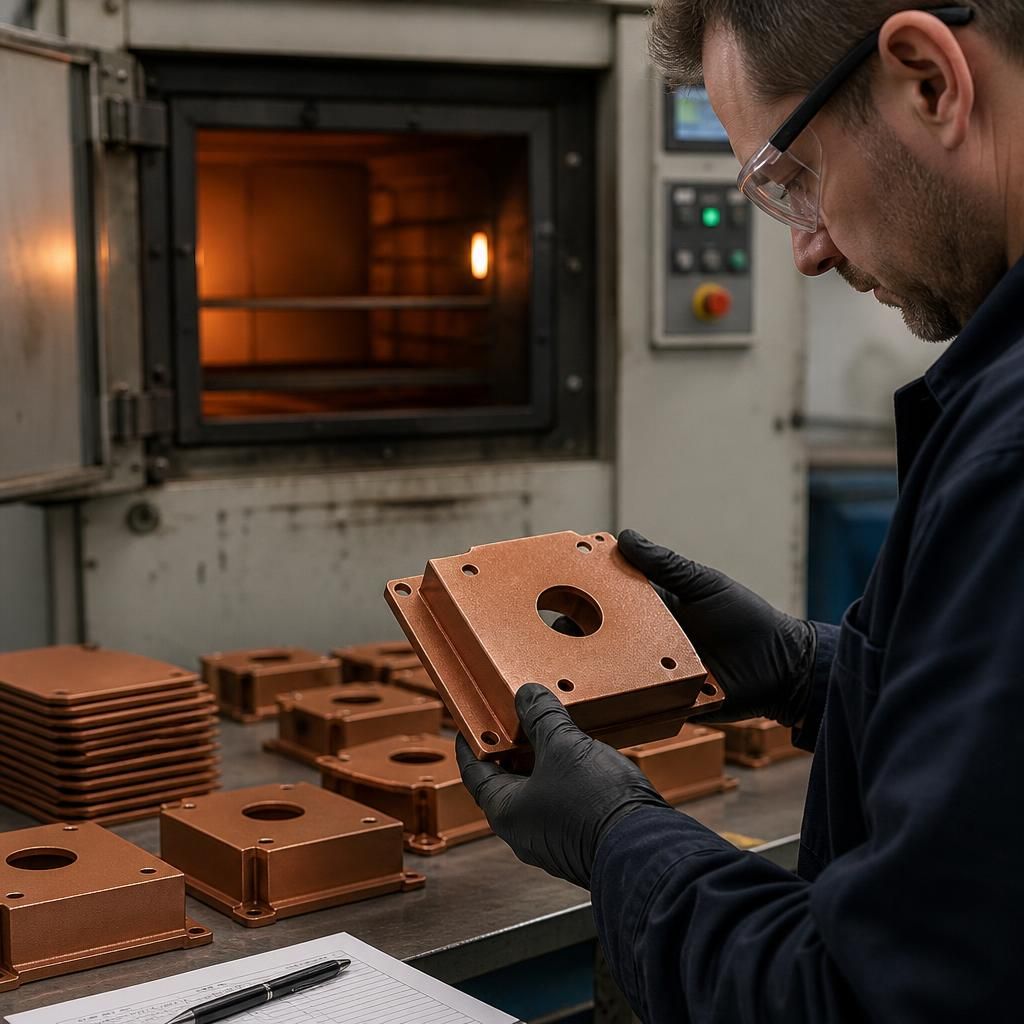
For components exposed to repeated heating and cooling, performance should be assessed by examining the coating after thermal cycling rather than relying only on its initial appearance. Inspection should look for cracking, blistering, loss of adhesion, colour change and deterioration around edges or joints. These checks can reveal weaknesses that may not be visible on a newly cured part.
A representative sample or trial batch can therefore add to the initial project cost, but it provides evidence that the selected specialist powder is suitable for the component’s actual duty. This is particularly useful where a nylon coating is chosen for mechanical protection or where a copper-coloured finish must retain a consistent appearance after exposure to heat.