

What considerations are crucial when selecting the right colour and finish for high temp powder coatings to ensure both aesthetic appeal and performance in industrial applications?
Selecting a colour and finish for high temperature powder coating requires balancing the coating’s heat resistance and thermal stability with the required appearance, gloss level, texture and colour retention. Specify a formulation proven for the operating temperature and environment, then confirm that its colour and finish remain suitable through heat exposure, cleaning and thermal cycling.
The right colour and finish should be selected as part of the complete high-temperature coating specification, not as a separate decorative choice. The decision should account for the component’s actual service conditions, how its surface will be inspected and cleaned, the required visual consistency, and whether the chosen powder can be applied to the substrate at the specified film build and cure conditions.
Start with the operating environment. Identify the normal, peak and intermittent temperatures at the coated surface rather than relying only on the temperature of the surrounding air. Consider direct radiant heat, contact with hot components, temperature gradients across the part and repeated heating and cooling. These conditions can affect the suitability of particular pigments, binders and surface effects. A colour that is acceptable on a cooler external panel may be unsuitable on a section exposed directly to a furnace, exhaust, burner or process line.
Colour can also have a functional effect. Dark and light surfaces absorb and emit radiant energy differently, which may influence surface temperature in some applications. This should not be used as the sole method of controlling component temperature, but it is relevant where the coated part is exposed to intense radiant heat or where heat dissipation matters. The coating supplier or applicator should therefore assess the selected colour within the complete thermal design rather than treating all colours as interchangeable.
Specify the visual requirement precisely. A colour reference, approved sample or industry colour standard is more useful than a description such as “dark grey” or “matt black”. Record whether the part must match adjacent equipment, identify different process lines or remain visually consistent across multiple batches. Define acceptable variation between components, including differences caused by viewing angle, part geometry and the orientation of the powder application.
Finish selection should reflect how the component will be used and inspected. A highly smooth surface may make contamination, scratches or handling marks easier to see, while a textured surface can alter the perceived colour and conceal minor surface irregularities. Texture may also affect cleanability, especially where dust, oils or process residues must be removed. If the part is subject to frequent wiping, abrasive cleaning or chemical exposure, assess the practical effect of the chosen surface rather than selecting it on appearance alone.
Check pigment and coating-system compatibility. High-temperature performance depends on the complete formulation, including the resin, pigments, additives and curing behaviour. Some decorative effects, bright shades or unusual finishes may have narrower service limitations than standard solid colours. Ask for technical evidence that the specific colour and finish—not merely the general coating family—has been evaluated for the intended temperature range and environment.
Application details are equally important. Colour and finish can change with film thickness, cure history, substrate temperature, spray technique and part orientation. Excessive build may affect edge definition, recesses and dimensional tolerances, while insufficient build can produce uneven coverage or a visibly inconsistent surface. Complex fabrications should be reviewed for Faraday cage areas, welds, sharp edges, deep corners and areas that require masking. These features can create visible differences even when the same powder is used throughout.
Use representative samples before approving production. A test panel should use the intended substrate preparation, powder, film-build range, cure cycle and application method. For a complex component, a representative section or sample part is more informative than a flat panel alone. Inspect the result under the lighting used for final quality checks and compare it with adjacent materials or previously approved components.
Testing should reflect the actual maintenance regime. Examine the finish after exposure to the expected cleaning agents, oils, fuels, process chemicals and handling conditions. Where thermal cycling is involved, assess whether the colour, surface appearance and adhesion remain acceptable after repeated temperature changes. The purpose is not simply to confirm the initial shade, but to establish whether the complete colour-and-finish specification remains suitable throughout the component’s intended use.
Document the approved specification. Include the colour reference, finish description, coating product type, substrate preparation, film-build limits, cure requirements, masking details and inspection criteria. Retain an approved sample where practical, since colour perception can vary between lighting conditions and batches. If future repairs or replacement parts are likely, record enough information to reproduce the original finish and identify whether a local repair will be visually acceptable.
For industrial work, the best selection is therefore the one that satisfies the thermal and chemical demands without creating avoidable problems in application, inspection, cleaning or future maintenance. A specialist powder-coating applicator can help review sample parts and production constraints, but the final colour and finish should be approved against the component’s documented service requirements.
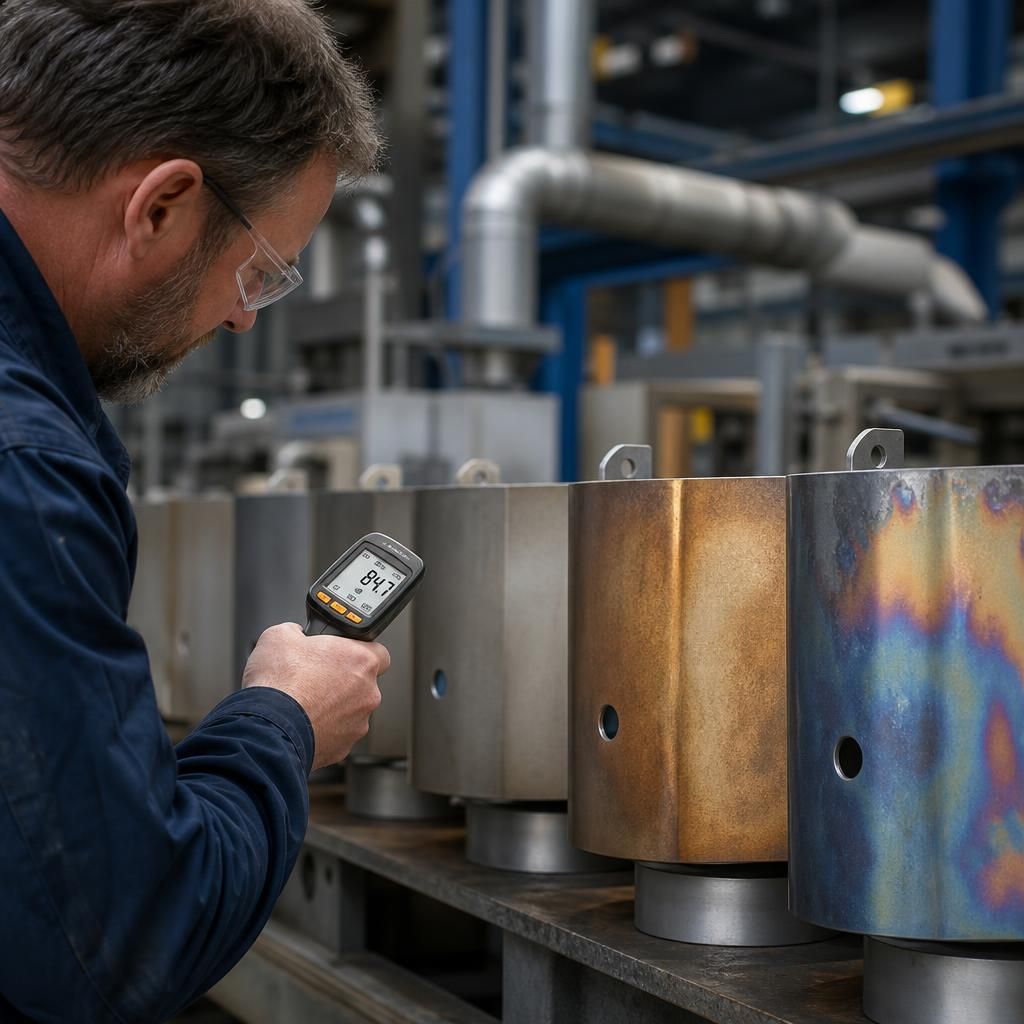
Do not treat a visible colour change as a reliable temperature reading unless the coating has been specifically designed and validated for that purpose. High-temperature exposure, oxidation, contamination and chemical attack can all alter appearance, so a darker or faded area may not indicate one precise surface temperature.
If colour is intended to support condition monitoring or maintenance inspection, define the meaning of each visual change and verify it against representative thermal exposure. Otherwise, select a colour for identification and inspection purposes only, using independent temperature measurements where service conditions need to be assessed.