

How does high temp powder coating contribute to the longevity and performance of industrial metal components?
High-temperature powder coating helps industrial metal components last longer by forming a heat-resistant barrier that limits corrosion, oxidation and surface degradation. By retaining adhesion and protective performance under elevated operating temperatures, the coating helps components maintain their appearance, dimensional integrity and functional reliability.
High-temperature powder coating contributes to longer service life by helping an industrial component withstand the combined effects of heat, movement, handling and the surrounding operating environment. Its value is not limited to appearance: when the coating formulation, substrate preparation, application method and curing cycle are matched to the part, the finished surface can support more consistent component performance and reduce the frequency of coating-related maintenance.
A key benefit is the preservation of a stable protective film during service. Industrial parts may be exposed to heat from ovens, exhaust systems, furnaces, engines, process equipment or hot fluids. A suitable high-temperature coating is formulated to resist softening, embrittlement, blistering and loss of adhesion within its intended operating range. This helps the surface remain continuous rather than developing defects that can expose the metal beneath.
The coating can also improve resistance to mechanical wear associated with industrial use. Components may be subject to rubbing, vibration, loading, impact during handling or contact with tools and adjacent parts. A correctly selected powder coating provides a hard, cohesive finish that helps limit scuffing and surface damage. This is particularly useful where minor surface defects could become starting points for corrosion, contamination or further deterioration.
Thermal movement must be considered alongside peak temperature. Metal components expand and contract as operating conditions change, and repeated temperature changes can place stress on the coating-to-metal interface. The long-term result depends on the coating’s thermal cycling capability, the geometry of the part and the difference between the metal and coating behaviour. Selecting a system suited to the expected heating and cooling pattern helps reduce cracking, flaking and loss of film continuity over repeated cycles.
Coating thickness and coverage have a direct bearing on performance. Thin areas, sharp edges, recessed sections and inaccessible faces can leave weaker points in the finished system. Before coating, the component should therefore be assessed for its geometry, hanging points, welds, corners, threaded areas and masking requirements. Proper preparation and application help create an even film while avoiding excessive build-up that could interfere with assembly, clearances or moving interfaces.
The condition of the metal before application is equally important. Oil, grease, mill scale, rust, weld residues and other contaminants can prevent the powder from bonding properly. Cleaning and appropriate surface preparation provide the foundation for durable adhesion. Welds and fabricated joints may need particular attention because residues, porosity or sharp transitions can affect both coating coverage and service performance.
Curing is another important factor in component longevity. Powder must be heated sufficiently for the specified binder system to form the intended film properties. The relevant condition is the temperature reached by the metal itself, not simply the air temperature inside the oven. Large, heavy or irregularly shaped parts can heat at different rates, so the curing process should be considered in relation to the component’s mass, configuration and production batch.
High-temperature powder coating can support performance in several practical ways:
- Maintaining a consistent surface finish on components exposed to elevated heat.
- Reducing the risk that handling and service wear will quickly expose the substrate.
- Helping components remain easier to clean where the coating is compatible with the process contaminants involved.
- Supporting dimensional and functional consistency where surface breakdown could affect fit, movement or contact.
- Reducing the need for remedial surface treatment when the coating system is correctly matched to the service environment.
Selection should be based on the complete operating environment rather than temperature alone. Important considerations include continuous and peak temperatures, heating and cooling rates, exposure duration, humidity, chemicals, abrasive particles, ultraviolet exposure and the required appearance. A coating that performs well in dry heat may not be suitable where hot oils, solvents, salts or cleaning agents are also present.
It is also important to distinguish the coating’s temperature capability from the metal’s own design limits. Powder coating does not increase the structural strength, fatigue resistance or maximum safe temperature of the underlying component. Engineers must continue to assess the grade and thickness of the metal, weld quality, loading, ventilation and thermal design. The coating is one part of the component protection system, not a replacement for correct material selection or engineering design.
Performance can be assessed through inspection during production and after installation. Useful checks include surface cleanliness, coverage of edges and recesses, film thickness, visible defects, cure verification and adhesion testing where appropriate. In service, early signs such as discolouration, cracking, bubbling, chalking or localised damage should be investigated rather than covered over. The correct maintenance response depends on whether the cause is heat exposure, chemical attack, mechanical damage, preparation failure or an unsuitable coating specification.
For industrial metal components, the most durable result comes from treating the coating as a complete process: define the thermal and environmental demands, select a compatible powder system, prepare the substrate carefully, control application and curing, and inspect the finished work. This coordinated approach allows the coating to support reliable component operation over its intended service life without assuming that every high-temperature powder coating is suitable for every industrial application.
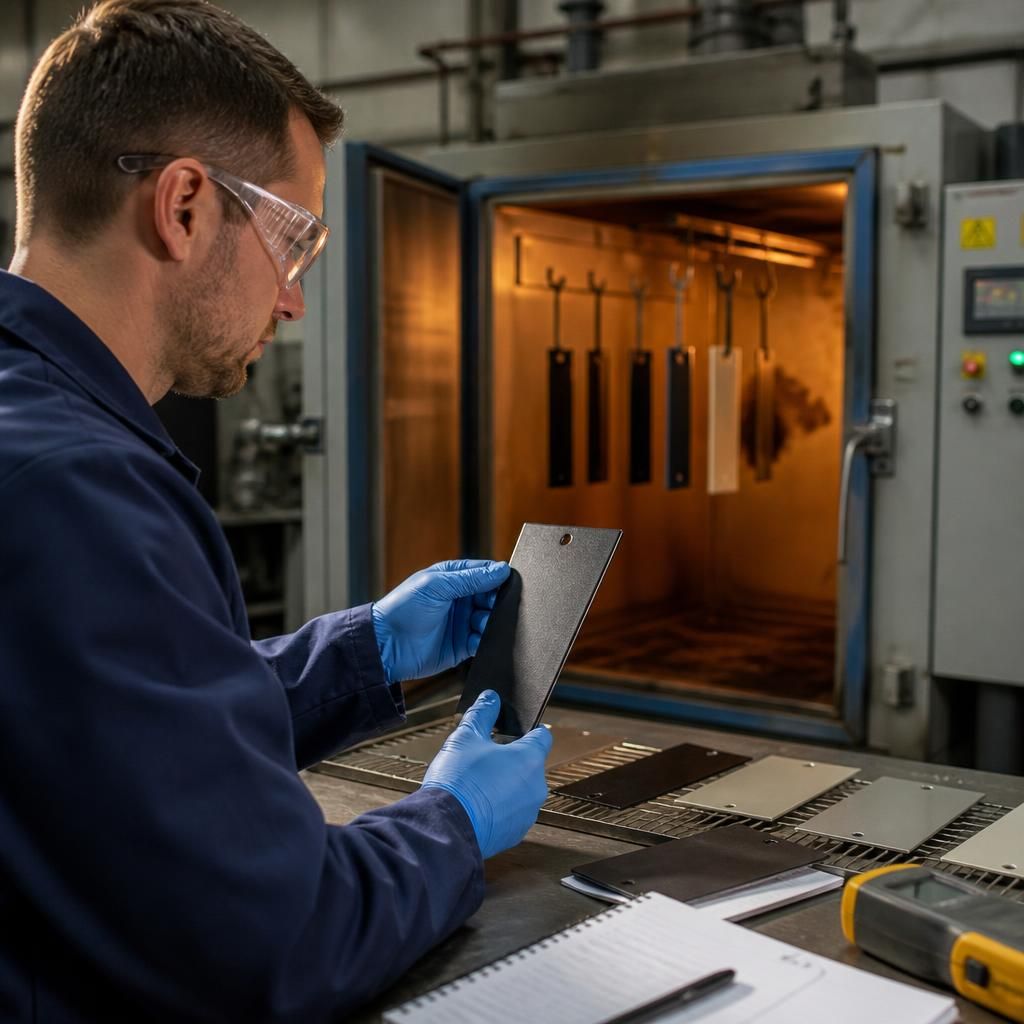
Representative sample testing helps confirm whether a high-temperature powder coating will retain its protective and functional properties in service. Test panels or component sections can be exposed to the expected heat profile and surrounding contaminants, then examined for changes in adhesion, colour, surface continuity and evidence of blistering or cracking.
For complex parts, testing should also consider practical requirements such as clearances, masking, electrical contact points and the effect of the coating on moving or mating surfaces. Comparing the tested result with the original specification gives engineers a more reliable basis for approving the coating system before full production, particularly where failure would affect component operation rather than appearance alone.
Discuss your high-temperature powder coating requirements
Discuss your high-temperature powder coating requirements with our team, including the component material, operating temperatures and service conditions. This information helps identify a suitable coating approach for your industrial metal parts.