

How can the thermal cycling capabilities of a high temp powder coating affect long-term metal component performance in your specific industry?
Thermal cycling repeatedly expands and contracts both the metal component and its high temp powder coating, so coating flexibility, adhesion and resistance to cracking directly affect long-term performance. In industries such as manufacturing, construction and automotive, a correctly specified coating can help maintain surface protection through changing temperatures, provided it is compatible with the metal substrate and operating conditions.
Thermal cycling capability determines whether a high temperature powder coating continues to perform after repeated exposure to changing operating conditions. In practical terms, the coating must tolerate the component’s complete temperature profile: ambient storage, start-up, operating temperature, peak excursions, shut-down and cooling. A coating selected only for its maximum stated temperature may perform poorly if the real application includes rapid transitions, local hot spots or prolonged dwell periods.
The most important consideration is the difference between continuous and intermittent heat. A component that remains at a moderately elevated temperature may place different demands on a coating from one that repeatedly reaches a higher peak. The frequency of the cycles, the rate of temperature change and the time spent at each temperature all influence the coating’s long-term condition. Thermal data should therefore be assessed against the actual duty cycle rather than a single temperature figure.
In manufacturing equipment, this distinction is relevant to ovens, heat-treatment assemblies, process machinery and fabricated guards or housings located near heated zones. A suitable coating can help the component retain its intended surface protection and appearance through regular production cycles. If the coating is not suited to the process, repeated exposure may lead to loss of surface integrity, discoloration, embrittlement or local breakdown around the hottest areas.
Automotive applications can involve especially variable conditions. Components may experience heat from engines, exhaust systems, braking activity or adjacent powertrain parts, followed by cooling when the vehicle is stationary. Road contamination, oils, fuels and cleaning chemicals can add further stress. The coating specification must consequently account for temperature cycling alongside chemical exposure, abrasion and the geometry of the part. A formulation that performs adequately on a relatively sheltered bracket may not be appropriate for a component exposed directly to heat and contaminants.
For construction and infrastructure equipment, temperature changes may be combined with outdoor moisture, condensation and weathering. Metalwork around heating, ventilation or industrial processing systems can move between operating and inactive conditions, while external components may also experience seasonal changes. In these situations, long-term performance depends on maintaining a continuous protective surface, particularly at edges, corners, fixing points and fabricated joints where coating coverage can be more difficult to control.
Thermal cycling also affects the interfaces within a finished component. Different metals, inserts, fasteners and welded sections may respond differently to heat. A thick weld, a thin panel and a bolted joint can each develop different temperature profiles during the same operating cycle. These variations can concentrate stress in particular areas or expose poorly prepared regions first. Design review should therefore consider the whole assembly, not just the nominal base metal.
- Operating profile: record normal, peak and transient temperatures, together with ramp rates and dwell times.
- Heat distribution: identify hot spots, shielded sections and areas affected by direct flame, radiant heat or heated air.
- Substrate and construction: assess the metal type, thickness, welds, bends, joints and any dissimilar materials.
- Additional exposure: include moisture, chemicals, oils, fuels, salt, abrasion and cleaning procedures.
- Appearance requirements: establish whether colour, gloss and texture must remain consistent after service exposure.
- Maintenance conditions: consider inspection access, recoating requirements and whether damage can be identified before corrosion develops.
Preparation and curing are equally important to the result. Contamination, oxide, oil or unsuitable pretreatment can create weak points that become evident only after repeated heating and cooling. The coating must be applied at the specified film build and cured according to the product requirements. For complex parts, the metal temperature reached during curing may differ between sections, so process control matters as much as the nominal oven setting.
A sensible specification process begins with the component’s service conditions and works back to the coating system. Obtain the coating manufacturer’s technical information for the intended formulation, then check its stated temperature range, thermal cycling data, chemical resistance and substrate compatibility. Where the duty is severe or unusual, representative sample panels or production-like components can be exposed to the expected cycle and inspected for visual change, adhesion, cracking, blistering and corrosion at damaged areas.
The result should be judged against the relevant industry requirement, not simply whether the coating looks acceptable immediately after testing. A coating that retains its appearance but loses adhesion, or remains intact while becoming vulnerable at edges and joints, may not provide adequate long-term protection. For manufacturers, fabricators, construction firms and automotive businesses, defining the thermal cycle in detail allows the powder coating specification to reflect the component’s actual use and reduces the risk of selecting a finish based on peak temperature alone.
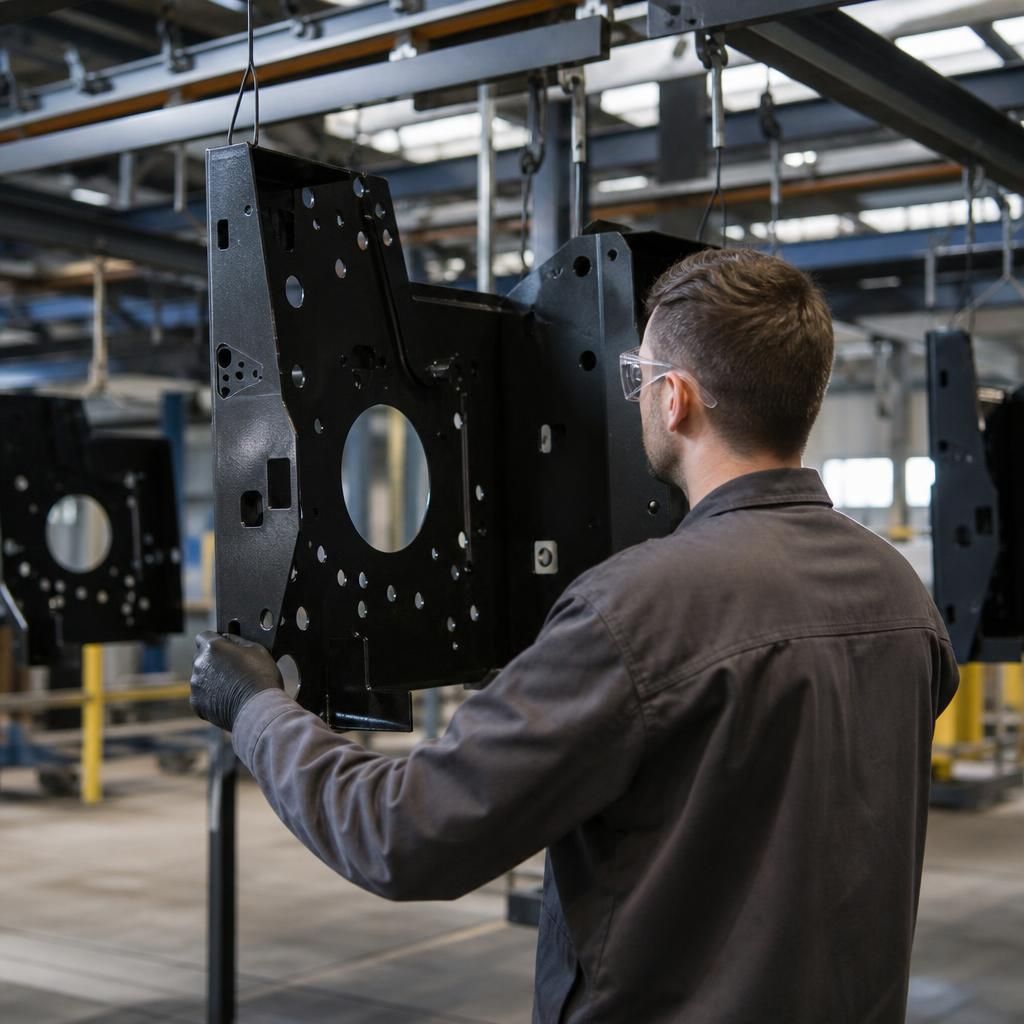
A high temperature powder coating protects the metal surface during thermal cycling, but it does not prevent heat from reaching the component itself. In an industrial assembly, the metal’s own expansion, strength and dimensional stability must therefore be assessed alongside the coating. This is particularly important where a coated part supports seals, bearings, fasteners or other components whose fit or performance depends on stable dimensions.
For manufacturing equipment, a coating may remain visually sound while heat-related movement affects clearances or alignment elsewhere in the assembly. Automotive and construction applications can present similar issues around brackets, guards and enclosures exposed to changing temperatures. The coating specification should consequently be reviewed as part of the complete component design, with attention to operating tolerances, adjoining materials and any heat-sensitive parts nearby.