

What factors should I consider when selecting epoxy or polyester powder coatings for different metal substrates?
Selecting epoxy or polyester powder coating depends on the metal substrate’s preparation and heat tolerance, the required adhesion and corrosion protection, and the conditions the finished part will face. Epoxy is generally suited to interior components needing strong chemical and mechanical resistance, while polyester is usually preferred for exterior metalwork because it offers better resistance to ultraviolet exposure and weathering.
The correct choice depends on the interaction between the metal substrate, its preparation, the service environment and the powder’s curing requirements. Epoxy and polyester powders can both produce sound finishes on many metals, but the most suitable system is determined by factors such as surface condition, porosity, thermal mass, required film performance and the risk of coating failure at edges, joints or difficult-to-reach areas.
Start by identifying the substrate accurately. Mild steel, galvanised steel, aluminium, stainless steel, cast iron and zinc-based components each present different preparation challenges:
- Mild steel: The surface normally requires degreasing and removal of mill scale, rust and weld contamination. Abrasive blasting can provide a suitable profile for adhesion, but the specification should account for flash rusting and the need to coat prepared steel before contamination or corrosion returns.
- Galvanised steel: Zinc surfaces may contain passivation treatments, oils or soluble residues. Cleaning and a suitably controlled sweep blast or chemical preparation may be required. Excessive blasting can remove too much zinc, while inadequate preparation can contribute to poor adhesion or flaking.
- Aluminium: Aluminium forms an oxide layer rapidly and can be marked or distorted by overly aggressive blasting. Cleaning, an appropriate surface profile and, where specified, a conversion treatment are important. Extrusions, castings and fabricated aluminium parts may also require different preparation because their surface condition is not identical.
- Stainless steel: Its passive surface can make adhesion more demanding. Contamination from carbon-steel tools or blasting media should be avoided, and the preparation method should be selected to create a clean, receptive surface without compromising corrosion resistance.
- Cast iron: Porosity can retain oil, moisture or casting residues. These contaminants may be released during heating and create pinholes, bubbling or craters. Cleaning, controlled preheating or outgassing procedures may therefore need to be considered before the final coating is applied.
- Zinc die castings and other porous alloys: Entrapped gases can cause defects during curing. A suitable powder, pre-treatment and cure strategy may be needed, particularly where appearance is important.
Assess the condition and design of the component, not just its material. Rust, welding residue, sharp edges, deep recesses, threaded holes, lap joints and mixed-metal assemblies can all affect the result. Sharp edges tend to receive less coating than broad faces, while recesses can be difficult to cover evenly because of the electrostatic effect used during application. Drainage and vent holes may be necessary on hollow or enclosed fabrications to allow cleaning fluids and air to escape safely.
Match the resin to the exposure and required performance. Epoxy is often selected where adhesion, hardness and resistance to chemicals or mechanical contact are important. Polyester is commonly considered where the part will experience sunlight and changing weather conditions. The choice should be based on the actual exposure rather than the substrate alone. For example, a steel component used indoors may require a different specification from an aluminium component installed outdoors, even if both can accept powder coating.
Also consider the particular substances and forces involved in service. Contact with oils, fuels, cleaning agents, acids, alkalis, moisture, road salt or abrasive materials can alter the preferred coating specification. A standard decorative powder should not automatically be assumed suitable for prolonged chemical immersion, severe abrasion or continuous high-temperature use. The powder manufacturer’s technical data should be checked for the relevant resistance characteristics and limitations.
Confirm that the substrate and component can tolerate the curing cycle. Powder coating is cured by heating the part, so the important measurement is the metal temperature and the time it remains at the required temperature, rather than the oven air temperature alone. Thick steel sections heat more slowly than thin sheet, while aluminium heats differently because of its thermal properties. Assemblies containing seals, bearings, adhesives, electronics or dissimilar materials may have restrictions that affect the coating choice. The selected powder must be capable of achieving full cure within a cycle that the complete component can withstand.
Component geometry can also influence the finish. Large weldments may have different thermal masses within the same part, creating a risk of under-cure in heavier areas or overexposure in thinner sections. Deep cavities and Faraday cage areas may receive less powder, and excessive film build in corners can affect appearance or curing. A trial panel or representative sample is useful where the component has complex geometry, mixed substrates or a demanding appearance requirement.
Define the finish specification before choosing the powder. Record the required colour, gloss level, texture, acceptable variation, film thickness and visual standard. Smooth finishes can make pinholes, craters and substrate defects more visible than textured finishes, while heavy textures may conceal some minor irregularities but can be more difficult to clean. If parts must fit together, the coating thickness on mating faces, threads and sliding surfaces must be allowed for in the design.
Preparation and inspection are as important as resin selection. A practical specification should address:
- the cleaning and pre-treatment method for the specific metal;
- the required surface cleanliness and profile;
- the powder type and approved cure schedule;
- the target film thickness and areas requiring masking;
- the treatment of welds, edges, joints and enclosed sections;
- the tests or visual checks used to confirm adhesion and cure.
Adhesion testing, film-thickness checks and visual inspection can help identify problems, but the test method should reflect the intended use. Where corrosion resistance is critical, the whole system—including substrate preparation, pre-treatment, powder and cure—should be assessed rather than judging the resin in isolation.
For a production coating specification, provide the coater with the substrate grade, previous finishes, service environment, component dimensions, maximum permitted process temperature and any masking or assembly requirements. On unfamiliar alloys, contaminated castings or mixed-metal fabrications, testing a representative part before batch processing is a sensible way to confirm adhesion, appearance and cure compatibility.
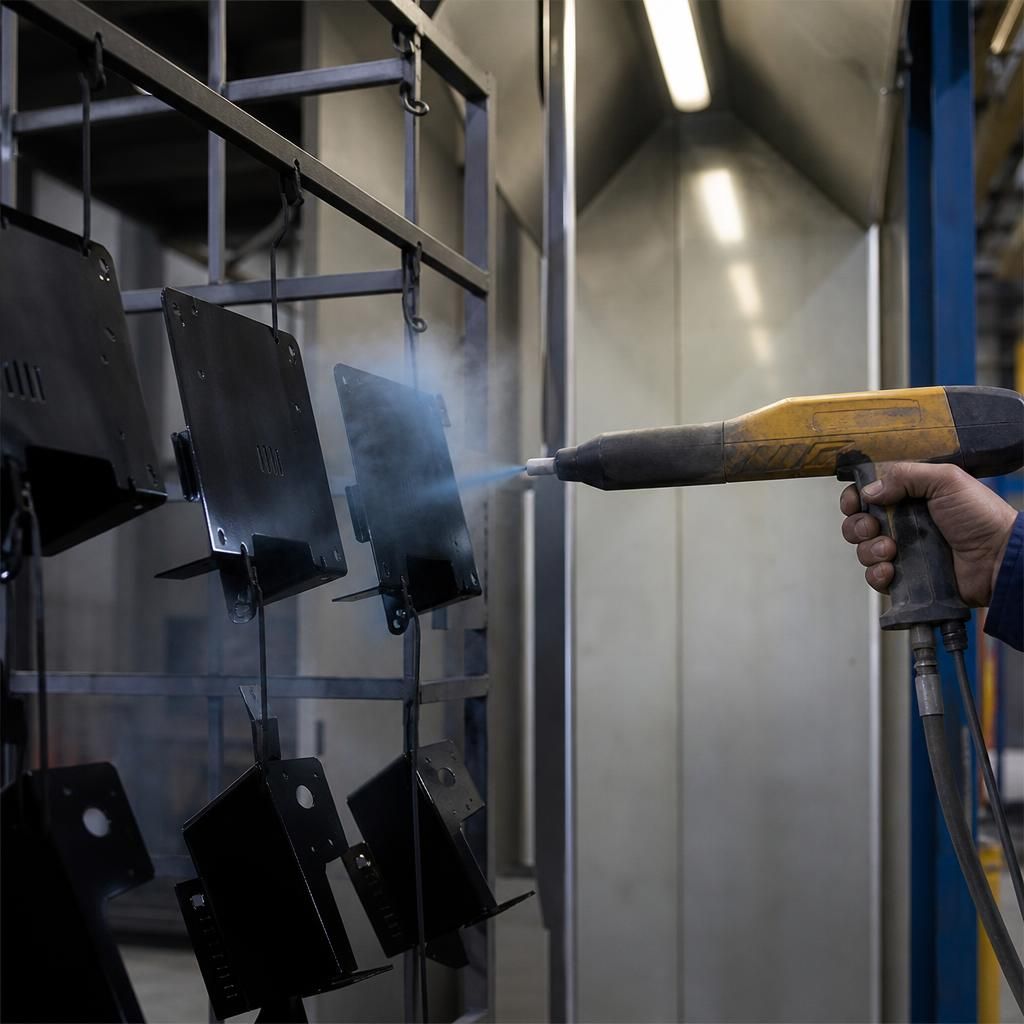
Metal substrates must also be suitable for electrostatic powder application. The part needs a reliable electrical path so powder particles are attracted evenly to its surface. Insulating residues, non-conductive previous coatings, heavy oxide layers or poorly grounded fixtures can reduce transfer and leave thin areas, particularly around recesses and edges.
Before choosing an epoxy or polyester system, confirm that the substrate condition, preparation method and racking arrangement will support consistent deposition. This is especially important for assemblies containing treated aluminium, galvanised sections or different metals, where surface conductivity and electrical contact may vary across the component.
Discuss Your Epoxy or Polyester Powder Coating Requirements
Discuss your component’s metal substrate, service environment and required finish with the powder-coating team to help identify a suitable epoxy or polyester specification. Where compatibility is uncertain, provide representative parts or samples for assessment before batch processing.