

What preparation steps are necessary before applying polyester powder coating?
Before polyester powder coating, metal components should be thoroughly cleaned and degreased, with rust, mill scale, old coatings and other contaminants removed by suitable preparation such as abrasive blasting. The surface should then be inspected for defects, dried completely, and masked where coating is not required so the powder can bond evenly and cure correctly.
Successful preparation for polyester powder coating is a controlled process that ensures the component is suitable for treatment, can be coated without interfering features, and can withstand the curing cycle. In addition to preparing the surface itself, the part’s design, material, condition, handling method and coating specification must all be checked before it enters production.
- Confirm the substrate and coating system. Identify whether the component is mild steel, galvanised steel, aluminium or another compatible metal. The substrate affects the pre-treatment route, the risk of outgassing and the way the finished coating will perform. The required colour, gloss level, film thickness, performance class and intended environment should also be agreed in advance.
- Inspect the fabrication. Welds should be continuous where necessary, with spatter, sharp projections and loosely attached residue removed. Sharp corners can produce thin coverage, while deep recesses may be difficult for powder to reach. Any cracks, dents, laminations, porosity or poor weld finishing should be corrected before coating, as powder will not conceal structural or fabrication defects reliably.
- Provide suitable drainage and venting. Hollow sections, folded profiles and fabricated enclosures need correctly positioned drain and vent holes. These allow pre-treatment fluids to leave the part and help prevent trapped moisture, steam or chemicals during curing. Without adequate drainage, residues may leak from joints or create local coating defects after processing.
- Address porous or heat-sensitive materials. Castings, porous welds and some fabricated assemblies can release air or contaminants when heated. This may cause pinholes, blistering or other surface imperfections. Where the component presents a known outgassing risk, the preparation plan may include pre-heating, additional conditioning or a suitable outgassing-resistant powder system, subject to the coating specification.
- Prepare galvanised or previously treated metal appropriately. Zinc-coated surfaces may require a compatible pre-treatment and careful control of their condition before powder is applied. White corrosion products, storage contamination and uneven zinc surfaces need to be dealt with using a method that does not damage the protective layer. Existing coatings should not simply be coated over unless their adhesion and compatibility have been assessed.
- Plan masking and racking details. Define which faces, threads, bores, mating surfaces and electrical contact points must remain free of powder. Racking positions should provide secure support while limiting visible contact marks and allowing the powder cloud to reach the required surfaces. The part must also be electrically connected to the rack during application so the powder can be attracted consistently.
- Check dimensions and assembly requirements. Powder adds a measurable film to coated surfaces, which can affect close tolerances, threaded holes, bearings, sliding fits and press-fit areas. Critical dimensions should be identified before processing, with suitable masking or post-coating machining considered where necessary. Components that can be dismantled should generally be separated when joints or concealed surfaces also require protection.
- Control handling before application. Prepared metal should be handled with clean equipment and suitable gloves to prevent fingerprints, oil transfer and recontamination. Parts should be kept dry and protected from dust, condensation and contact with unsuitable packaging. Any contamination introduced after preparation can reduce adhesion or create visible defects.
- Agree the curing requirements. Polyester powder is cured by heat, so the component must tolerate the specified oven conditions. Large, thick or complex parts may heat at a different rate from thin sections, and the relevant cure schedule should be based on the metal temperature rather than oven air temperature alone. This is particularly important where the assembly contains seals, inserts or heat-sensitive components.
A final pre-coating inspection should confirm that the fabrication is complete, the specified preparation route has been followed, masking and racking are correct, and no new contamination or damage has occurred. For demanding applications, a trial component or test panel can be used to verify appearance, adhesion, coverage and curing before the full batch is processed. This preparation review is especially valuable for repeat production, where consistent part presentation helps maintain uniform results between batches.
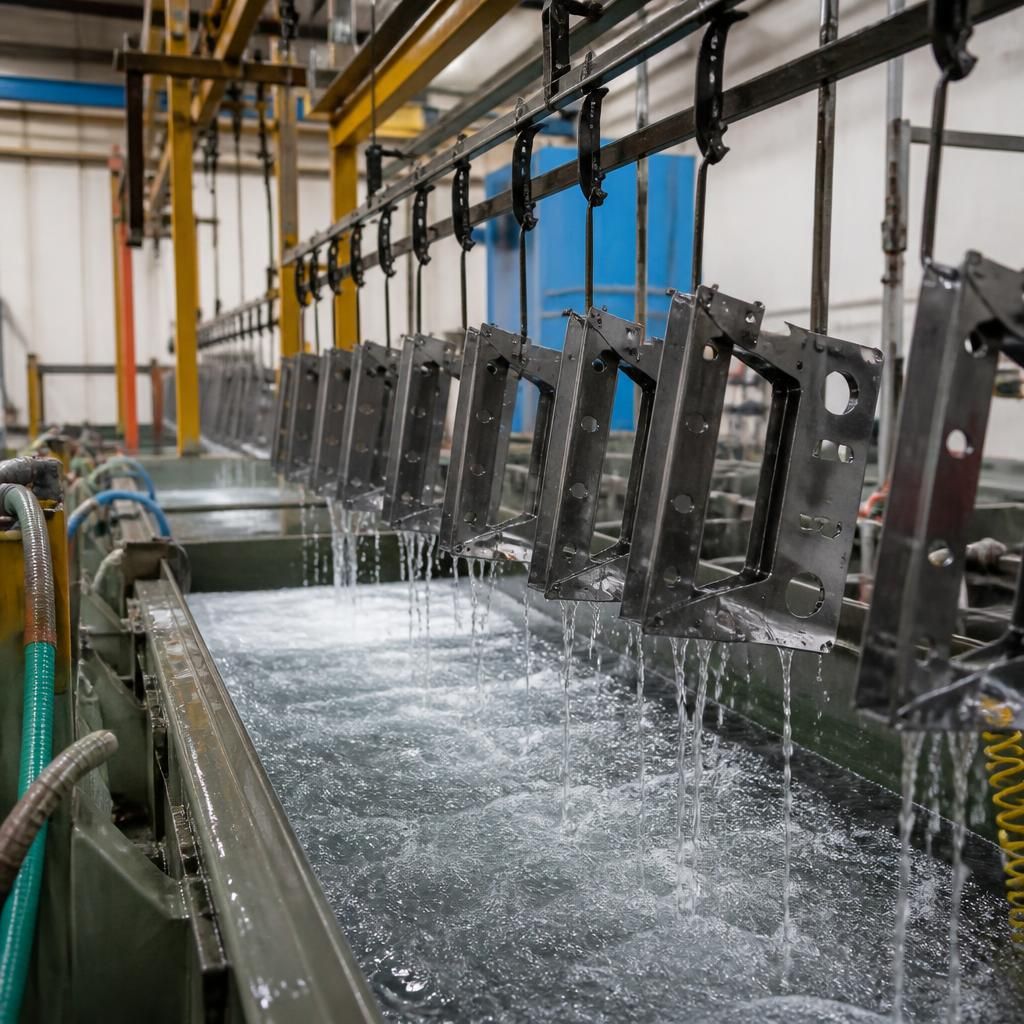
Chemical pre-treatment is a separate preparation stage from cleaning or abrasive blasting. After visible contamination and surface corrosion have been removed, the selected conversion treatment helps condition the metal for powder coating and supports adhesion and corrosion resistance. The treatment must be compatible with the substrate and the polyester coating specification, particularly where different metals are included in the same production batch.
Rinsing and drying are equally important. Residual chemicals, rinse water or trapped moisture can cause adhesion problems, staining, blistering or premature coating defects. Components should therefore be checked after treatment for complete drainage and thorough drying, with process controls maintained consistently between batches. A clean, dry, chemically conditioned surface is ready for the final inspection, masking and powder application stages.
Discuss your polyester powder coating preparation requirements
Discuss your polyester powder coating preparation requirements with powder-coatings.co.uk, including the substrate, component design, tolerances and intended service environment, so the appropriate preparation route can be assessed before processing.