

How does the curing process differ between epoxy and polyester powder coatings?
Epoxy and polyester powder coatings are both thermoset materials, so each must be heated to a specified metal temperature and held for the required time to complete cross-linking. The temperature and dwell time depend on the powder formulation and component thickness, but epoxy curing is typically controlled for chemical resistance and adhesion, while polyester curing is specified to develop durable exterior performance and colour stability.
The curing process for epoxy and polyester powder coatings uses the same basic industrial principle, but the correct cure schedule is determined by the formulation rather than by the resin name alone. Epoxy powders are generally selected where the coating must develop strong adhesion and chemical resistance, whereas polyester powders are formulated to retain finish and performance in exterior conditions. These different performance objectives influence how the cure is specified, checked and assessed.
What happens during curing
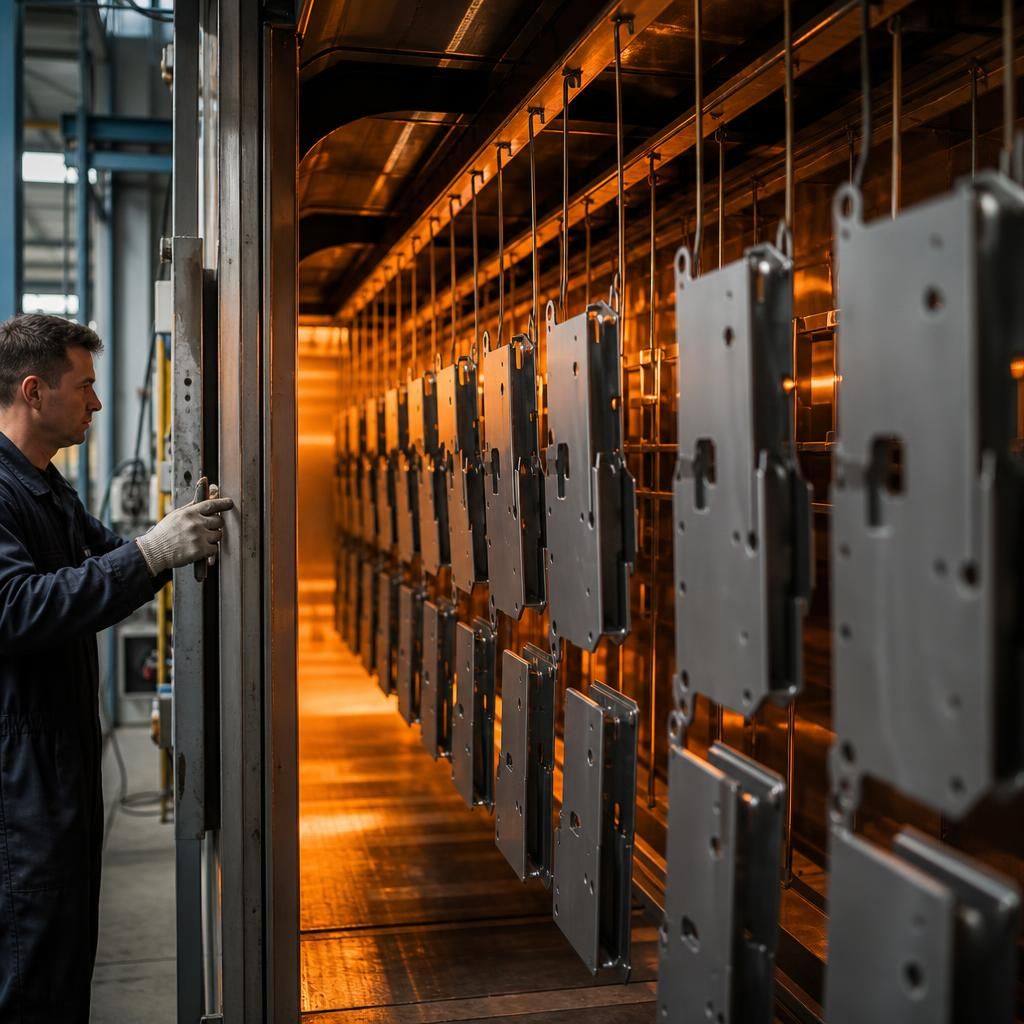
After the powder has been applied, the coated component enters an oven. Heat melts the powder into a continuous film and initiates a reaction between the resin and its curing agent. The coating then flows, levels and forms a cross-linked structure. It is the completion of this chemical reaction—not simply the point at which the surface feels dry—that determines whether the coating has cured properly.
Powder manufacturers normally provide a cure schedule based on the metal temperature reached by the component. The oven air temperature alone is not a reliable indication of cure, because a thin bracket and a heavy fabricated section can take very different lengths of time to reach the required temperature. Part thickness, geometry, loading, racking and airflow all affect the result.
How epoxy cure behaviour differs
- Epoxy formulations are commonly designed to prioritise adhesion, hardness and resistance to chemicals, moisture and corrosion-related environments.
- An under-cured epoxy may remain softer than intended and may not achieve its specified resistance or adhesion.
- Excessive heat exposure or an unsuitable dwell can affect colour, gloss and film properties. Epoxy is also prone to losing its visual quality when exposed to prolonged ultraviolet radiation, although that is an in-service exposure issue rather than a failure of the oven cure itself.
- For components destined for enclosed, internal or chemically demanding environments, cure verification is particularly important because the coating may be relied upon for functional resistance as well as appearance.
How polyester cure behaviour differs
- Polyester powders are generally formulated for stronger exterior durability, including improved resistance to sunlight, weathering and colour change.
- The specified cure must still be achieved throughout the part. A polyester coating that looks acceptable at the oven exit can remain under-reacted in less accessible or heavier areas.
- Incorrect cure can affect hardness, flexibility, adhesion, impact performance and long-term appearance, even where the initial finish appears uniform.
- Over-curing can also alter colour and gloss, so increasing the oven setting is not a dependable way to compensate for poor heat transfer or an inadequate process.
Why the schedules cannot be assumed from the coating type
There is no single universal epoxy cure or polyester cure. Products within the same coating family can use different resin systems, curing agents, particle sizes and performance specifications. A polyester intended for architectural or general industrial use may have a different recommended schedule from a polyester designed for a particularly demanding environment. The same applies to epoxy products intended for chemical resistance, electrical insulation or heavy-duty protection.
The coating technical data sheet should therefore be treated as the controlling document. It may specify a combination of component temperature and dwell time, and may give more than one acceptable schedule. These alternatives are not interchangeable without considering the component and the oven. A shorter dwell at a higher metal temperature can produce a different result from a longer dwell at a lower temperature, particularly on thick or heat-sensitive assemblies.
How a coater checks the process
- The coating system is selected for the substrate, service environment and required finish.
- The component is cleaned and prepared so that contamination, oil, oxidation and other adhesion problems do not interfere with the coating.
- Powder is applied at the specified film build, with attention to recesses, edges, corners and areas where the electrostatic field may produce uneven deposition.
- The oven is operated to bring the metal—not merely the surrounding air—to the required temperature.
- Representative parts are monitored where necessary, particularly when the batch contains a mixture of light and heavy sections or complex fabrications.
- The finished coating is assessed for appearance and, where required, for properties such as adhesion, hardness, film thickness and resistance relevant to its intended use.
These controls matter for both resin types. Poor preparation cannot be corrected by additional oven time, and a coating that has been applied too thickly may not flow or cure in the same way as a correctly applied film. Likewise, a heavily loaded oven can change heat transfer and extend the time needed for the coldest parts to reach the specified condition.
Practical selection implications
For internal components exposed to chemicals, oils or solvents, epoxy may be the more appropriate starting point, provided its limitations in direct sunlight are acceptable. For external metalwork where weathering and colour retention are central requirements, polyester is usually considered instead. Where both internal resistance and exterior durability are needed, an epoxy/polyester hybrid may be assessed, although its cure requirements and service properties must be confirmed as a separate product system.
For a production batch, the important question is therefore not whether epoxy or polyester cures at a universally different oven temperature. It is whether the selected powder, component and oven combination can achieve the manufacturer’s specified cure throughout every part. Accurate process control prevents under-cured areas, avoids unnecessary heat exposure and helps the finished coating deliver the properties for which that particular formulation was chosen.
A powder’s curing schedule should not be confused with its maximum service temperature. The heat used in the oven activates cross-linking, while the cured coating’s ability to withstand ongoing heat is a separate formulation property. An epoxy is not automatically suitable for high-temperature service, and a polyester chosen for exterior durability is not necessarily designed for continuous heat exposure. Where a coated component will operate near a heat source, the powder’s technical data should be checked for both its required cure schedule and its stated temperature resistance.