

How do epoxy and polyester powder coatings differ in terms of application methods and curing processes?
Epoxy and polyester powder coatings are generally applied in the same way: prepared metal is sprayed with charged powder, then heated so the powder melts, flows and cures into a continuous film. Their application equipment and basic curing method are therefore similar, but the correct oven temperature and dwell time depend on the specific formulation and component thickness, while epoxy is typically selected for chemical and corrosion resistance and polyester for improved exterior durability and UV resistance.
Epoxy and polyester powder coatings use broadly comparable application equipment, but their performance depends on how the powder is deposited, how the component is prepared and how the particular formulation is cured. The main practical differences are the powder’s response to heat, its cross-linking chemistry and the way the finished film is expected to perform in service.
Application methods for both coating types
For most fabricated metal parts, the process begins with cleaning and preparation. Oil, grease, rust, mill scale and previous coatings must be removed or suitably treated. The preparation method may include degreasing, abrasive blasting or a chemical pre-treatment, depending on the substrate and the required level of corrosion protection. Any moisture or contamination left on the surface can affect adhesion and create defects during heating.
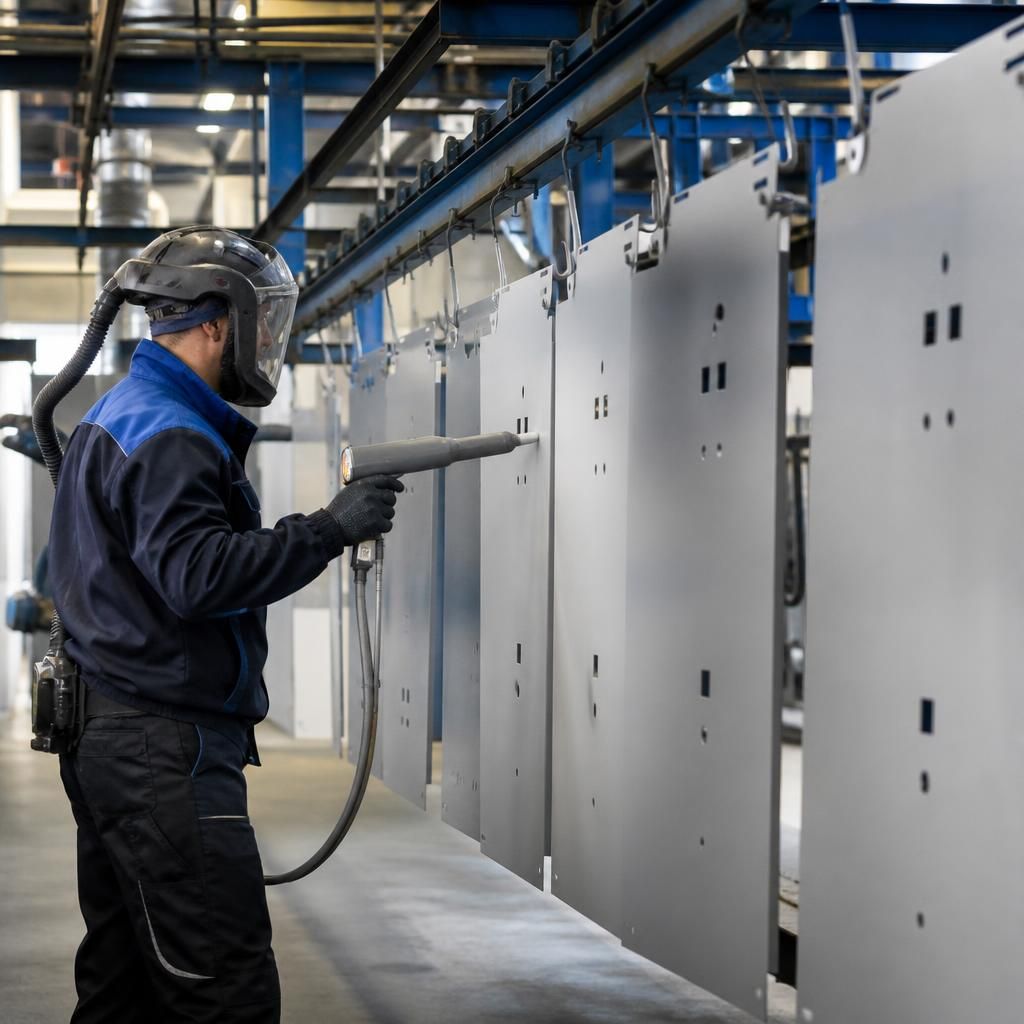
The most common deposition method is electrostatic spray. The powder particles are charged as they pass through the spray gun, while the metal component is electrically earthed. The charged particles are attracted to the component and form a dry layer before curing. This method can be used for both epoxy and polyester powders, provided the gun settings, powder feed and air flow are suitable for the formulation.
Coating operators adjust the application technique to the shape of the part. Flat panels and open sections are generally straightforward, while recesses, corners, mesh, enclosed profiles and deep channels can produce Faraday-cage effects. In these areas, the electric field may make it difficult for powder to reach the surface evenly. Reducing the spray voltage, changing the gun angle, using a different spray distance or applying the powder with controlled manual passes can help improve coverage.
Manual spraying is often appropriate for varied components, repair work or smaller batches. Automatic guns may be used where parts have consistent dimensions and repeatable presentation. A fluidised-bed process is another option for some components: the part is heated before being immersed in aerated powder, which melts onto the surface. This can produce a relatively heavy coating, but it is not suitable for every geometry or specification. The selected method must account for the required film build, dimensional tolerances, access to all surfaces and the heat resistance of the substrate.
Epoxy and polyester powders should not be treated as interchangeable during application. Each product has its own recommended storage conditions, spraying characteristics, film-thickness range and cure schedule. Reclaim systems also need appropriate control, as mixing different chemistries or colours can alter the final appearance and performance.
How the curing process works
After application, the coated component enters a curing oven. The powder first softens and flows, filling the surface profile and joining into a continuous film. The resin and hardener then react to form a cross-linked thermoset coating. Once this reaction has taken place, the coating cannot be remelted into its original powder form.
Epoxy powders commonly use a chemical system designed to produce a tightly cross-linked film with strong adhesion and resistance to chemicals, solvents and corrosion-related attack. Polyester powders use a different resin and curing system, formulated to provide better retention of appearance when exposed to sunlight and outdoor weathering. The distinction is therefore created by the chemical reaction within the powder, rather than by a fundamentally different type of oven.
The stated cure schedule for a powder normally relates to the temperature of the metal itself and the time it remains at that temperature, not simply the temperature shown on the oven control panel. A thick or heavy component takes longer to reach the required metal temperature than a thin section. Its mass, shape, number of parts loaded, spacing and the efficiency of air circulation can all affect the actual cure achieved.
For this reason, oven settings should be established from the powder manufacturer’s technical data and checked against the component. Thermal profiling can be used to record the temperature of the metal during the cycle. This helps identify cold spots, excessive heating or insufficient dwell time, particularly when large, dense or mixed-size parts are processed together.
Under-curing and over-curing
Under-curing can leave either coating with reduced hardness, adhesion and resistance. The film may remain soft, show poor chemical resistance or fail to develop its intended mechanical properties. Under-cured epoxy may be especially vulnerable where the component is exposed to chemicals or demanding industrial handling.
Over-curing can also be detrimental. Excessive heat or an unnecessarily long cycle may affect colour, gloss and appearance, and can cause some formulations to become brittle or discolour. Polyester coatings intended for exterior use still require the correct cure; outdoor durability is not a substitute for accurate oven control.
Choosing the application and cure process
- Confirm the substrate, preparation standard and any pre-treatment requirements before selecting the powder.
- Choose the spraying method according to component geometry, access, production volume and required film thickness.
- Use the powder supplier’s cure data for the exact product rather than applying a generic epoxy or polyester setting.
- Allow for the component’s thickness and thermal mass when establishing oven dwell time.
- Check coverage in recesses, corners and edges, where electrostatic deposition can be less uniform.
- Inspect the finished coating for adhesion, appearance, film build and signs of incomplete flow or cure.
In a properly controlled process, either chemistry can be applied consistently using electrostatic powder equipment. The appropriate choice depends on the service environment, substrate preparation, component design and the technical requirements of the specified powder, while the curing cycle must be controlled for the actual metal temperature and formulation.
Where a coating system uses more than one powder layer, the application and curing sequence becomes especially important. An epoxy primer may be specified beneath a polyester topcoat to combine corrosion protection with improved exterior durability, but the primer must be cured or gelled exactly as required by the system specification before the next layer is applied.
Applying the second powder over a fully cured first coat can affect intercoat adhesion, while insufficiently cured material may be disturbed during the next application stage. The correct sequence depends on the products, film thicknesses and required performance, so multi-layer systems should be assessed as a complete specification rather than treating epoxy and polyester powders as interchangeable.
Discuss Your Epoxy or Polyester Powder Coating Requirements
Discuss your component geometry, substrate, service environment and required finish with the powder-coating team to identify a suitable epoxy or polyester specification and curing approach. Share your coating requirements for an informed assessment of the application process.