

What specific factors should be considered when selecting a high heat epoxy coating for components subjected to both chemical exposure and extreme temperatures?
Select a high heat epoxy coating by assessing the component’s continuous and peak temperatures, thermal cycling, chemical type and concentration, contact or immersion conditions, and the required resistance to corrosion and mechanical wear. Confirm that the coating is compatible with the metal substrate and can be correctly prepared, applied and cured at the required film thickness, then verify performance against the actual service conditions rather than relying on a nominal temperature rating alone.
A suitable high heat epoxy coating is selected by matching the complete service environment to the coating’s tested performance, not by choosing the product with the highest headline temperature rating. The assessment should cover the coating formulation, exposure pattern, thermal expansion behaviour, film design, regulatory requirements and the consequences of failure, alongside the operating conditions of the component.
1. Examine the exposure pattern, not just the chemical name
Chemical resistance can vary substantially according to how exposure occurs. Occasional splashes, persistent condensation, vapour contact, repeated wash-down and full immersion place different demands on the coating. Consider whether chemicals remain on the surface, migrate through the film or collect in joints and recesses. Mixed chemicals, cleaning agents and process residues may also behave differently from the individual substances listed in a safety data sheet.
Where possible, compile the actual substances, cleaning regime, exposure frequency and expected contact duration. The assessment should also consider whether the component is exposed while hot, during heating and cooling, or only after returning to a lower temperature. Chemical attack can become more significant at elevated temperatures, so a coating with acceptable resistance in laboratory conditions may not be appropriate for the same chemical at the component’s operating temperature.
2. Check the coating’s temperature behaviour across the operating range
A maximum temperature figure does not describe every property of a coating. Ask how hardness, flexibility, adhesion, colour stability and chemical resistance change as temperature rises. The glass transition range is particularly relevant because an epoxy may soften or lose dimensional stability before the resin visibly breaks down. The selected system should retain the properties that matter most for the component, rather than simply surviving without obvious blistering.
Also establish whether the stated rating applies to continuous operation, short-term excursions or a particular test method. Request technical data that explains the test conditions and distinguishes the coating temperature from the temperature of the surrounding air. This prevents an apparently suitable product from being selected on the basis of a rating that does not represent real service.
3. Consider expansion, stiffness and the component’s construction
Metal and cured epoxy do not expand at exactly the same rate. Large differences can place stress at the interface, especially on substantial components, thin sections, dissimilar metals or assemblies that heat unevenly. A very hard coating may resist indentation well but have less tolerance for movement than a more resilient formulation. Selection should therefore balance thermal stability with the flexibility needed by the component’s design.
Review welded areas, folded sections, threaded features, mating faces, sharp transitions and enclosed spaces. Coating build-up may affect clearances, threads, seals or electrical contact points. Masking and coating limits should be defined before production so that the finish does not interfere with assembly or inspection.
4. Define the required film system
High temperature and chemical service may require a particular primer, tie coat or topcoat rather than a single generic epoxy layer. Confirm that each layer is chemically compatible and that the complete system has been assessed together. A topcoat cannot compensate for a primer that loses adhesion or provides inadequate protection at the interface.
Film thickness also needs to be controlled within the coating manufacturer’s specified range. Excessive build can trap solvents, increase internal stress or delay full cure, while insufficient build may leave weak points over the surface. For critical parts, agree how thickness will be measured, which areas are excluded from measurement and how out-of-tolerance areas will be treated.
5. Assess cure requirements and production constraints
Epoxy performance depends on the resin and hardener reaching the required state of cure. Check the minimum and maximum application temperatures, recoat interval, induction requirements where applicable, handling time and final cure conditions. If components cannot be heated uniformly, a coating requiring a tightly controlled post-cure may be impractical.
Production details can influence selection as well. Consider component size, rack or jig contact points, masking, transport, storage and whether the coating must withstand assembly operations before full service. A system that performs well in a test panel may be unsuitable if the production process cannot reproduce the required preparation and cure conditions consistently.
6. Establish how performance will be verified
For demanding applications, define acceptance criteria before coating begins. Useful records may include the product data sheet, batch identification, substrate condition, environmental conditions during application, film-thickness readings and cure information. Depending on the risk, verification may include adhesion testing, visual inspection, holiday or pinhole detection, and exposure testing using representative samples.
Testing should reproduce the likely combination of stresses rather than examining each factor in isolation. For example, a sample exposed to the relevant chemical while hot may provide more useful evidence than separate tests carried out at room temperature and without chemical contact. Test panels should use the same substrate preparation, coating system and cure route as the production components.
7. Account for failure consequences and maintenance
The right specification depends partly on what happens if the coating deteriorates. On a non-critical enclosure, local cosmetic change may be acceptable; on a component protecting metal from an aggressive process, early blistering or underfilm corrosion may interrupt production or compromise the part. Define the acceptable level of colour change, chalking, softening, swelling and adhesion loss in advance.
Consider how the finished component will be inspected and repaired. A coating that can be visually monitored and locally reinstated may be preferable where removal from service is difficult. The specification should identify inspection points, permitted repair materials and whether repaired areas must undergo the same chemical or heat-resistance checks as the original finish.
8. Use application-specific evidence before approving the coating
When the service environment combines heat and chemicals, request evidence relevant to the actual application rather than relying on a general statement such as “heat resistant” or “chemical resistant”. Compare the proposed system against the component drawing, process description and risk assessment, then record any assumptions about exposure, temperature and cleaning.
A coating specialist can help translate those requirements into a workable specification and identify where laboratory data does not fully represent the intended use. The final choice should be the system that provides the necessary balance of chemical stability, thermal performance, adhesion, dimensional control, process compatibility and maintainability for the particular component.
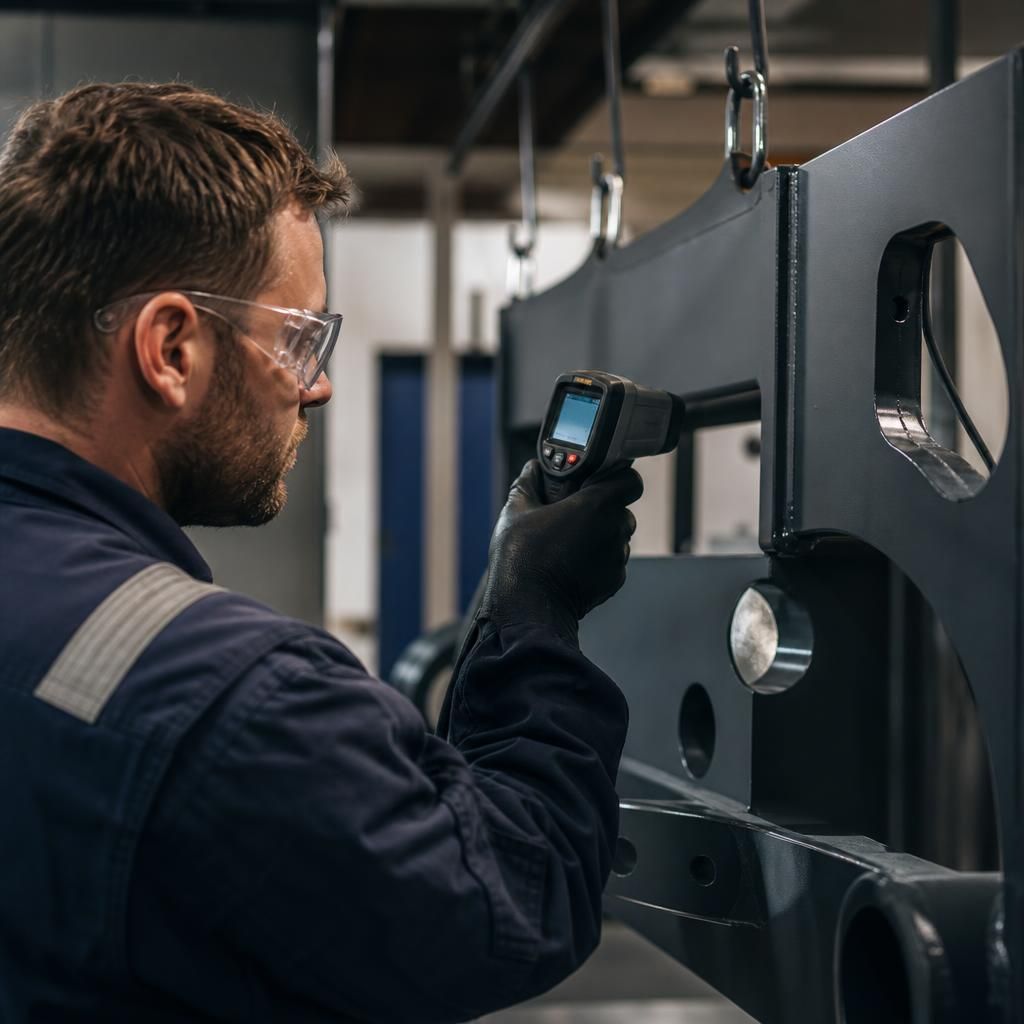
Selecting a high heat epoxy coating requires establishing the temperature at the coating-to-metal interface, not only the temperature of the surrounding process or equipment. Metal components can develop local hot spots around heating elements, welds, narrow sections and poorly ventilated areas, while the external air temperature may be considerably lower.
Use operating data, temperature measurements or thermal mapping to identify the normal range, start-up and shutdown conditions, and any short-lived peaks. Compare those conditions with coating test data that reflects the same substrate, film build and exposure duration. This helps distinguish a genuinely suitable coating from one that only meets a nominal temperature rating under less demanding conditions.
Discuss Your High Heat Epoxy Coating Requirements
Discuss your component drawings, operating conditions and chemical exposure requirements with our powder-coating specialists to identify the most suitable high heat epoxy coating specification.
We can help assess the practical requirements before coating work is approved.