

What are the maintenance considerations for ensuring the long-term effectiveness of epoxy polyester hybrid coatings?
Maintaining epoxy polyester hybrid coatings involves regular inspection, gentle cleaning and prompt attention to chips, scratches, corrosion or areas of coating breakdown. Avoid harsh chemicals and abrasive methods, and investigate any damage promptly so moisture and contaminants do not reach the underlying metal.
Long-term maintenance of epoxy polyester hybrid coatings depends on controlling the conditions around the coated component, preventing mechanical and chemical damage, and repairing defects before they affect the metal substrate. A suitable maintenance programme should therefore consider the component’s environment, how it is handled, the substances it contacts and whether the coating remains appropriate for its service conditions.
Match maintenance to the operating environment
Epoxy polyester hybrids are commonly selected for indoor metal components, where they provide a hard, uniform finish and resistance to everyday wear. Their long-term performance can be reduced if they are exposed to conditions outside the coating’s intended specification. This includes prolonged direct sunlight, standing water, persistent condensation, high humidity, salt-laden atmospheres and aggressive industrial chemicals.
Where components are used near wash-down areas, production processes or external openings, maintenance planning should account for the frequency and type of exposure. Water should not be allowed to remain trapped against the coating, particularly around folded sections, joints, fixings and horizontal surfaces. Good drainage and ventilation reduce the risk of moisture remaining at vulnerable points.
Prevent avoidable impact and abrasion
Many coating failures begin with handling or installation damage rather than gradual deterioration. Components should be lifted, stored and installed in a way that prevents them from striking hard surfaces or being dragged across one another. Protective separators, suitable packaging and non-damaging lifting equipment can help preserve edges and visible faces during transport and assembly.
Care is also needed when metal parts are adjusted, fastened or placed against other components. Excessive tightening, metal-to-metal contact and repeated movement can damage the finish at fixing points. If a coated part forms part of an assembly, check that adjacent components cannot rub against it during vibration or normal operation.
Control contact with chemicals and process materials
Maintenance should include a review of the materials that may come into contact with the coating. Oils, solvents, cutting fluids, detergents, disinfectants and process residues can affect the finish if their compatibility has not been established. The relevant safety data and coating specification should be consulted before introducing a new chemical or changing a cleaning regime.
Spillages should be dealt with using a method appropriate to both the substance and the coating. Avoid leaving residues to dry on the surface, and do not assume that a product suitable for bare metal or another coating system is suitable for an epoxy polyester hybrid. A small compatibility test on an inconspicuous area can help identify softening, staining, gloss loss or colour change before wider use.
Pay particular attention to edges, joints and fixings
Edges, corners, drilled holes, weld areas, seams and points beneath fasteners can be more vulnerable than broad, flat faces. These areas may have a thinner coating, greater exposure to impact or a greater tendency to retain moisture. During planned maintenance, check that seals, caps and drainage paths remain correctly positioned and that fixings have not created gaps through which contaminants can enter.
Any design or process change that creates a new cut edge, hole or exposed interface should be treated as a potential coating-maintenance issue. The affected area may require suitable preparation and a compatible repair system rather than being left untreated.
Repair damage using a controlled process
A local repair is appropriate only when the surrounding coating is sound and the affected area is limited. The repair process normally involves removing loose material and corrosion, preparing the exposed substrate, cleaning away residues and applying a compatible repair coating in accordance with its technical instructions. The edges of the sound coating should be blended carefully so that the repair does not leave a raised, weak boundary.
Where damage is extensive, corrosion has spread beneath the coating, adhesion has failed across a wider area or the finish has become broadly degraded, isolated touch-up work may not provide a reliable solution. The component should be assessed to determine whether more substantial preparation and recoating is required. Applying new material over poorly bonded or contaminated coating can conceal the problem without restoring protection.
Keep a coating maintenance record
For industrial components, maintenance records provide useful evidence of how the coating is performing. Record the component location, operating environment, chemicals encountered, visible defects, repair materials and any changes in use. Photographs can help compare the same areas over time, particularly at edges, joints and high-contact points.
These records can also support decisions about future coating selection. If a hybrid coating repeatedly suffers from ultraviolet exposure, chemical contact, abrasion or temperature conditions beyond its design range, the issue may be one of system suitability rather than insufficient maintenance. The next coating specification should then be based on the actual service conditions, substrate preparation requirements and expected handling.
Review the coating after changes in use
A coated component may require a fresh technical assessment if it is moved outdoors, exposed to a different chemical, subjected to higher temperatures, installed in a more humid location or given a more abrasive duty. Maintenance is not simply a fixed cleaning routine; it should reflect any change that could alter adhesion, appearance or corrosion protection.
For critical or heavily used metalwork, planned maintenance should be coordinated with the coating specification and the original application information. This helps establish whether a defect is superficial, whether the substrate is affected and whether a compatible repair or complete recoating is the appropriate remedy.
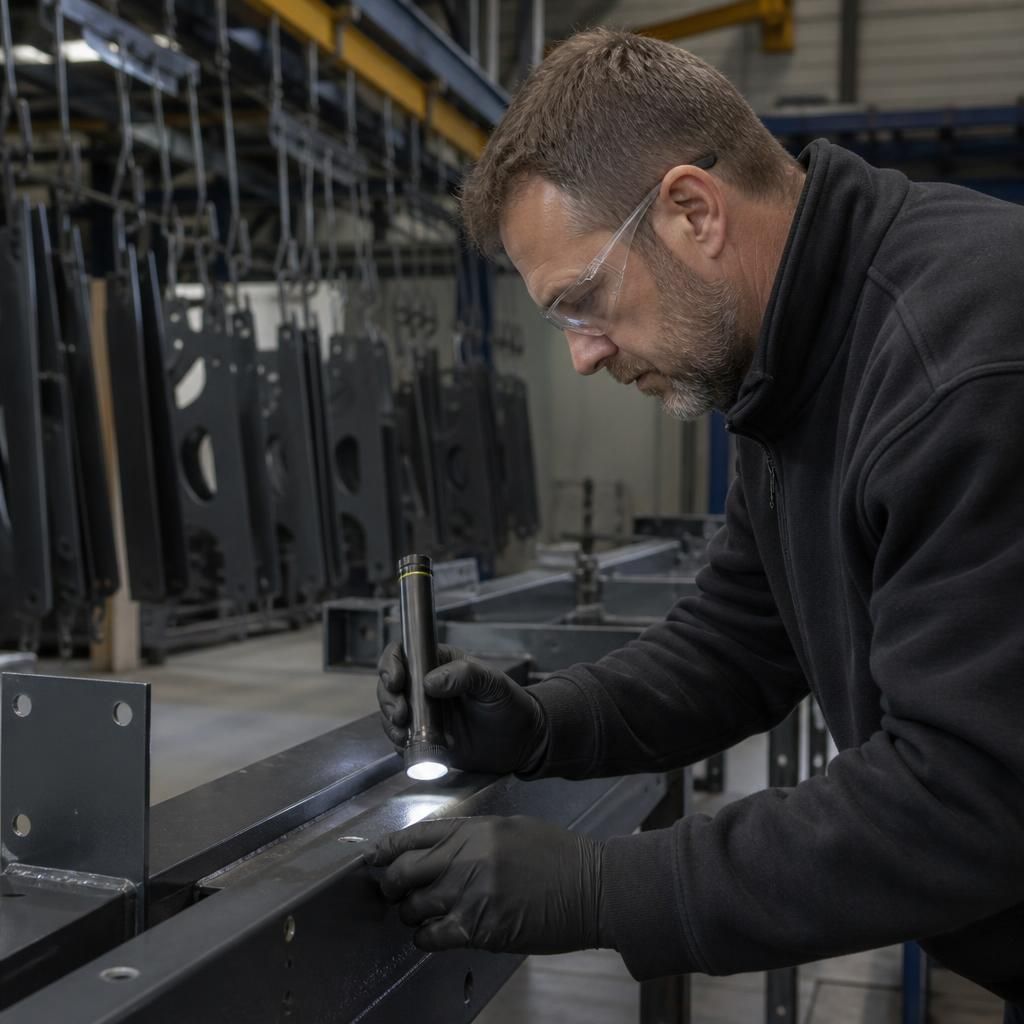
Condition assessment helps determine whether an epoxy polyester hybrid coating still provides effective protection, rather than relying on appearance alone. A finish can remain visually acceptable while adhesion, film integrity or the metal beneath it is beginning to deteriorate.
Where there is uncertainty about performance, assessment should consider:
- Visual condition: Look for blistering, flaking, cracking, rust staining, bubbling, powdering or changes in gloss and colour.
- Adhesion: If areas appear loose or lifting, an appropriate adhesion assessment can establish whether the coating remains bonded to the substrate.
- Film integrity: Coating thickness checks may identify thin or inconsistent areas that are more vulnerable to early breakdown.
- Substrate condition: Rust staining, swelling or corrosion around defects can indicate that deterioration has progressed beneath the coating.
The results should be interpreted alongside the component’s service conditions and coating specification. This prevents unnecessary recoating of a sound finish while identifying cases where surface preparation and a broader remedial programme are needed.
Discuss your epoxy polyester hybrid coating requirements
Discuss your epoxy polyester hybrid coating requirements with our Midlands powder coating specialists, including the component’s substrate, service environment and maintenance needs. This information helps identify a suitable coating specification and repair or recoating approach.