

How do epoxy polyester hybrid coatings compare to traditional powder coatings in terms of durability and flexibility?
Epoxy polyester hybrid coatings generally provide a better balance of durability and flexibility than single-resin powder coatings: the epoxy component supports adhesion and hardness, while the polyester component improves weathering resistance and reduces brittleness. They are often suited to indoor or moderately demanding applications, but a polyester-based powder coating may be more appropriate for prolonged exterior exposure.
Epoxy polyester hybrid powder coatings usually offer a more balanced performance than traditional single-resin powder coatings, particularly where a component needs good film adhesion and mechanical resistance without becoming excessively rigid. Their actual durability and flexibility still depend on the coating formulation, metal substrate, surface preparation, film thickness, curing conditions and service environment.
Durability is not one single property. For industrial components, it can include resistance to impact, abrasion, scratching, chemicals, moisture, corrosion at damaged areas and repeated handling. A hybrid coating can perform well across several of these requirements because its resin system is formulated to combine different characteristics. By contrast, a traditional epoxy or polyester powder coating may be optimised more strongly towards a particular performance area.
- Impact and handling: A coating that is too hard or brittle can chip when components are dropped, assembled or subjected to vibration. Hybrids can provide a useful compromise between surface hardness and the ability of the film to absorb limited movement.
- Abrasion and scratching: Hardness supports resistance to scuffing, but hardness alone does not determine service life. Coating adhesion, cure and the nature of the contact are also important. A well-cured hybrid may be suitable for components that experience routine handling or moderate mechanical contact.
- Chemical exposure: The specific chemistry and exposure conditions matter more than the word “hybrid”. Cleaning agents, oils, solvents, salts and industrial chemicals can affect different formulations in different ways, so the coating should be selected against the substances and temperatures involved.
- Corrosion protection: Powder coating helps isolate the metal from moisture and contaminants, but it cannot compensate for poor preparation, sharp edges, contamination or inadequate coverage. The condition of the substrate and the treatment of joints, corners and welds remain central to the result.
Flexibility concerns the coating film, not simply whether the metal bends. A flexible film can accommodate limited expansion, contraction or distortion with less risk of cracking. This is relevant to fabricated parts, panels and assemblies that are handled during installation or experience changes in operating temperature. However, no powder coating should be expected to tolerate severe bending after curing unless the coating system has been specifically selected and tested for that purpose.
Traditional powder coatings are not automatically inflexible. Some polyester systems provide good resistance to cracking, while some epoxy systems deliver strong adhesion and robust mechanical performance. The meaningful comparison is therefore between the properties required by the component and the tested properties of the proposed formulation, rather than between “hybrid” and “traditional” as fixed categories.
Film thickness also affects the comparison. An excessively thick film may be more prone to cracking or loss of flexibility, while insufficient coverage can reduce protection at edges and exposed areas. Consistent application and correct oven curing are necessary for the resin to develop its intended properties. Under-cured powder may have reduced chemical and mechanical resistance; over-curing can also alter the finish and performance.
For indoor equipment, machinery parts, enclosures and fabricated metalwork exposed to handling, a hybrid can be a practical choice when the specification calls for a combination of adhesion, hardness and moderate flexibility. For components exposed to sustained sunlight or demanding outdoor weathering, the suitability of the chosen hybrid must be checked carefully rather than assumed from its general durability. The required level of exterior resistance may favour a formulation designed specifically for that environment.
When comparing coating options, assess:
- the likely impact, abrasion and handling loads;
- whether the substrate will flex or experience thermal movement;
- contact with water, chemicals, oils, salts or cleaning products;
- indoor or outdoor exposure and the expected sunlight;
- required appearance, film thickness and gloss retention; and
- the preparation, application and curing controls available for the component.
In practice, a hybrid coating is best viewed as a balanced specification option rather than a universal upgrade. It may outperform a single-resin coating where the component needs several properties at once, but a specialist traditional formulation can be the better choice when one requirement—such as severe exterior exposure, particular chemical resistance or unusually high flexibility—dominates the application. A coating specialist can use the component’s service conditions and production process to identify the appropriate system and confirm whether performance testing is needed.
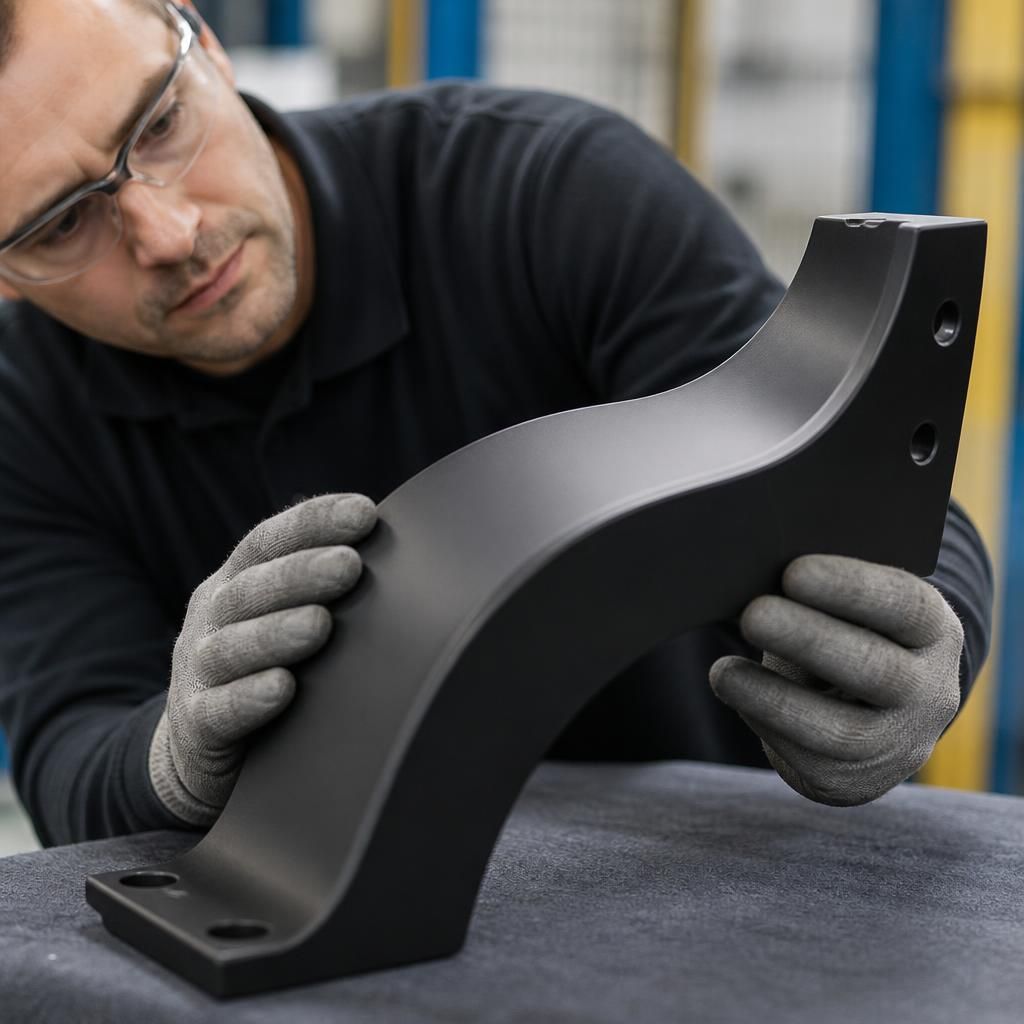
The practical difference between a hybrid and a traditional powder coating depends partly on when the metal component must flex. Movement during service is less demanding than bending, folding or forming a component after the coating has cured. A hybrid may accommodate limited movement, but it should not be treated as a substitute for a coating specifically approved for post-coating forming.
If a part will be pressed, folded, crimped or adjusted after coating, this requirement should be identified before the system is chosen. The coating specification should state whether forming is permitted and, where necessary, be confirmed through a representative sample or bend assessment. Components formed first and coated afterwards can generally be assessed on their service requirements instead, making adhesion, surface hardness and resistance to handling more relevant than post-cure forming capability.