

How do epoxy polyester hybrid coatings compare to traditional powder coatings in terms of cost-effectiveness and performance in industrial applications?
Epoxy polyester hybrid coatings can be more cost-effective than traditional single-resin powder coatings where a balance of durability, appearance and corrosion resistance is required, because one formulation provides complementary properties. They generally offer better interior performance and finish retention than epoxy alone, while avoiding the outdoor limitations of standard epoxy; however, polyester remains the stronger choice for prolonged exterior exposure, so cost-effectiveness depends on the component’s environment and service requirements.
Epoxy polyester hybrid powder coatings are usually most cost-effective where industrial components need a balanced combination of corrosion resistance, finish quality, adhesion and moderate durability, rather than the maximum outdoor weathering performance. Compared with traditional single-resin powder coatings, their value comes from combining epoxy and polyester characteristics in one coating system; the best option still depends on the substrate, operating environment, production process and expected service life.
Cost comparison
- Material cost: The powder itself is only one part of the coating cost. A hybrid may provide the required performance without specifying separate coating systems for different properties, but a conventional epoxy or polyester powder can be more economical where its individual characteristics already meet the specification.
- Application cost: Hybrid powders are applied using the same general electrostatic spraying and oven-curing principles as other thermosetting powder coatings. This means the comparison should include spraying, masking, handling, curing and inspection rather than material price alone.
- Production efficiency: A coating that produces consistent coverage and an acceptable finish can reduce rework, sorting and rejected components. Actual results depend on surface preparation, powder recovery, film thickness, part geometry, curing control and operator practice; the resin type cannot compensate for poor process control.
- Energy use: Curing requirements are determined by the product specification and the mass and configuration of the components. A hybrid is not automatically cheaper to cure than every traditional powder, so oven loading, cure schedule and throughput should be assessed as part of the process cost.
- Whole-life cost: The most relevant comparison is often the cost of coating, handling, replacement, cleaning and potential refurbishment over the component’s intended life. A lower purchase price may be poor value if the finish is unsuitable for the service environment or requires premature remedial work.
Performance characteristics
Epoxy polyester hybrids are formulated to balance properties that are often prioritised differently in single-resin systems. Epoxy contributes strong adhesion, hardness and resistance to many indoor chemical and corrosive conditions. Polyester contributes improved appearance and better resistance to light exposure than a standard epoxy-only finish. The resulting coating is commonly suited to indoor equipment, fabricated metalwork, electrical enclosures, shelving, machinery components and other parts where appearance and general protection are important.
Traditional epoxy powder can provide excellent adhesion, hardness and chemical resistance, but prolonged exposure to ultraviolet light can lead to chalking, fading or loss of appearance. A hybrid can improve on this limitation, although it should not automatically be treated as an exterior-grade substitute for a suitably specified polyester system. Where components face sustained sunlight, rain, moisture cycling or demanding atmospheric exposure, a weather-resistant polyester formulation may offer the more appropriate performance profile.
Compared with polyester powder, a hybrid may offer advantages where adhesion, hardness or indoor chemical resistance carry greater weight than long-term exterior colour retention. Polyester remains preferable when resistance to ultraviolet exposure and weathering is the principal requirement. Selecting a hybrid solely because it is described as a compromise can therefore be misleading: the coating must be matched to the dominant failure risks for the component.
Factors that determine industrial value
- Service environment: Indoor, sheltered, exterior, humid, chemically exposed and mechanically demanding locations place different demands on the coating.
- Substrate and preparation: Degreasing, removal of rust or mill scale, suitable pretreatment and correct surface profile have a major effect on adhesion and corrosion protection. These preparation requirements should be included in any cost comparison.
- Part design: Sharp edges, recesses, threaded areas, welds and enclosed sections can affect powder coverage and curing. A coating that performs well on flat panels may require different controls on complex fabrications.
- Appearance requirements: Colour, gloss, texture, edge coverage and resistance to visual deterioration can influence both specification and inspection costs.
- Mechanical demands: Impact, abrasion, bending and handling damage should be considered alongside hardness. A very hard finish is not necessarily the best choice if the component is likely to flex or receive impact during assembly.
- Batch and component volume: Set-up, masking, racking, colour changes and handling can affect the cost per part. These process factors may be more significant than small differences in powder price.
When a hybrid is likely to offer better value
A hybrid is often a sensible specification for components used indoors or in controlled environments where a combination of adhesion, corrosion protection, surface appearance and general mechanical resistance is required. It can avoid over-specifying a coating designed primarily for severe exterior exposure while providing broader performance than an epoxy-only finish in applications where appearance matters.
It is less likely to be the most economical choice where one clearly defined property dominates. Examples include components requiring prolonged outdoor weathering, where an appropriate exterior polyester may be more suitable, or parts requiring particularly high chemical resistance, where the full specification of the operating chemicals and exposure conditions may favour a different system. The cheapest coating on paper is not necessarily the lowest-cost option once premature deterioration, recoating or replacement is considered.
For an industrial comparison, the specification should therefore record the substrate, preparation method, indoor or outdoor exposure, contact with chemicals, expected mechanical handling, appearance requirements and curing conditions. Comparing those requirements with the technical data for the proposed hybrid and traditional alternatives provides a more reliable cost-effectiveness assessment than comparing purchase prices alone.
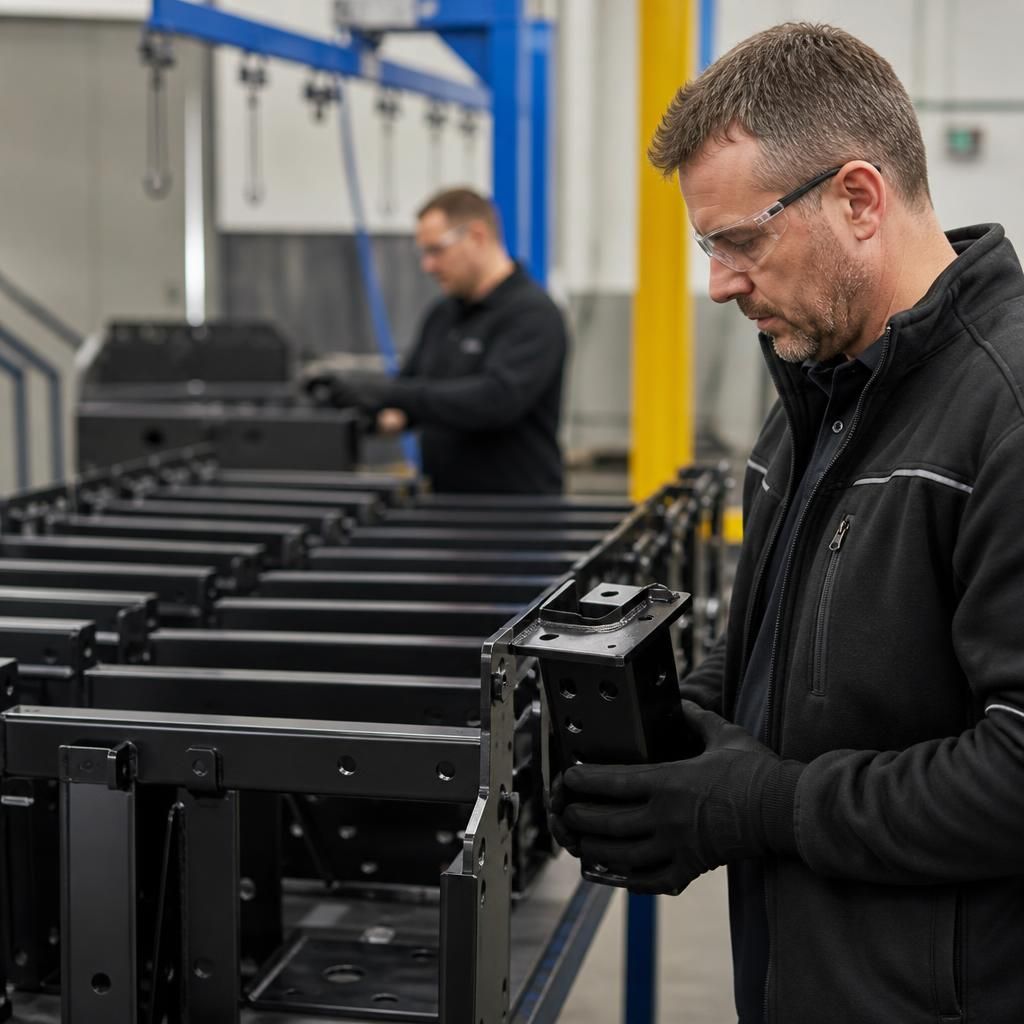
Cost-effectiveness also depends on how the coating affects assembly, not only on its resistance to corrosion or weathering. Powder build on mating faces, threaded sections, close-tolerance areas and electrical contact points may require masking or post-coating removal. These extra operations can influence the installed cost of a hybrid just as they can with a traditional powder coating.
For this reason, the comparison should include a representative component rather than a flat test panel alone. Checking coverage, film build, masking requirements and fit after curing helps establish whether the selected coating can be integrated into the production process without avoidable rework or assembly problems.