

How does the epoxy powder coating thickness affect the protective qualities and overall performance on steel surfaces?
Epoxy powder coating thickness affects how effectively the finish forms a continuous barrier against moisture, chemicals and abrasion on steel: insufficient thickness can leave weak coverage, while excessive thickness may impair curing, adhesion or surface quality. The best performance comes from achieving a consistent, application-appropriate film thickness rather than simply applying the thickest possible coating.
Epoxy powder coating thickness is an engineering control that influences steel protection, mechanical resistance, adhesion, appearance and dimensional fit. The appropriate thickness is not a universal maximum or minimum; it is a specified cured dry-film thickness selected alongside the epoxy formulation, steel condition, surface preparation, component geometry and expected service environment.
Protection depends on consistent coverage. The coating must cover the steel continuously, including welds, joints, recesses, edges and other difficult areas. A stated nominal thickness does not necessarily mean that every point on a component has the same film build. Sharp edges, internal corners, holes and recessed sections can produce local variations during spraying. For this reason, a specification should identify acceptable minimum, nominal and maximum readings, rather than relying on one measurement from an easily accessible flat face.
Thickness also interacts with the condition of the steel beneath it. Mill scale, rust, grease, moisture, weld spatter and surface contamination can prevent the coating from bonding properly, regardless of the measured film build. Abrasive preparation, suitable cleaning and appropriate pretreatment provide the foundation for adhesion. Increasing the amount of powder cannot compensate for poor preparation or uncoated defects.
Corrosion performance is governed by the complete coating system. A thicker film can provide more material over prepared steel, but corrosion resistance also depends on the epoxy chemistry, substrate profile, edge treatment, curing and the severity of exposure. Welds, cut edges, fastener areas and locations where water or contaminants collect deserve particular attention because local breakdown often starts at these features rather than at the centre of a broad, well-coated surface.
For components exposed to moisture, salts or industrial chemicals, the coating requirement should therefore define more than a target film build. It should also cover preparation, pretreatment, curing, inspection and any required testing. The coating manufacturer’s technical data and the intended service conditions should be used to establish a suitable range.
Mechanical performance changes with film build and formulation. Thickness can affect resistance to handling damage, rubbing and impact, but film build alone does not determine durability. The cured hardness, flexibility, adhesion and chemical resistance of the epoxy are equally important. A coating that is too rigid or heavily built for a component that flexes, vibrates or undergoes repeated thermal movement may be more vulnerable to cracking or chipping. Conversely, a film that is not developed sufficiently for the intended wear conditions may be damaged during service.
Epoxy coatings are often selected for their protective and chemical-resistant properties, but the final finish must still be matched to the part’s movement and loading. Where steel components are bent, assembled under pressure or exposed to impact at edges, the coating specification should consider flexibility and edge robustness as well as thickness.
Curing is closely linked to thickness. Powder coating is cured by heating the component so that the powder melts, flows and chemically cross-links. The relevant condition is the temperature reached by the steel and the time held at that temperature, not simply the oven’s displayed air temperature. A change in film build can affect flow, heat transfer and the appearance of the finished surface. Coating applied over a contaminated, porous or outgassing substrate can also develop pinholes or surface defects that are not solved by adding more powder.
Under-cured epoxy may have reduced hardness, adhesion and resistance to chemicals. Excessive heat or an unsuitable cure profile can alter colour, gloss or flexibility. Thickness checks should therefore be considered alongside cure verification, particularly where parts have substantial variation in section thickness or are processed in different rack positions.
Film build can affect fit and function. On components with close tolerances, coating thickness must be allowed for on every coated face. Threads, bores, slots, mating surfaces, bearing locations, hinge points and sliding interfaces may require masking or a controlled coating limit. Even where the nominal film is relatively small, coating both sides of a close-fitting assembly can reduce clearance and make installation difficult.
Drawings should identify surfaces that must remain bare, areas requiring masking and any maximum build around holes or mating faces. This is particularly important for fabricated assemblies, precision parts and components that will be bolted together after coating. A coating specification that considers the final assembly prevents thickness variation from becoming a dimensional problem.
Measurement should reflect the shape of the part. Dry-film-thickness gauges suitable for steel can be used to check the cured coating, but a reliable inspection plan takes several readings across representative areas. Measurements should include broad faces, edges, corners, recesses and locations where the spray pattern is difficult to control. The gauge should be checked and used in accordance with its instructions, with the substrate and surface condition taken into account.
For repeat production, consistent results come from controlling the variables that influence deposition: powder application settings, gun distance and movement, grounding, component orientation, rack design, surface preparation and cure conditions. Recording thickness readings by batch or component type can help identify drift before it affects a larger production run.
The correct specification balances protection with function. Before coating steel parts, the required information should include:
- the exposure to moisture, chemicals, abrasion, impact and temperature changes;
- the steel grade, surface condition, welds, cast features and substrate profile;
- the required minimum, nominal and maximum cured film thickness;
- critical dimensions, masking requirements and assembly tolerances;
- the epoxy formulation, preparation and pretreatment requirements;
- the curing schedule based on the component’s actual metal temperature; and
- the inspection method and acceptance criteria for coverage and film build.
For simple flat parts, thickness control may be relatively straightforward. Complex fabrications, perforated sections, deep recesses and assemblies with tight tolerances need a more detailed plan, because the average reading can conceal local thin areas or excessive build. A practical coating assessment should evaluate the complete part, not just the nominal number, so that the epoxy finish provides the intended steel protection without compromising cure, appearance, fit or service performance.
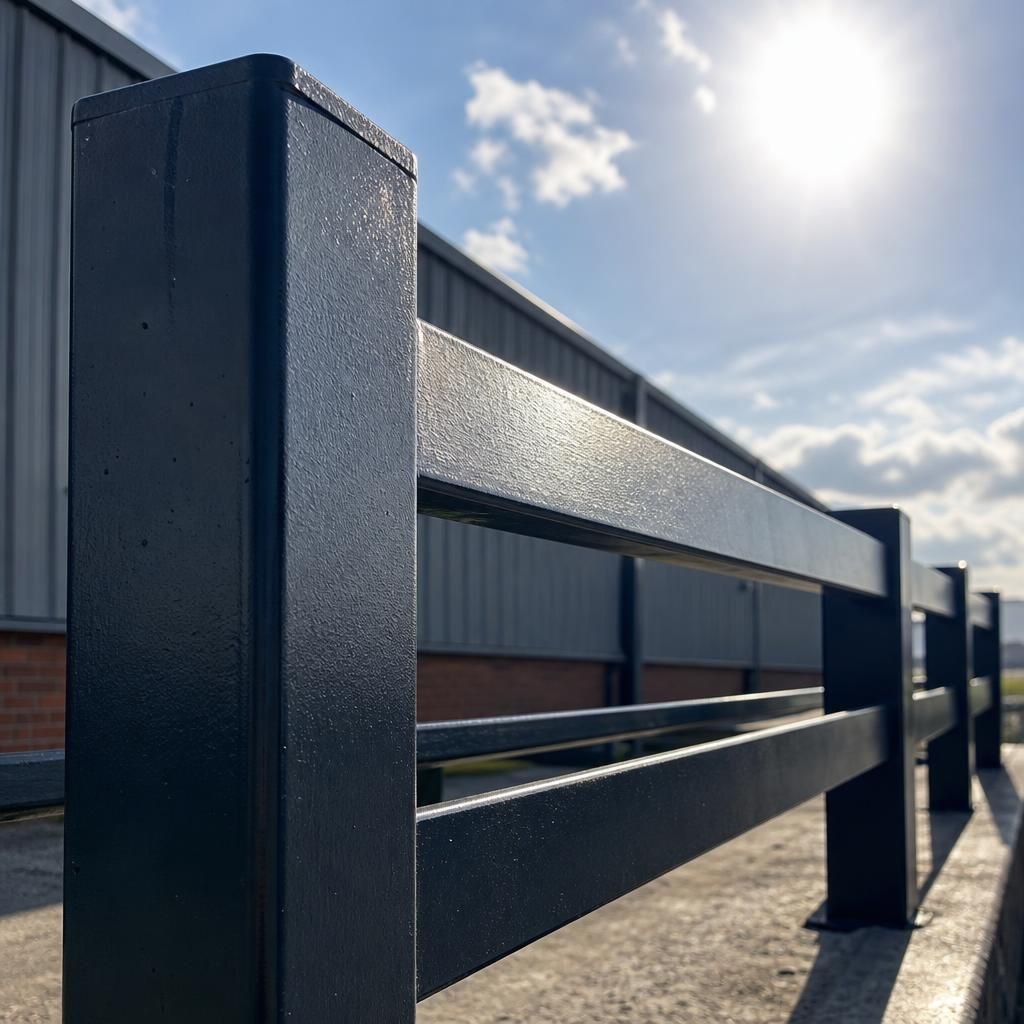
For steel components exposed to sunlight, increasing epoxy powder coating thickness does not by itself improve resistance to ultraviolet degradation. Epoxy can lose gloss or develop surface chalking under prolonged UV exposure, even when the film is sound and correctly cured.
Where outdoor exposure is expected, the coating specification should consider the complete system and finish requirements rather than relying on additional film build. A suitable UV-resistant topcoat or alternative formulation may be needed to preserve appearance and surface performance.
Discuss the Right Epoxy Powder Coating Thickness for Your Steel Components
Discuss your steel components, operating conditions and dimensional requirements with the powder-coating.co.uk team to establish an appropriate epoxy film-thickness specification. Providing drawings or sample parts can help identify critical surfaces, masking needs and inspection requirements before coating.