

How does the epoxy powder coating process differ when applied to various metal substrates such as aluminium and hot rolled steel?
The epoxy powder coating process varies mainly in surface preparation and heat control: aluminium usually needs careful degreasing, conversion treatment or suitable blasting to remove its oxide layer, while hot rolled steel generally requires more intensive removal of mill scale, rust and contaminants. Both substrates then receive electrostatically applied epoxy powder and are cured to the coating manufacturer’s specified time and temperature, adjusted for the component’s mass and heat characteristics.
The main difference after basic preparation is how the substrate’s composition, geometry and thermal behaviour affect application, curing and quality control. Aluminium generally demands tighter control of handling, racking and pretreatment compatibility, whereas hot rolled steel usually requires greater attention to component mass, welds, edges and the risk of corrosion developing beneath or around the coating.
Aluminium substrate considerations
Aluminium is relatively soft and can be marked by abrasive handling, hooks, racks or contact with contaminated equipment. Components should therefore be supported and transported in a way that avoids dents, drag marks and embedded debris. Any marks that remain before coating can become more visible after the powder has cured, particularly where the finish has a smooth or lightly textured appearance.
The alloy and condition of the aluminium can also affect the result. Castings, extrusions and fabricated sheet may have different surface characteristics, while some alloys contain constituents that respond differently during pretreatment or heating. Where the component is unfamiliar, a trial piece or representative sample can help confirm adhesion, appearance and cure before a production batch is processed.
Racking requires particular care because the coating process depends on a reliable electrical connection between the part and the application system. Contact points should be placed where they will not affect visible faces or critical fits, while still providing a stable earth path. Thin aluminium sections can also distort if they are inadequately supported, especially when the design has long unsupported spans or uneven wall thicknesses.
Hot rolled steel substrate considerations
Hot rolled steel is usually more robust during handling, but its fabricated features can make coating control more demanding. Weld beads, corners, holes, overlaps and recessed areas can influence powder deposition and may receive a different film thickness from broad, accessible faces. Sharp edges can attract less coating than adjacent flat surfaces, so edge condition and component orientation should be considered during preparation and application.
Steel fabrications may contain weld spatter, residues or enclosed sections that are not obvious from an external inspection. These features can interfere with adhesion or release gas during curing. Blind holes, folded sections and cavities should be assessed before processing, with suitable drainage or venting where the design permits. Otherwise, trapped moisture or air can contribute to pinholes, blistering or later corrosion-related defects.
Because steel components are often heavier than aluminium equivalents, the coater must assess how the part is supported and how evenly it will reach the required curing condition. A surface reading alone may not represent the temperature at the coldest or most heavily built-up area. Cure validation should therefore take account of the thickest section, joints, brackets and other areas likely to heat more slowly.
Differences in application and film build
The same nominal powder specification does not automatically produce the same visual result on both metals. Surface texture, edge shape and the reflectivity of the substrate can affect how uniform the cured finish appears. Powder may accumulate differently around corners, recesses and contact points, so racking and gun access should be planned from the component drawing rather than treating every face identically.
Dimensional tolerances are another practical distinction. On aluminium assemblies, coating thickness may affect sliding fits, threads and close-fitting interfaces. Steel fabrications can present the same issue at machined faces, hinge points, threaded holes and mating surfaces. These areas may need masking or an agreed coating exclusion zone. Masking materials must also tolerate the curing cycle without leaving residue or damaging the finish.
Curing and inspection
Epoxy powder must be assessed against the coating supplier’s specified cure requirement, with the part temperature—not simply the oven air temperature—being the relevant consideration. Aluminium may transfer heat through thin sections rapidly, while a substantial steel fabrication can contain colder areas for longer. Cure records, test panels or temperature probes can be used where the component’s mass or geometry makes the heating profile uncertain.
Inspection should be substrate-specific rather than limited to a visual check. Useful checks can include:
- visual uniformity, including runs, pinholes, craters, inclusions and areas of uneven texture;
- adhesion testing on a representative area where the specification requires it;
- dry film thickness checks on flat faces, edges and recessed features;
- confirmation that masked interfaces, threads and machined surfaces remain within tolerance; and
- review of contact marks, rack points and any areas that were difficult to reach with the powder.
For either substrate, the required result depends on the component’s service environment, design and specification. Aluminium and hot rolled steel should not simply be processed to one identical work instruction: the racking method, handling controls, masking plan, heating assessment and inspection points should reflect the metal and the part geometry. A Midlands powder-coating specialist can use the component drawings and batch requirements to establish those controls before production coating begins.
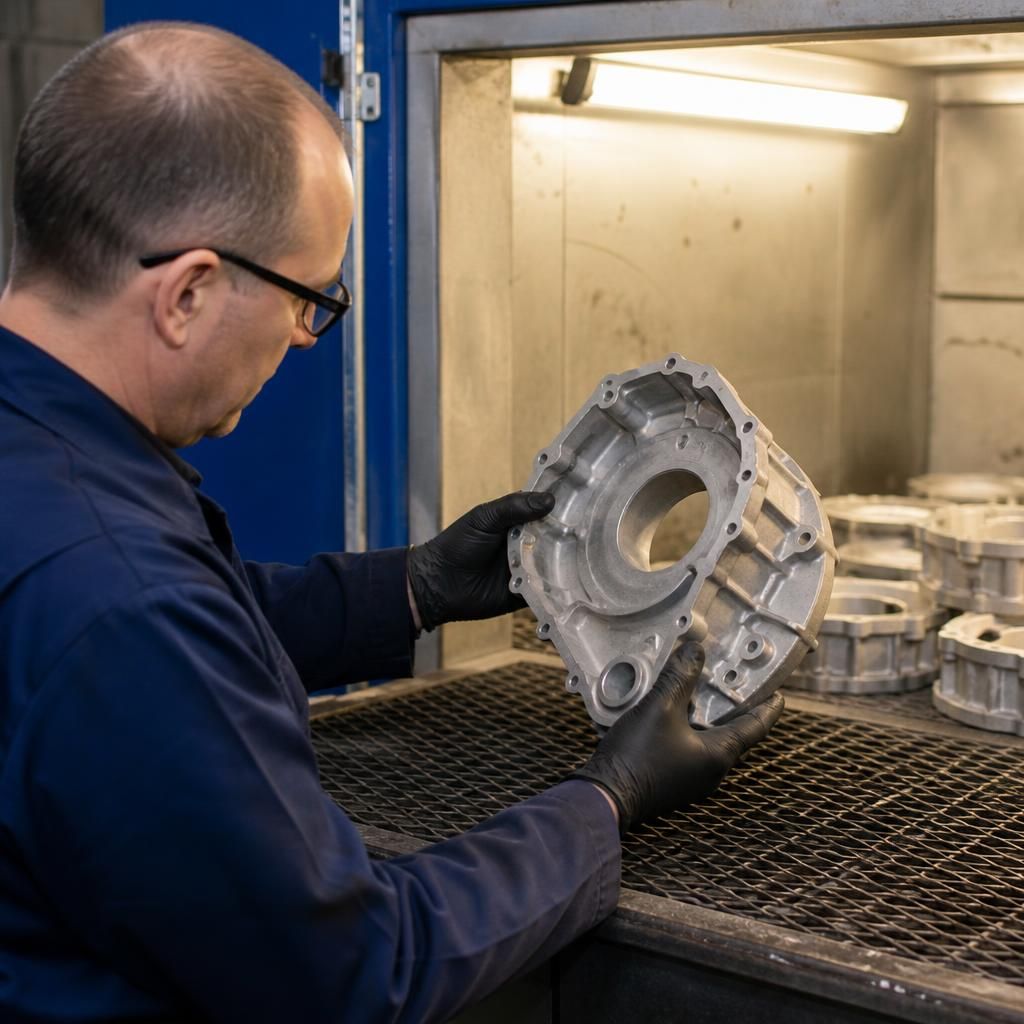
Aluminium castings may require additional attention because porous areas can retain air, moisture or residue that is released during the oven cycle. This outgassing can create pinholes, bubbles or small craters in the cured epoxy film, even when the surface initially appears clean.
For cast aluminium components, the proposed preparation and cure schedule should therefore be checked on a representative sample before batch coating. Preheating, suitable pretreatment and, where appropriate, an outgassing stage may be considered, but the correct approach depends on the casting condition, alloy, porosity and coating specification. Machined or extruded aluminium generally presents less outgassing risk, although it still requires preparation compatible with the particular surface and finish required.