

What is the difference between electrostatic powder painting and traditional liquid painting?
Electrostatic powder painting applies electrically charged dry powder to an earthed metal component before curing it in an oven, while traditional liquid painting sprays wet paint onto the surface and relies on drying or curing. Powder coating generally produces a tougher, more uniform finish with less liquid waste, whereas liquid painting offers greater flexibility for colour matching, thin coats and heat-sensitive components.
Electrostatic powder painting and traditional liquid painting differ in the coating material, how it is applied, how it cures and the performance requirements they suit. Powder painting uses electrically charged dry particles that are attracted to an earthed metal component and then fused during oven curing. Traditional liquid painting applies a wet coating by spray, brush or other methods, with the carrier evaporating or the coating chemically curing afterwards.
Application and transfer: The electrostatic charge helps powder particles cling to exposed areas of a conductive metal component before curing. This can support efficient coverage of suitable shapes, although recessed sections, internal corners and areas shielded from the spray require careful gun positioning and process control. Liquid paint does not depend on the same powder-to-metal attraction, so it can be applied using different techniques and may be more adaptable for complex touch-up work or components that cannot be placed through a powder-coating line.
Coating thickness and edge detail: Powder coating normally creates a relatively substantial protective film once cured. This is useful where the component needs resistance to handling, abrasion or general industrial exposure, but the added thickness must be allowed for when parts have close tolerances, threaded holes, mating faces or moving interfaces. Liquid painting can be applied in very thin layers and may therefore be preferable where dimensional build-up must be tightly controlled. Both methods need suitable masking and preparation to keep critical surfaces free from coating.
Curing requirements: Powder coating requires the component to withstand the heating cycle needed to melt and cure the powder. The relevant consideration is the temperature reached by the metal itself, not simply the oven setting. Liquid coatings may dry through solvent or water evaporation, or cure through a chemical reaction, depending on the formulation. This gives liquid painting a wider role for heat-sensitive substrates and large items that cannot be accommodated in an oven, while powder is generally intended for conductive metal parts compatible with controlled oven curing.
Surface preparation: Neither process can compensate for poor preparation. Oil, grease, rust, mill scale, moisture and contamination can interfere with adhesion and lead to defects or premature failure. A suitable preparation route may include cleaning, abrasion, chemical treatment or blasting, selected according to the base metal, existing finish and intended service conditions. Powder and liquid coatings can both perform well when the preparation, application and curing stages are correctly matched.
Finish and appearance: Powder systems are available in a broad range of colours, gloss levels, textures and special-effect finishes. Liquid systems also offer extensive appearance options and can be advantageous where a very specific shade, fine visual adjustment or multi-layer decorative system is required. The final appearance depends not only on the coating type but also on surface condition, film build, spray technique, curing or drying conditions and how consistently each batch is processed.
Repairs and rework: A powder-coated component is normally finished after oven curing, so defects may require local preparation and an appropriately compatible repair coating, or complete reprocessing where the specification demands it. Liquid paint can often be blended, recoated or repaired on the item, subject to compatibility and preparation. This makes the planned inspection, handling and packaging arrangements important for both methods, particularly where components have visible faces or are supplied as assembled products.
Production considerations: Powder coating is well suited to repeatable production of prepared metal components that can be safely handled, electrically earthed and cured. Colour changes, masking requirements, part size and oven capacity influence how a batch is planned. Liquid painting can be more flexible for on-site work, oversized items, isolated repairs and substrates requiring a low-temperature process, but drying space, ventilation, overspray control and the coating’s specified application conditions must be considered.
For a business choosing between the two, the main questions are:
- Can the component tolerate the required powder-curing temperature?
- Does the part have tight tolerances or surfaces that cannot accept additional film thickness?
- Is the item conductive, suitably prepared and practical to earth during application?
- Are there internal areas, deep recesses or assembled sections that may be difficult to coat consistently?
- What level of resistance, appearance, colour control and repairability does the end use require?
- Can the component be transported, masked, handled and cured without distortion or damage?
In practical terms, electrostatic powder painting is usually considered for compatible metal components requiring a robust factory-applied finish and repeatable batch processing. Traditional liquid painting remains useful where low-temperature application, very thin films, unusual component dimensions, specialist layering or on-site repair is more important. The correct choice is therefore determined by the component, specification and operating environment rather than by the application method alone.
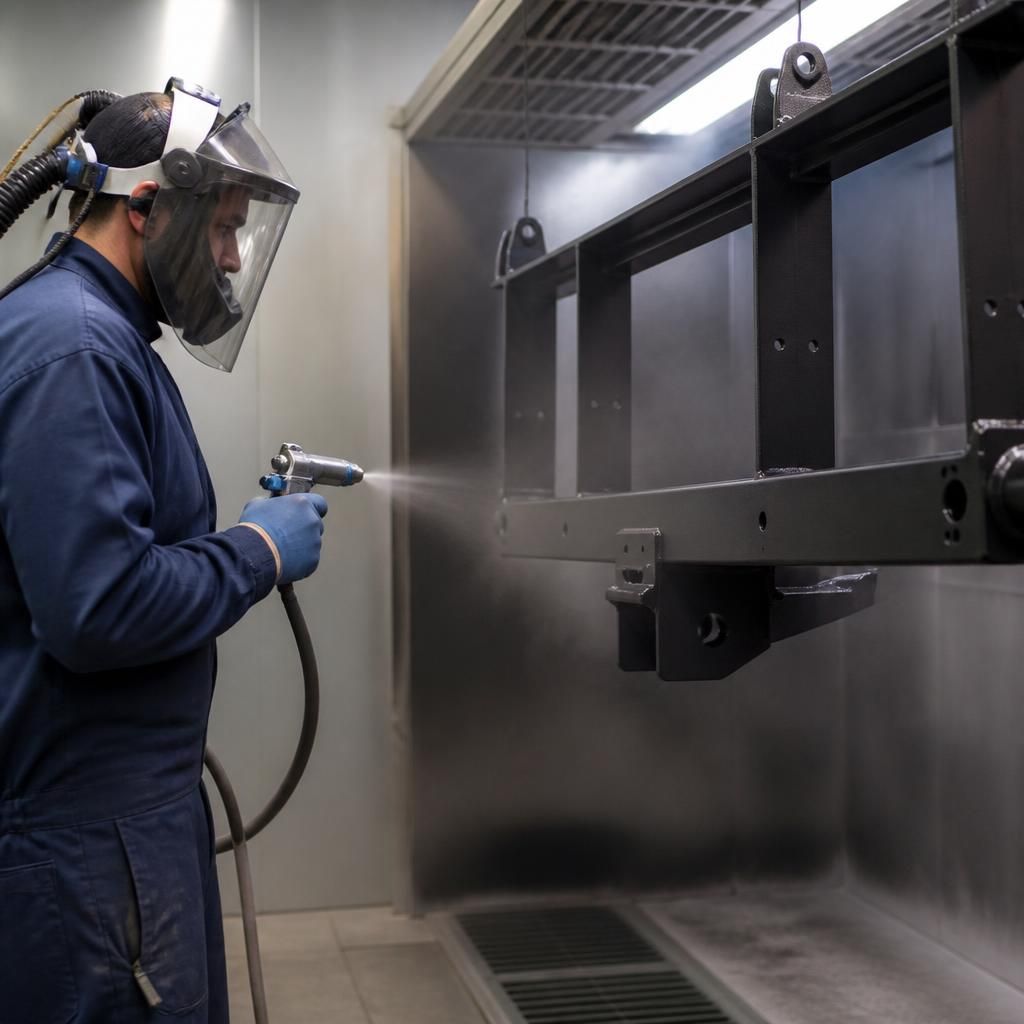
A further difference is how each system can be built up to meet a coating specification. Powder coating is often applied as a single cured layer, although powder primers and multi-layer systems are also available for particular corrosion or performance requirements. Liquid painting can be specified as a primer, intermediate coat and topcoat, allowing each layer to perform a defined function, such as adhesion, corrosion protection or colour retention.
This layered approach can be useful when a component needs a carefully controlled coating system rather than a general-purpose finish. It also introduces additional requirements: each coat must be compatible with the next, and drying or curing conditions must be controlled between stages. The choice between powder and liquid painting should therefore consider the complete coating specification, not just the application method or final appearance.
Discuss Electrostatic Powder Painting for Your Components
Discuss your component dimensions, substrate, finish requirements and operating conditions with the powder-coating.co.uk team to assess whether electrostatic powder painting is suitable. They can advise on the appropriate coating approach and collection or delivery arrangements for your project.