

What energy efficiency measures should I consider when operating industrial paint curing ovens for powder coating?
Energy efficiency in industrial powder coating ovens depends on retaining heat, controlling the cure cycle accurately and avoiding unnecessary heating of unused space. Key measures include maintaining insulation and door seals, using efficient temperature controls, matching oven loading to production requirements, preventing excessive exhaust, and recovering usable heat where the system allows.
Energy efficiency in an industrial powder coating oven is best improved by measuring where energy is being used, matching the heating system to the curing load and preventing the coated work from receiving more heat than the powder specification requires. In addition to the oven’s basic heat retention and temperature-control measures, operators should assess burner or electrical-heating performance, fan operation, airflow balance, cure verification, operating patterns and the condition of associated equipment.
Start with an energy-use assessment. Record the oven’s energy consumption alongside production information such as batch size, part mass, cure temperature, dwell time and the number of production cycles. Separate energy used during warm-up, curing, idle periods and shutdown where possible. This helps identify whether the main opportunity lies in the heating system, air movement, process scheduling or extended periods with little or no coated work. Sub-metering the oven, extraction equipment and ancillary plant can provide a more useful picture than relying only on a site-wide utility bill.
Check the heating system’s operating efficiency. Gas-fired ovens should be assessed for correct burner adjustment, clean combustion-air paths and suitable flue performance. Poor combustion can waste fuel and may create uneven heating. Electric ovens should be checked for the condition and performance of heating elements, electrical connections and switching equipment. Any inspection or adjustment should be carried out by a suitably competent engineer, particularly where gas, combustion systems or high-voltage equipment are involved.
Use variable-speed drives where the process allows. Circulation fans and extraction fans do not always need to operate at their maximum speed throughout every stage of a cure cycle. Controlling fan speed according to the oven’s required airflow can reduce the electricity used by motors while maintaining the air movement needed for even curing. This must be validated carefully: reducing circulation too far can create temperature variation, cold spots or inconsistent coating performance.
Balance airflow throughout the chamber. Efficient heating is not simply a matter of raising the air temperature. The heated air must reach the work evenly, with suitable return paths and correctly positioned supply points. Blocked ducts, damaged baffles, leaking joints or poorly distributed air can cause operators to extend the cure cycle or increase the set temperature to compensate. Airflow checks, temperature mapping and inspection of internal components can reveal these problems without relying on guesswork.
Verify the cure on the part rather than judging it only from the oven display. Powder cures according to the temperature reached by the substrate and the time it remains at that temperature. A thick steel component may take longer to reach curing temperature than a thin item, even when both enter the oven together. Measuring part temperature during representative production runs can help establish a suitable process window and prevent unnecessary over-curing. It also supports more accurate decisions about cycle length when part geometry, material thickness or batch composition changes.
Review production planning. Grouping compatible work can reduce repeated warm-up periods and avoid running a large oven for a small quantity of work. Similar parts may be scheduled together where they use the same powder cure requirements and do not create unacceptable risks of contamination or quality problems. Planning should still respect hanging limitations, airflow requirements, safe working practices and the powder manufacturer’s technical data.
Consider heat recovery as part of the wider site design. Where suitable, heat from oven exhaust or other warm process air may be transferred to incoming combustion air, make-up air or another compatible process. The design must account for contamination, moisture, fire risk, pressure balance and the possibility that recovered heat is not available consistently. A recovery system that restricts airflow, complicates cleaning or transfers contaminants may reduce overall efficiency rather than improve it, so its whole-life performance should be assessed.
Reduce unnecessary auxiliary energy use. Conveyors, pumps, compressed-air systems and powder-recovery equipment can consume energy associated with the curing process even though they do not heat the oven directly. Inspect compressed-air leaks, avoid running ancillary equipment when it is not required for a production stage and consider whether motors can be controlled according to demand. Any change must preserve powder application quality, safe handling and reliable movement of parts through the line.
Use an operating procedure that links energy performance to coating quality. The procedure should define the approved cure schedule, acceptable loading arrangements, start-up and shutdown sequence, checks for abnormal temperature variation and the action to take when the oven is not achieving the required profile. Operators should record changes to powder type, substrate, part thickness or line speed because these can alter the energy needed for a valid cure.
Energy-efficiency improvements should be evaluated against coating quality, safety and maintenance requirements rather than consumption alone. A lower-temperature or shorter cycle is not beneficial if it produces under-cured coating, while excessive airflow reduction can create uneven finishes. For a commercial powder coating operation, reviewing these factors with an oven engineer and validating changes through temperature profiling provides a controlled way to improve efficiency without compromising the finished metal components.
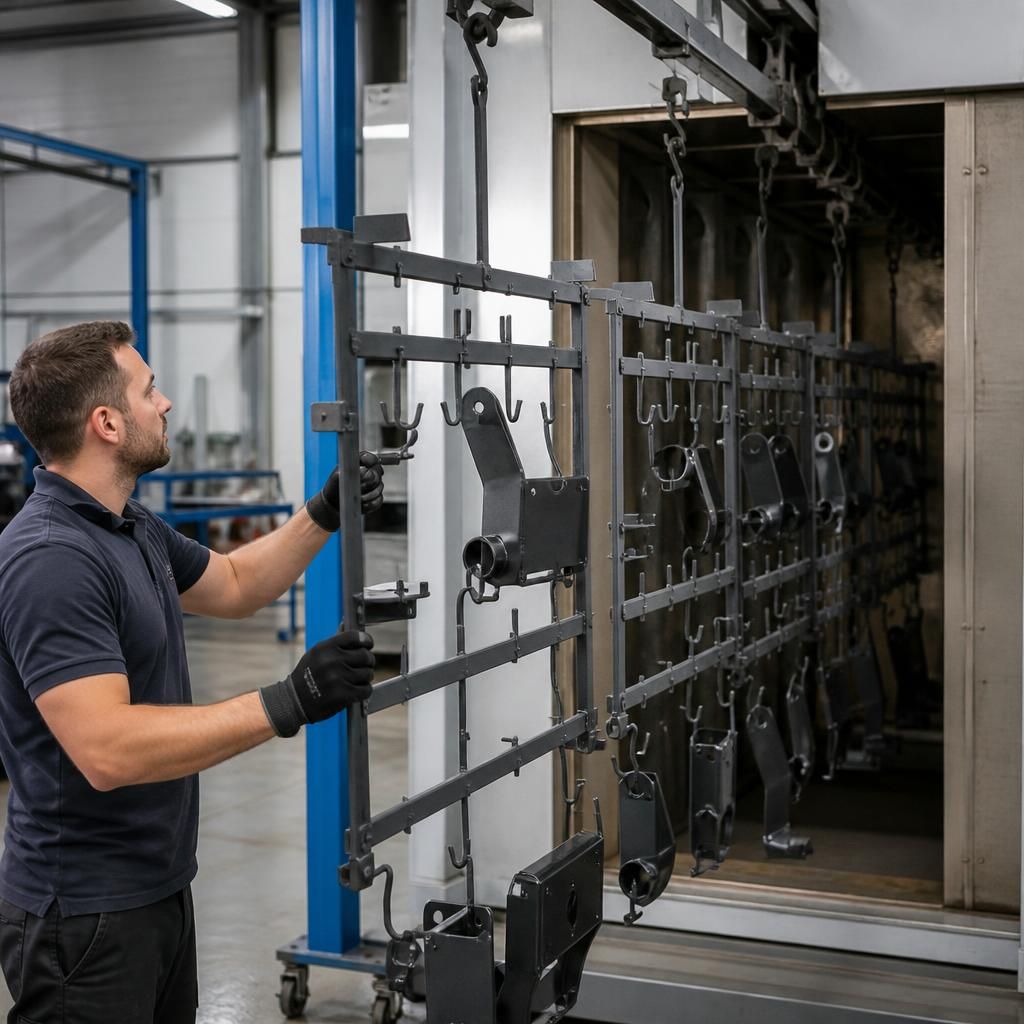
Reducing the thermal mass carried through the oven can lower the energy required for each cure cycle. Heavy racks, hooks and fixtures absorb heat alongside the coated components, so review whether they can be redesigned using lighter, suitably heat-resistant materials without affecting load security, electrical continuity or airflow. Remove redundant fixtures and prevent cured powder build-up from adding unnecessary weight. Hangers should also be arranged to support the parts securely without obstructing circulation, helping the oven heat the product rather than excess metal.