

What are the most common challenges faced during the curing process in powder coating ovens, and how can they be effectively mitigated?
Common powder coating oven curing challenges include uneven heat distribution, incorrect time or temperature settings, restricted airflow, heavy or inconsistent loading, and contamination. Mitigate them by verifying the powder manufacturer’s cure schedule, calibrating temperature controls, monitoring part temperature rather than air temperature alone, maintaining clear airflow, loading consistently, and keeping the oven clean and properly maintained.
The most persistent curing challenges in powder coating ovens are often caused by the interaction between the powder, the metal substrate and the oven’s thermal cycle. Even when the nominal cure temperature is reached, defects can result from outgassing, inadequate substrate preparation, excessive film build, an unsuitable cure window or excessive heat exposure. Effective mitigation depends on identifying whether the fault is caused by the coating material, the component or the curing process, then controlling that variable systematically.
Outgassing and pinholing
Castings, galvanised steel, welds and porous fabrications can release trapped air, moisture, oil or other gases as they heat. The gas may form pinholes, blisters or small craters in the film. These defects can appear during curing even when the powder has been applied correctly.
- Remove oil, moisture, residues and corrosion products through an appropriate pre-treatment process.
- Allow porous or complex components to release trapped gases before applying the final coating where the process permits.
- Use a powder formulation suited to the substrate and finish requirements.
- Inspect welds, cast surfaces and enclosed sections carefully, as these areas commonly retain contaminants or air.
- Do not rely on additional heat to correct outgassing; excessive heat can worsen bubbling and damage the finish.
Inadequate adhesion after curing
A coating can appear cured while still showing poor adhesion if the substrate has not been prepared properly. Oils, oxides, flash rust, mill scale and incompatible residues can prevent the powder film from bonding to the metal. Adhesion problems may become apparent only after impact, bending, assembly or exposure to moisture.
Mitigation starts before the part enters the oven. The preparation method should match the substrate and the intended service conditions. Pretreatment chemistry must be controlled, rinsed correctly where applicable, and followed by thorough drying. A cross-hatch or similar adhesion test on representative parts can help distinguish a curing fault from a surface-preparation fault. If adhesion varies between batches, compare the incoming metal condition and preparation records rather than changing the oven settings immediately.
Excessive film thickness
Heavy powder deposits can create runs, orange peel, poor edge coverage or a finish that looks different from the approved sample. A thick film may also retain solvents or gases released from the substrate, increasing the risk of surface defects. Conversely, thin areas may show inadequate coverage or reduced protection.
Control the applied film rather than attempting to compensate in the oven. Check gun settings, earthing, powder delivery and part geometry, then measure film thickness at representative locations. Edges, recesses and Faraday areas should be assessed separately because the deposited film may not be uniform. Correcting application consistency reduces the temptation to extend the cure cycle for a problem that originated during spraying.
Gloss, colour and surface changes from excessive heat exposure
Over-curing can alter gloss, colour and texture, particularly where a component remains hot after it has completed its required cure. Some powders may yellow, lose gloss or become brittle when exposed to excessive thermal energy. A finish can therefore meet its basic hardness requirement while no longer matching the specified appearance.
Use an approved cure window rather than treating the stated cure temperature as a target to exceed. Consider the complete thermal history, including heat-up and cooling, when investigating colour or gloss variation. Retain an approved reference panel or sample for comparison, and separate visual changes caused by over-cure from those caused by contamination, substrate differences or powder batch variation.
Under-cure masked by a hard surface
A coating may feel dry or resist a light mark while remaining insufficiently cured through its full film depth. This can lead to weak chemical resistance, poor flexibility, reduced adhesion or premature failure in service. The risk is higher where the part geometry causes different heating rates or where the powder has a relatively narrow cure window.
Assess cure using a method appropriate to the powder and the customer’s specification, rather than relying on touch alone. Solvent resistance, adhesion, flexibility and appearance checks can provide useful evidence when interpreted together. Testing should be carried out on representative production parts or suitably matched test pieces, because a small flat sample may not reproduce the behaviour of a complex fabrication.
Powder incompatibility or mixed systems
Different powder chemistries may require different cure conditions and may not produce a consistent result when used on the same job without technical approval. Mixing reclaimed powder, old stock or material from different systems can affect colour, gloss, flow and cure response. Applying a new powder over an incompletely cured or incompatible layer can also create adhesion and appearance defects.
- Keep powder systems, colours and batches clearly identified.
- Follow the relevant technical data and cure requirements for the specific product.
- Avoid combining materials unless compatibility has been established.
- Use retained samples and batch records when a finish must be reproduced across production runs.
Moisture-related defects
Moisture on the substrate, in compressed air or in stored powder can contribute to poor flow, craters, adhesion loss and inconsistent application. Condensation is especially relevant when cold metal is moved into a warmer environment. Powder should be stored in conditions that protect it from moisture and physical degradation, while compressed-air systems should provide clean, dry air suitable for spraying.
Bring components to a stable, dry condition before coating and check for condensation on difficult-to-see surfaces, including internal faces and joints. If a defect appears only after a change in weather or storage conditions, investigate moisture control before altering the cure cycle.
Cooling and handling damage
Freshly cured parts may be hard enough to remove from the oven but still vulnerable to marking, distortion or contamination while cooling. Contact with hooks, racks, packaging or adjacent components can damage the finish before it has stabilised sufficiently for handling.
Use suitable contact points and handling equipment, prevent coated surfaces from rubbing together, and define a consistent point at which parts may be packed or assembled. Cooling should take place in a clean area where the finish is protected from dust, moisture and impact. This separates genuine curing defects from damage introduced after the oven.
A practical investigation method
- Describe the defect precisely, including its location, size, appearance and whether it affects adhesion, appearance or performance.
- Compare affected parts with an approved sample and with an unaffected batch.
- Check the powder identity, batch information, storage condition, film thickness and substrate preparation records.
- Review the complete thermal history of representative parts rather than relying on the oven’s displayed air temperature.
- Use controlled test pieces or a small trial to change one variable at a time.
- Record the confirmed cause and corrective action so the same defect can be recognised and prevented on later production runs.
This approach prevents unnecessary changes to oven settings when the underlying issue is preparation, application, material compatibility or handling. For industrial work, curing control is most reliable when the powder specification, substrate preparation, application checks and thermal-process records are treated as one connected system.
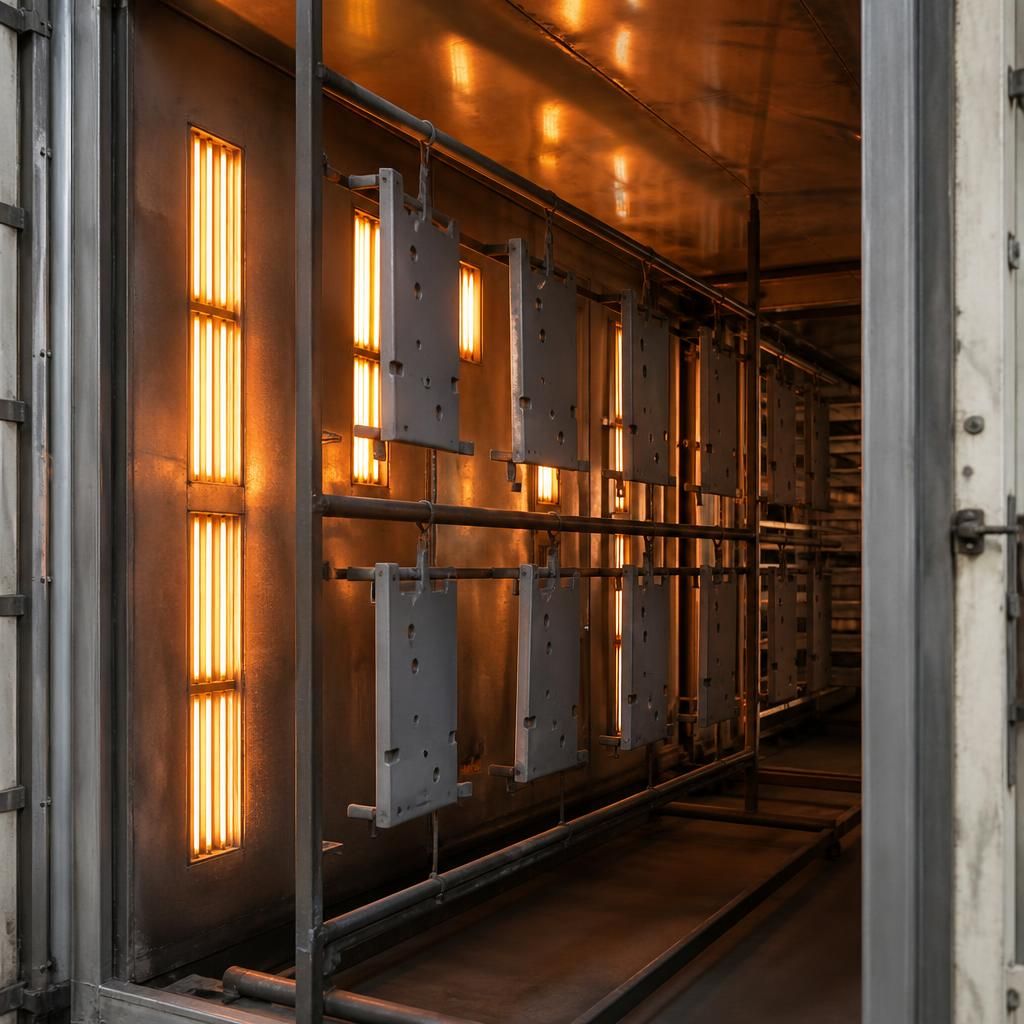
Radiant powder coating ovens can create curing differences when components shield one another from the heat source. Exposed faces may receive more direct radiant energy, while recessed or covered surfaces remain cooler, particularly on fabricated assemblies, brackets and closely nested parts. This can produce a finish that appears acceptable on one face but is insufficiently cured on another.
Mitigation involves reviewing how each component is positioned in relation to the radiant elements. Avoid overlapping parts, maintain suitable spacing, and orient complex fabrications so critical coated surfaces are not hidden behind other metal. Validate the arrangement using representative parts, including recessed and shielded areas, rather than checking only the most exposed face. If the geometry cannot be cured consistently with direct radiation, a different oven configuration or process may be more appropriate.
Discuss Your Powder Coating Oven Curing Challenges
Discuss your powder coating oven curing challenges with a specialist to review the coating system, component requirements and process controls involved. This can help identify the most appropriate next step before further production adjustments are made.