

What are the different types of curing ovens used in powder coating, and how do they impact the process?
Powder coating curing ovens are commonly batch, continuous conveyor, infrared or hybrid systems, with each type differing in how it applies heat, controls dwell time and handles component volumes. These differences affect temperature uniformity, throughput, energy use and the consistency of the finished coating.
Powder coating curing ovens are industrial heating systems that bring coated components to the conditions needed for the powder film to melt, flow and chemically crosslink. The main choices are batch ovens, continuous conveyor ovens, infrared ovens and hybrid systems; their design affects how components are loaded, heated, monitored and moved through the curing stage.
Batch ovens are enclosed chambers in which parts remain stationary during the complete heating cycle. Components are loaded onto racks, frames, trolleys or fixtures, and the oven is then heated to the required process conditions. This arrangement suits varied production, large or awkward fabrications, low-to-medium volumes and jobs where different components require separate curing profiles.
The principal process consideration with a batch oven is the relationship between air temperature, part temperature and dwell time. A heavy steel assembly may take considerably longer to reach the required metal temperature than a thin bracket, even when both enter the oven together. The oven therefore needs sufficient circulation and a controlled cycle rather than reliance on the chamber air reading alone. Poor loading can create shadowed areas, restrict airflow or cause parts to shield one another, resulting in uneven flow, gloss or crosslinking.
Continuous conveyor ovens form part of a linked production line. A conveyor carries components through pre-treatment, powder application and curing, with the oven providing a defined heated zone as the parts travel through it. This layout is suited to repeatable batches and steady production because the process can be organised around a consistent component path and loading pattern.
With a conveyor system, the effective curing process is governed by the interaction of line speed, oven length, air temperature, part mass and the position of the components on the conveyor. A change to one of these factors can alter the thermal history of the coating. For example, increasing line speed reduces the time available for heating and curing, while heavier parts may retain heat differently from smaller items. Conveyor fixtures must also support parts without creating uncoated contact areas or obstructing heat around critical surfaces.
Infrared ovens transfer energy by radiation rather than depending mainly on heated air to warm the component. Infrared emitters can heat exposed surfaces rapidly, making this approach useful where fast surface heating or a compact oven arrangement is required. The coating still needs to reach the necessary condition throughout its film, so the apparent speed of infrared heating does not remove the need for process verification.
Infrared performance is affected by the coating colour, surface orientation, component shape and distance from the emitters. Flat, directly exposed surfaces may heat quickly, while recessed sections, shaded faces and complex geometries can receive less energy. This makes emitter arrangement, part presentation and shielding important. A surface that appears cured may not represent the condition of the complete coating or the colder areas of the metal substrate.
Hybrid ovens combine heating methods, commonly using infrared to raise surface temperature quickly and convection to distribute heat through the component and surrounding chamber. The purpose is to balance rapid response with more even heating across parts with different thicknesses or shapes. Hybrid equipment can be useful where a production line includes both relatively light components and heavier fabrications, although the process still has to be validated for the actual mix of work.
Ovens can also differ in how their heat is generated and circulated. Electric systems use heated elements and fans, while gas-fired systems typically heat air directly or through a heat exchanger. Direct-fired arrangements can provide strong heating performance, whereas indirect systems keep combustion products separate from the oven atmosphere. The relevant choice depends on the required temperature control, oven design, component characteristics, installation constraints and the coating process being used.
The oven type affects the powder coating process in several practical ways:
- Heating uniformity: Air movement, emitter position, chamber geometry and part loading determine whether all surfaces receive comparable heat. Uneven heating may leave some areas under-cured while others are exposed to excessive heat.
- Thermal response: Thin sections usually respond more quickly than thick sections. Ovens must be selected and operated with the substrate, not just the powder film, in mind.
- Production arrangement: Batch systems allow greater variation between jobs, while conveyor systems favour a controlled sequence of similar work. Infrared and hybrid systems introduce additional options for line layout and heating speed.
- Coating appearance: Inadequate melting or crosslinking can produce poor flow, inconsistent gloss, weak adhesion or reduced resistance to service conditions. Excessive thermal exposure can also affect appearance and coating performance.
- Energy use: Chamber volume, insulation, door openings, conveyor operation, burner or element control and the mass of material being heated all influence energy demand. An oven that is too large for its normal workload may waste heat, while one that is undersized may restrict production or encourage unsuitable loading.
- Handling and contamination: Batch loading and conveyor movement create different risks of contact damage, dust entry and overspray accumulation. Fixtures, airflow paths and chamber cleanliness must be considered as part of the oven process rather than treated as separate issues.
Choosing between oven types starts with the components rather than the heating technology alone. Relevant factors include the largest and smallest part dimensions, substrate thickness, component weight, geometry, coating system, expected production pattern, required flexibility and the way parts can be safely supported. A business coating occasional large fabrications may need the flexibility of a batch chamber, whereas a manufacturer with a repeatable stream of similar parts may gain more from a conveyor arrangement.
Whichever oven is used, curing should be assessed against the temperature reached by the component and the time it remains at the powder system’s specified condition. Air probes indicate the chamber environment but do not necessarily show the temperature of the coldest or most heavily loaded part. Temperature profiling, appropriate sensors and representative test pieces help identify hot and cold zones, heating delays and changes caused by loading patterns.
In practice, the most suitable oven is the one that can deliver a repeatable thermal profile for the actual work, not simply the one with the highest heating rate. Correct oven selection, consistent loading and verification of part temperature together determine whether the powder melts evenly, crosslinks adequately and produces a durable industrial finish.
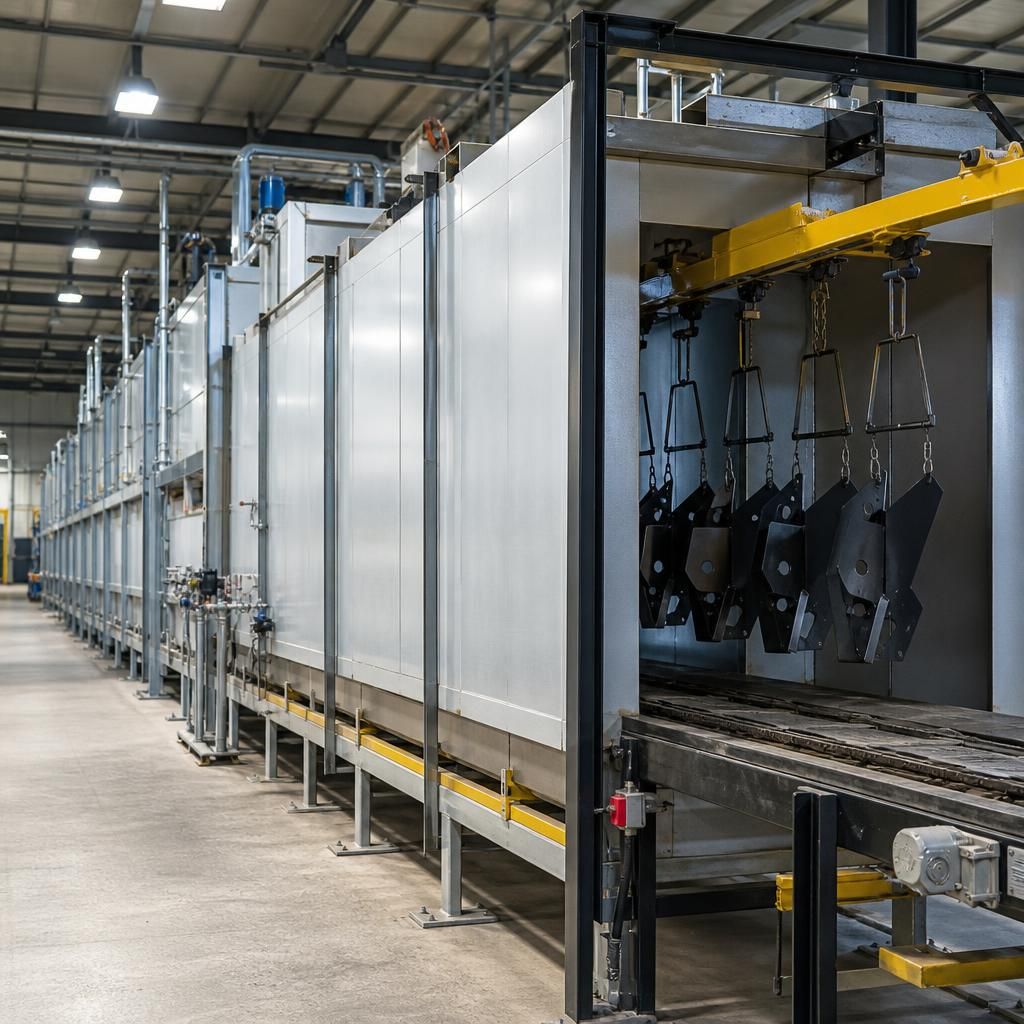
Some powder coating ovens are divided into separate thermal zones rather than operating at one uniform setting throughout. This allows the process to progress through controlled stages, such as initial heating, powder flow and final crosslinking, as components move through the chamber.
Zoned control can be useful where parts have different thermal characteristics or where a conveyor line needs a gradual temperature transition. Each zone must still be assessed against the actual component temperature and coating specification: changing zone settings or loading patterns can alter the curing profile, even when the conveyor speed remains unchanged.