

What are the common issues faced during the powder coating curing process, and how can they be prevented?
Common powder coating curing issues include under-curing, over-curing, uneven heating, contamination and incorrect film thickness, which can cause poor adhesion, colour variation, brittleness or loss of gloss. Prevent them by following the powder manufacturer’s time-and-temperature requirements, verifying the workpiece temperature rather than relying only on air temperature, maintaining consistent oven airflow and cleaning and preparing components correctly.
Powder coating curing problems usually arise when the coating, substrate and oven cycle are not matched. The most effective prevention is to control the complete process: confirm the powder’s curing window, understand how the component absorbs heat, validate the oven profile for each product family and investigate defects systematically rather than changing several settings at once.
Outgassing, pinholes and blistering are common on castings, porous metals, galvanised parts, welds and components with cavities. Air, moisture, oil or other volatile material can expand as the metal heats and escape through the coating. This may leave small holes, bubbles or raised blisters even when the powder appears to have flowed correctly. Prevention measures include:
- Allowing porous or heavily welded components to release trapped gases before the final coating cycle, using a controlled preheat or trial process where appropriate.
- Ensuring parts are completely dry before coating and avoiding designs that trap liquid in seams, folds or blind cavities.
- Providing suitable venting or drainage on enclosed fabrications where the design permits.
- Using a powder system suitable for the substrate and accepting that some porous materials may require a specified degassing approach.
Where outgassing is suspected, compare a test panel or preheated component with an untreated sample. If the defect reduces after preheating, the substrate rather than the oven setting is likely to be the principal cause.
Poor flow and orange peel occur when the powder does not form a smooth film before it gels, or when the coating chemistry and thermal cycle are unsuitable for the required appearance. Surface texture can also become more noticeable on broad, highly visible panels. To reduce this risk, use the correct powder grade for the finish required, keep the deposited coating within the supplier’s recommended range and avoid mixing powders with different cure chemistries in the same production cycle. A controlled trial on the actual component is more reliable than judging suitability from a small flat test panel alone.
Gloss loss, yellowing and embrittlement indicate that the coating has experienced excessive thermal exposure or an unsuitable heating profile. These effects can result from an unnecessarily long dwell, repeated heating, local hot spots or a product being processed to a schedule intended for a different powder chemistry. Prevention involves matching the full cycle to the powder technical data, separating products with materially different requirements and checking whether slow-heating components remain in the oven after the coating has already reached its required cure. Any change to oven temperature, conveyor speed, batch size or loading pattern should be followed by a profile check.
Inconsistent results between batches often result from changes in component mass, loading density, rack position or the time taken for parts to reach their process condition. A lightly loaded oven and a densely loaded oven do not necessarily produce the same thermal history. Establish repeatable loading arrangements, keep parts adequately spaced and record the product type, rack configuration and cycle settings for each run. Large fabrications and mixed loads should be assessed separately from small, lightweight components rather than treated as interchangeable.
Incorrect dwell time can occur when the conveyor speed or batch cycle is measured from the oven entrance instead of from the point at which the coated metal reaches the required curing condition. The stated cure schedule normally relates to the coating and substrate reaching the required combination of temperature and time, not simply to the duration that a part spends inside the oven. Confirm the effective dwell for representative parts, including the heaviest or most thermally demanding components, and repeat the assessment after process changes.
Oven measurement errors can conceal the real cause of a curing defect. Sensors may drift, be positioned where they do not represent the useful working zone or display air conditions that differ from those experienced by the component. Use calibrated instruments, maintain a record of checks and carry out periodic temperature profiling at relevant positions in the oven. Profiling should include different load conditions so that dead zones, overshoot and recovery behaviour are identified before they create a production problem.
Powder condition can also affect curing performance. Moisture absorption, contamination from incompatible material and storage outside the powder supplier’s specified conditions may alter application and flow characteristics. Store powder in its original sealed packaging under the recommended conditions, rotate stock appropriately and keep reclaimed material controlled and traceable. Do not assume that a change in cure settings will correct powder that has deteriorated or become contaminated.
A practical investigation should begin by recording the defect’s location, appearance, component material, powder identification, batch or load arrangement and complete oven cycle. Compare a defective part with a correctly finished sample, then change one factor at a time. Useful checks may include coating appearance, cure verification, substrate condition, powder storage history and oven profile data. This approach distinguishes a true curing fault from defects introduced during design, preparation, application or handling, and provides a repeatable basis for corrective action.
For industrial work, written process sheets should specify the approved powder system, component loading method, cycle parameters, inspection points and action to take when a result falls outside the agreed standard. Where a component is unusually large, porous, thick, enclosed or made from a heat-sensitive material, a trial run is advisable before committing a full batch.
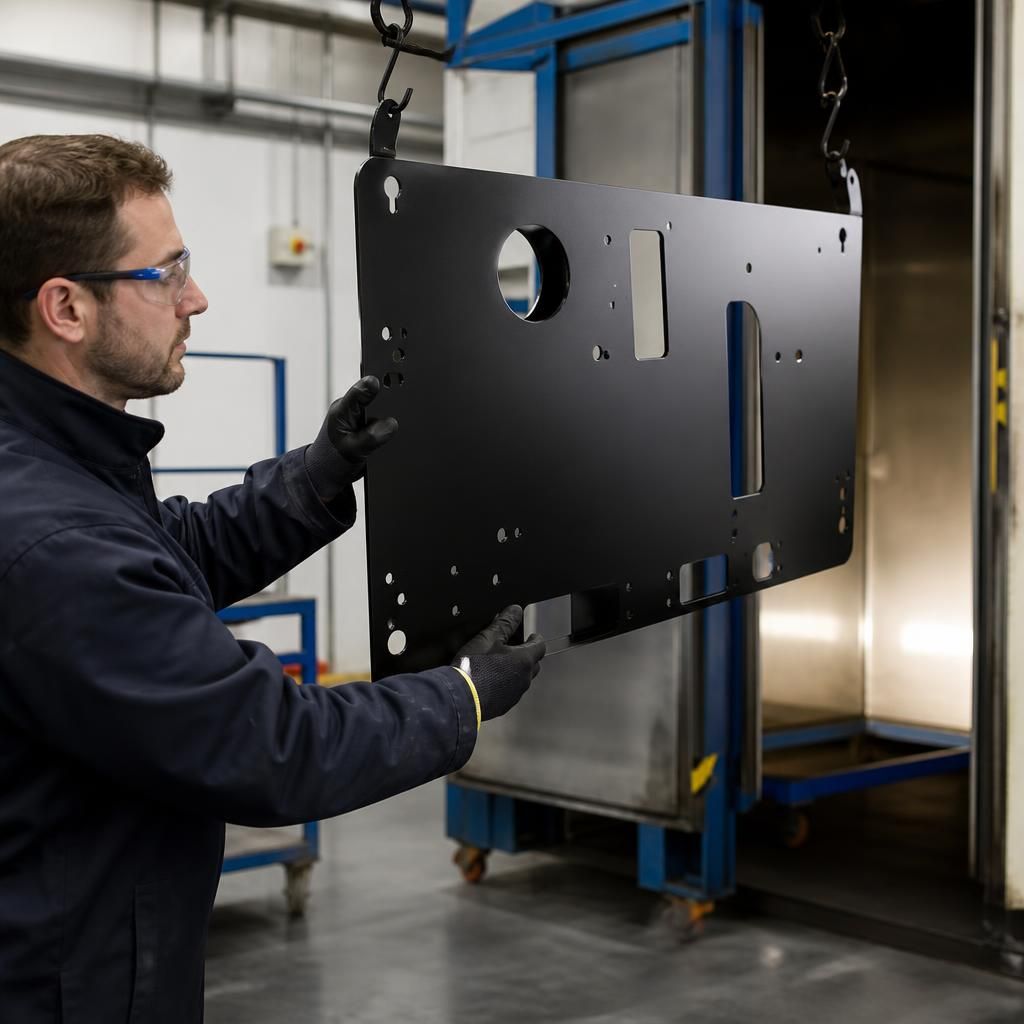
Handling a component before the coating has cooled sufficiently can create marks, imprints or local loss of gloss that may be mistaken for a curing fault. A film can remain softer immediately after leaving the oven because it is still hot, even when the powder has completed its required cure.
Prevent handling-related defects by supporting parts at suitable contact points, avoiding contact between coated faces and allowing residual heat to dissipate before stacking or wrapping. If a finish appears soft after cooling, assess its cure using the powder supplier’s recommended method rather than judging it while the component is still hot. This helps separate genuine under-cure from damage introduced during unloading, inspection or packaging.