

How do I determine the appropriate curing time for different powder coatings in my industrial paint curing ovens?
Determine the curing time from the powder manufacturer’s technical data sheet, using the specified metal temperature and coating type rather than relying only on the oven air temperature or a fixed timer. Confirm that the thickest or most heat-absorbing part reaches the required temperature, then validate the result through checks such as coating appearance, adhesion and hardness.
The appropriate curing time is the period for which the coating remains at its specified cure temperature, after the coated metal has reached that temperature. Establish it by combining the powder’s technical data with a measured oven profile, the part’s thermal characteristics and checks on the finished film.
Start with the coating supplier’s cure schedule
Technical data sheets normally provide a cure window rather than a single universal setting. This may be expressed as a minimum metal temperature with a corresponding time, or as alternative temperature-and-time combinations. Use the schedule for the exact powder formulation, finish and colour being applied. Do not transfer a setting from one product family to another simply because both coatings are applied in the same oven.
Record the required metal temperature, minimum dwell period, permitted upper temperature and any restrictions relating to recoatability, gloss or appearance. Where the data sheet gives more than one cure option, the selection should reflect the component, oven capability, production volume and acceptable risk of thermal damage.
Measure the part rather than relying on the oven display
An oven controller indicates the air temperature at its sensor location. It does not confirm the temperature of every component moving through the oven. Use a temperature profiler or suitable data-logging system to attach probes to representative areas of the load, including heavy sections, joints, enclosed areas and locations close to the edge of a rack.
The profile should show the time taken for each area to reach the required metal temperature and the time it remains there. This distinguishes true curing time from the total time spent in the oven. If a thick bracket takes longer to heat than a thin panel, the line speed or dwell must be based on the bracket if both are processed together.
Allow for component design and loading
Metal thickness, material type, folded sections, welds, cavities and the way parts are hung all affect heat transfer. Closely packed loads can shield surfaces from circulating air and extend the heat-up period. Large assemblies may also create differences between exposed edges and insulated internal areas.
For a mixed batch, identify the slowest-heating component and profile it during a representative, normally loaded run. Avoid setting the process only from a lightweight test panel, as this can make the apparent cure time unsuitable for heavier production parts. If the load changes significantly, repeat the assessment rather than assuming the previous setting remains valid.
Account for coating formulation and film build
Different thermoset powder formulations can have different cure responses. Film thickness also matters: an unusually heavy film may affect appearance and performance even when the metal has followed the nominal temperature schedule. Excessive build can result from poor application settings, unsuitable gun positioning, difficult geometries or powder accumulation in recesses.
Keep the applied film within the product specification and investigate readings outside that range before changing the oven cycle. Increasing temperature or dwell to compensate for excessive build may create overbaking, colour change, loss of gloss or embrittlement rather than solving the underlying application problem.
Use a controlled validation process
- Identify the exact powder product, colour, finish and required cure schedule.
- Choose representative parts, including the greatest thermal mass and the most difficult geometry in the load.
- Attach temperature probes securely to critical areas and run the oven at normal loading conditions.
- Compare the recorded metal-temperature profile with the specified cure window.
- Inspect the coated parts and carry out relevant quality tests before approving the setting for production.
Keep the profile, load description, oven settings and inspection results as part of the process record. This makes it easier to distinguish a curing problem from an application, preparation or contamination problem when results change later.
Check the finished coating
A suitable cure should produce the appearance and mechanical properties specified for the powder. Depending on the application, checks may include visual inspection for colour and gloss, dry-film thickness, adhesion, hardness, flexibility and resistance to the chemicals or conditions expected in service. Use the test method and acceptance criteria appropriate to the coating specification rather than treating one inspection as proof of every property.
Under-cure may be indicated by poor adhesion, inadequate hardness or weak resistance to the intended service environment. Over-cure can present as colour or gloss variation, brittleness or other appearance changes. These symptoms are not conclusive on their own, so compare them with the temperature profile and application records before altering the cycle.
Recheck after process changes
Repeat profiling when the oven is adjusted, parts are redesigned, the loading pattern changes, the conveyor speed is altered or a different powder formulation is introduced. Burner performance, airflow, insulation condition and sensor position can also influence the relationship between the displayed oven temperature and the actual part temperature.
A reliable curing time is therefore a validated production setting, not a fixed number copied from another line. The most defensible setting is one supported by the coating data sheet, a measured profile on representative parts and documented checks on the resulting film.
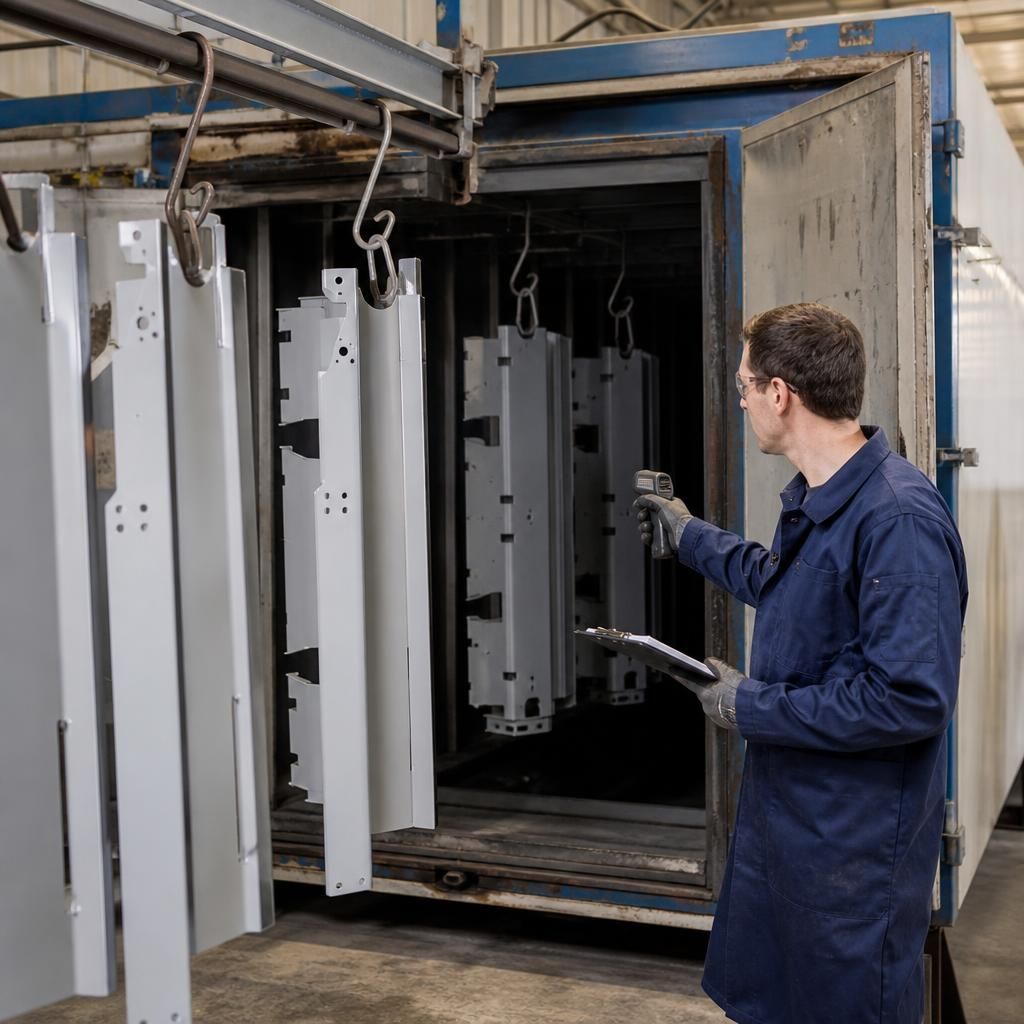
Nylon and other thermoplastic powders should not be assigned a curing time using the same logic as a thermoset powder. They melt and form a film through heating rather than relying on the same cross-linking reaction, so the relevant process conditions may include substrate preheating, powder melting, film flow and cooling.
For these coatings, use the product-specific processing instructions to establish:
- the required metal temperature before or during application;
- the heating conditions needed to melt and level the powder;
- the required film build and appearance criteria; and
- the cooling or handling conditions needed to prevent damage to the finished coating.
Do not extend a thermoset oven cycle simply because the powder has not been exposed to the same dwell time. Excessive heat can affect the substrate or coating appearance without improving performance. The correct cycle is the one that achieves the specified film characteristics for that particular powder technology.
Discuss your powder coating curing requirements
Discuss your powder coating curing requirements with our team to identify the appropriate process for your components, coating formulation and production requirements. Collection and delivery options are available for businesses across the Midlands and surrounding areas.