

What specific considerations should be made when selecting between epoxy and zinc primers for different industrial metal substrates?
Select epoxy primers for strong adhesion, chemical resistance and barrier protection where the substrate and service conditions suit them; choose zinc primers primarily for ferrous steel when galvanic, sacrificial protection is required. Check whether the metal is bare steel, galvanised steel, aluminium or another alloy, then confirm surface preparation, primer compatibility, operating environment and the intended topcoat before specifying the system.
The choice between an epoxy primer and a zinc primer should be based on the substrate’s electrochemical behaviour, the coating system required and the conditions the finished component will face. Epoxy is generally selected where adhesion, barrier protection and resistance to chemicals are the priority; a zinc-rich primer is more appropriate for prepared carbon or low-alloy steel where sacrificial protection can limit corrosion at exposed areas.
First identify what “zinc primer” means. The term may refer to a zinc-rich primer containing metallic zinc, or to a zinc phosphate primer in which zinc phosphate acts as a corrosion-inhibiting pigment. These products do not perform in the same way. Metallic zinc-rich primers can provide cathodic, or sacrificial, protection to ferrous steel when there is sufficient electrical contact between the zinc and the steel. Zinc phosphate primers are primarily barrier and inhibitive coatings. They may be easier to incorporate into a conventional paint or powder-coating system, but they should not automatically be treated as an equivalent to a zinc-rich system.
Carbon and low-alloy steel are the substrates most commonly considered for zinc-rich protection. This option can be valuable where the component may suffer small scratches, edge damage or local coating breakdown, because the zinc can corrode preferentially to the underlying steel. The specification must still account for the zinc content after curing, electrical continuity and the compatibility of the selected topcoat. An epoxy primer may be preferable where the steel will be exposed mainly to chemicals, moisture or abrasion and the design does not require sacrificial action. In many systems, zinc-rich primer and epoxy topcoat are combined, provided the products are designed to work together.
Galvanised steel requires a different assessment. It already has a zinc coating, so applying another zinc-rich primer is not automatically beneficial. The existing galvanising may be damaged, weathered, contaminated or affected by storage conditions, and the new coating must bond to that surface without causing adhesion failure. An epoxy-based adhesion-promoting or barrier system may be more suitable, subject to the condition and chemistry of the galvanised layer. The specification should also consider whether the component will be bent, drilled or cut after coating, as these operations can expose the underlying steel and require suitable local treatment.
Aluminium and its alloys should not normally be approached as if they were steel. Zinc-rich primers are designed principally around the protection of ferrous substrates. Direct contact between dissimilar metals in the presence of moisture can create galvanic effects, particularly at joints, fasteners and damaged areas. For aluminium, the more relevant questions are whether the primer can bond to the naturally forming oxide layer, whether it tolerates the alloy’s surface condition and whether it remains compatible with any conversion treatment or topcoat. An epoxy system formulated and approved for aluminium may therefore be the safer selection than a conventional zinc-rich product.
Stainless steel, copper, brass and other non-ferrous alloys also need product-specific consideration. Their corrosion mechanisms differ from those of mild steel, and a zinc primer may add complexity without providing its intended sacrificial benefit. Stainless steel, for example, can lose corrosion resistance if its surface becomes contaminated with ordinary steel particles during handling or preparation. Copper and brass may require a coating selected for adhesion and resistance to their particular surface chemistry. When the substrate is an unusual alloy, confirm compatibility with the coating manufacturer or the appointed coating specialist rather than relying on the generic product name.
Consider the component’s geometry as well as its material. Zinc-rich primers can be more difficult to specify on narrow edges, internal corners, holes and enclosed sections because the required film formation and electrical contact may vary across the part. Welds and heat-affected zones can also behave differently from the surrounding parent metal. Epoxy systems may offer more consistent barrier coverage in some complex geometries, but excessive film thickness, trapped solvent or poor access can create their own defects. The coating schedule should state how edges, welds, bolted connections and repaired areas are to be treated.
Service conditions can change the preferred option:
- Atmospheric exposure: either system may be suitable, but the risk category, moisture, pollutants and expected coating damage should determine the specification.
- Immersion or persistent condensation: check the primer’s immersion rating, cure requirements and topcoat compatibility. A product suitable for sheltered steel is not automatically suitable for continuous wet service.
- Chemical exposure: epoxy is often considered where resistance to oils, solvents or process chemicals is important, but resistance depends on the specific chemical, concentration, temperature and exposure time.
- High temperatures: verify the cured system’s temperature limits. Heat can reduce flexibility, alter adhesion and affect the performance of both the primer and topcoat.
- Abrasion and impact: assess the complete system rather than the primer alone. A sacrificial zinc layer does not remove the need for a mechanically suitable topcoat.
- Repairable structures: zinc-rich protection may be useful where small areas of steel could become exposed in service, whereas epoxy may be selected where easy recoating and chemical resistance are more important.
Electrical continuity is a decisive technical issue for zinc-rich primers. The zinc particles must be sufficiently connected within the cured film and in contact with the steel for sacrificial protection to operate. A thick insulating layer between the steel and the zinc-rich primer can prevent the intended electrochemical action. Conversely, a zinc-rich layer should not be assumed to protect adjacent aluminium, stainless steel or other dissimilar metals simply because they are part of the same assembly.
The intended topcoat must be assessed at the same time as the primer. Some zinc-rich products require a particular intermediate coat to prevent bubbling, pinholing or poor intercoat adhesion. Epoxy primers may be overcoated with epoxy, polyurethane or powder systems only where the complete coating schedule permits it. Recoating intervals, curing temperature, film thickness and the possibility of solvent entrapment all influence the result. For components destined for powder coating, the primer must be suitable for the curing cycle and for the chosen powder, rather than being selected solely on its corrosion-inhibiting name.
Specification and testing should resolve uncertainty. For a mixed batch of components, record the substrate grade, existing surface treatment, service environment, required appearance and proposed topcoat before choosing the primer. Where adhesion or compatibility is uncertain, a trial panel or representative sample can be used to check application, curing, intercoat adhesion and coating appearance. Relevant inspection may include visual checks, dry-film thickness measurements, adhesion testing and examination of edges, welds and repaired areas.
In practical terms, choose a zinc-rich primer when sacrificial protection of suitable ferrous steel is central to the design and the complete system can preserve electrical contact and topcoat compatibility. Choose an epoxy primer when the main requirement is a strongly bonded, chemically resistant barrier, particularly on a substrate or assembly where metallic zinc would not provide its intended benefit. For galvanised, aluminium, stainless or mixed-metal components, the substrate-specific compatibility assessment should come before the generic choice of primer.
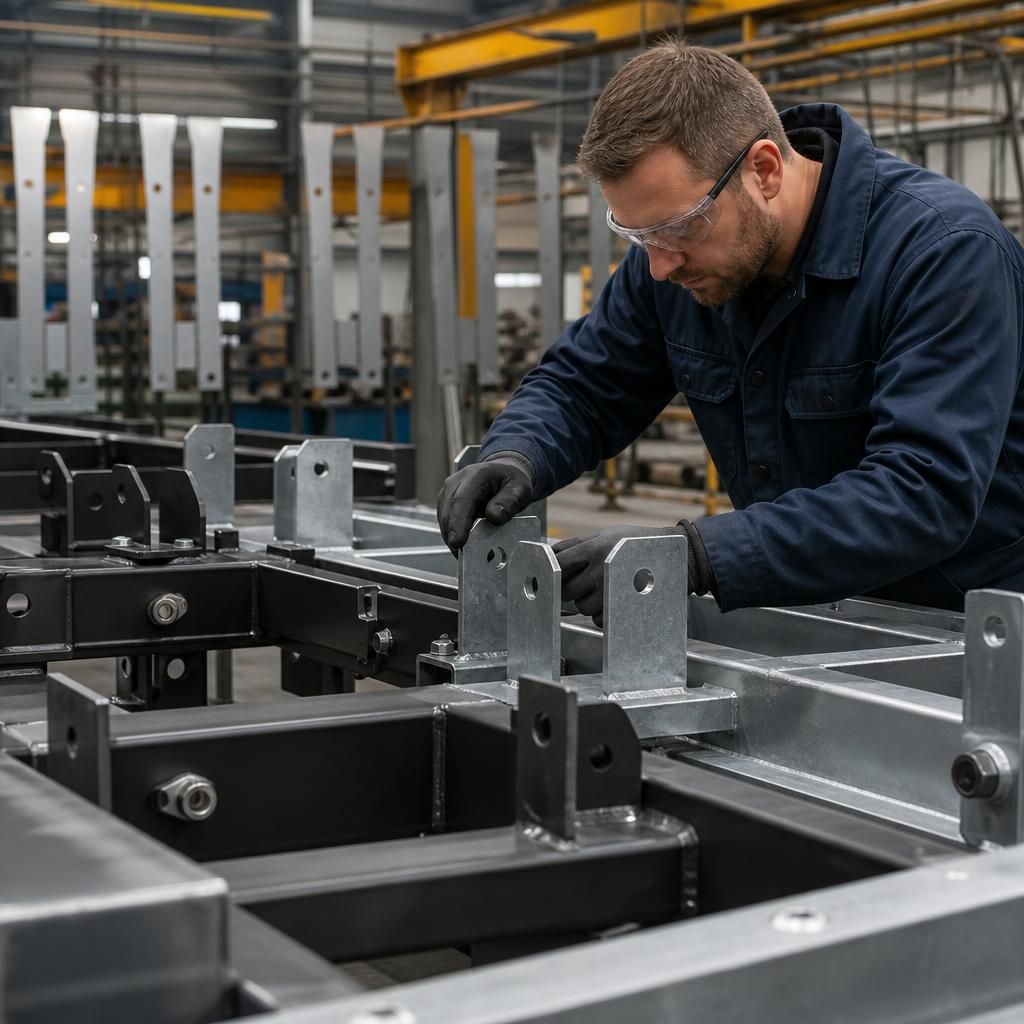
For assemblies made from more than one metal, primer selection should be coordinated with the fabrication sequence rather than decided from the dominant substrate alone. Steel, galvanised parts and aluminium sections may need different compatible coating treatments, particularly where welding, drilling, cutting or forming will expose untreated metal or alter an existing surface.
Specify the coating sequence before fabrication is complete. Identify which surfaces must remain accessible, whether components will be coated separately or after assembly, and how exposed edges, welds, fasteners and later repairs will be treated. This prevents a suitable primer on one substrate from creating adhesion, access or corrosion-control problems at the interfaces with another.