

How do anti-corrosion epoxy and zinc preps fare in cost-effectiveness compared to traditional protective coatings for industrial applications?
Anti-corrosion epoxy and zinc preps can be more cost-effective than traditional protective coatings where the added preparation and application cost is justified by the required corrosion resistance and service conditions. Their overall value depends on factors including the metal substrate, exposure environment, coating specification, batch size and likely maintenance requirements, so the lowest initial price is not always the lowest lifetime cost.
Anti-corrosion epoxy and zinc preparations are cost-effective when they reduce the frequency, extent or disruption of future corrosion repairs sufficiently to justify their additional coating-stage cost. Epoxy primers provide a strongly adherent, chemically resistant foundation, while zinc-based preparations can improve corrosion protection through inhibitive or, in the case of suitable zinc-rich systems, sacrificial action. Their value therefore needs to be assessed across the expected service life of the component rather than by comparing preparation prices alone.
Where the additional cost comes from
Compared with a conventional single-coat protective finish, a system incorporating epoxy or zinc preparation may involve more than one coating stage. The cost can include:
- degreasing, abrasive cleaning or other substrate preparation;
- primer material and its application;
- curing, handling and inspection between coating stages;
- masking of areas that must remain uncoated;
- additional specification, testing or film-thickness checks; and
- the logistics of processing components through a multi-stage coating system.
These costs are most significant where parts are small, quantities are low, access is straightforward and the operating environment is relatively mild. In those circumstances, a simpler traditional coating may provide sufficient protection without the extra process complexity.
Why lifecycle cost can favour epoxy and zinc systems
The financial advantage becomes clearer when corrosion would create costs beyond the coating itself. Rust-related expenditure may include removing components, cleaning and re-preparing the surface, replacing damaged metal, isolating equipment, repainting surrounding areas and managing production interruption. A correctly specified primer system can help preserve the substrate and extend the interval before remedial work is required.
Epoxy primers are particularly useful where adhesion, chemical resistance and barrier protection are important. They can form a dense layer that limits the movement of moisture and contaminants towards the metal. Zinc preparations may be selected where the specification calls for additional corrosion control at localised defects or on exposed steel, although the exact mechanism depends on whether the product is zinc phosphate-based or zinc-rich. Zinc phosphate is generally an inhibitive pigment within a primer; it should not automatically be treated as equivalent to a metallic zinc sacrificial coating.
This distinction matters economically. Selecting a zinc-rich system where a zinc phosphate epoxy is intended, or choosing either without considering the topcoat and exposure conditions, can add cost without delivering the expected service benefit. Conversely, using an under-specified coating in a demanding environment can lead to early failure and a much higher total cost.
Comparison with common traditional options
Traditional protective coatings are not a single category. A direct-to-metal powder coating, a conventional wet-paint system and a basic primer-plus-topcoat arrangement have different material, labour and performance characteristics. A fair comparison should therefore examine the complete specified system rather than treating every non-epoxy coating as identical.
- Direct-to-metal powder coating: this may be economical where the substrate can be thoroughly prepared, the component can tolerate the curing process and the environment is not unusually aggressive. It may be less forgiving where corrosion is already present, where sharp edges and joints are difficult to protect, or where the specification requires a dedicated anti-corrosion primer.
- Conventional wet paint: this can offer flexibility for large, fixed or heat-sensitive items and may have a lower initial process cost in some applications. Its value depends heavily on surface preparation, application control, drying or curing conditions and the number of coats required.
- Basic primer and topcoat systems: these can be suitable for moderate exposure when the products are compatible and the preparation standard is maintained. An epoxy or zinc preparation may be preferable when stronger adhesion, greater chemical resistance or more robust corrosion control is required.
There is no universal cost winner. A lower-cost coating can be the better choice when its performance matches the environment and the planned maintenance regime. A higher-specification system can be the more economical option when access for future repair is difficult or failure would affect an expensive assembly.
Factors that determine the return on the coating investment
The most useful assessment considers the following points together:
- Exposure: humidity, condensation, salt contamination, chemicals, abrasion and outdoor weathering all influence the protection required.
- Substrate condition: new, clean steel is different from previously coated or corroded metal. Existing contamination, mill scale and embedded rust can undermine even a high-performance primer.
- Component design: crevices, overlaps, welds, recesses and sharp edges can increase the risk of premature breakdown and may require particular preparation or detailing.
- Service and access: components that are difficult to remove or located within operational plant often justify more preventative protection than easily accessible parts.
- Finish compatibility: the primer, intermediate layer and topcoat must be chemically and mechanically compatible. A robust primer cannot compensate for an unsuitable finishing layer.
- Production quantities: repeat batches can make a controlled multi-stage process more economical because set-up, handling and inspection activities are distributed across more components.
- Dimensional requirements: coating thickness can affect fits, threads, mating faces and moving parts. Masking or post-coating machining may alter the cost comparison.
How to make a meaningful cost comparison
Request a comparison based on the complete coating specification. It should identify the preparation standard, primer type, number of coats, target film thickness, curing requirements, topcoat, inspection arrangements and any masking or special handling. Material cost alone can be misleading because labour, preparation and rework often form a substantial part of the total.
It is also useful to separate predictable planned maintenance from unplanned corrosion repair. A coating that costs more to apply but allows inspections and recoating to be scheduled may be financially preferable to a cheaper finish that fails unpredictably. The assessment should include the cost of removing the part from service, transporting it for repair, cleaning the affected surface and checking whether corrosion has damaged the underlying metal.
For industrial metal components, epoxy and zinc preparations are therefore best viewed as risk-management measures as well as coating materials. They are most likely to offer better value where corrosion consequences are significant, the operating environment is demanding, or future access is restricted. Where exposure is modest and maintenance is simple, a traditional protective coating may remain the more proportionate choice. The correct decision comes from matching the preparation and coating system to the substrate, exposure and required service life, then comparing the full installed and maintenance cost rather than the initial application price.
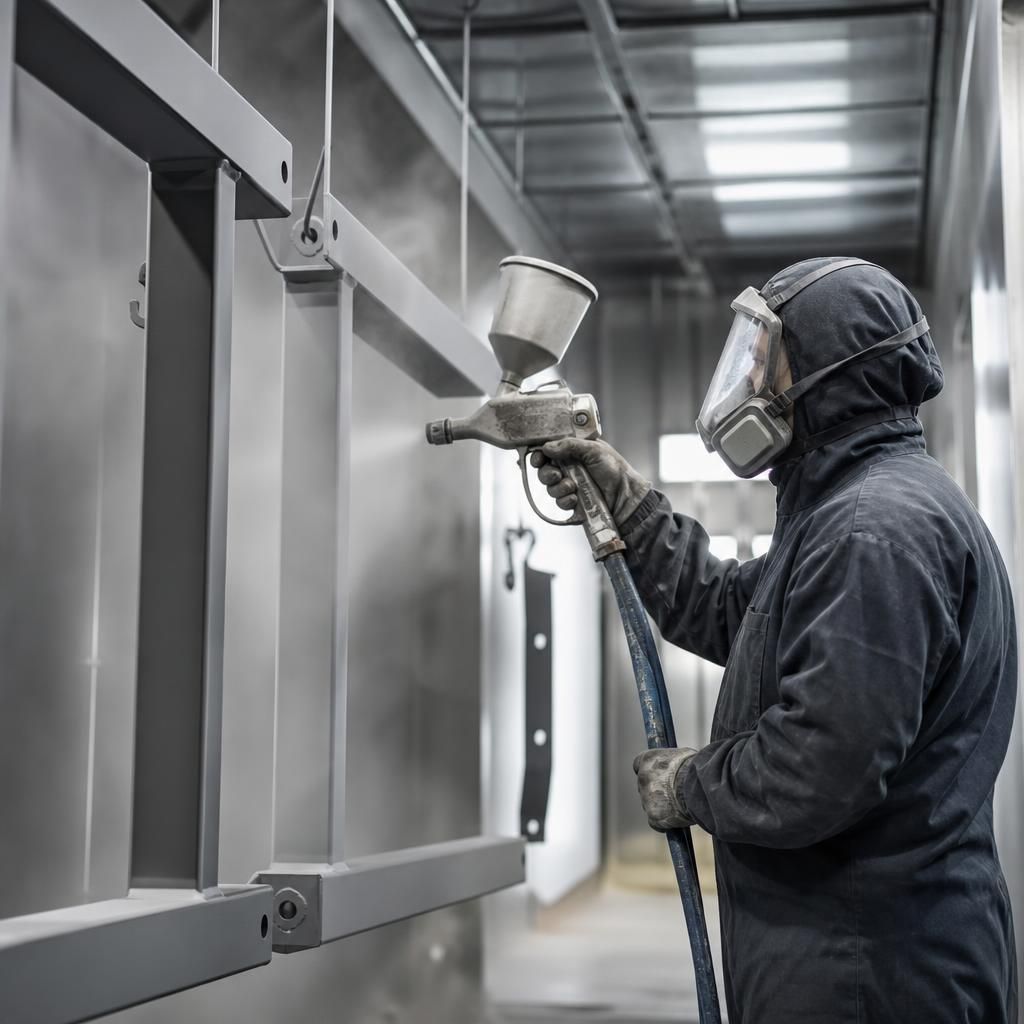
The cost-effectiveness of a zinc preparation depends on selecting the right type for the required protection. Zinc phosphate in an epoxy primer provides inhibitive corrosion control within a bonded primer film, whereas a zinc-rich system relies on a high level of metallic zinc and suitable electrical contact with the steel. These are different technologies, so treating them as interchangeable can result in unnecessary material and application costs.
A like-for-like assessment should therefore compare the protection mechanism, compatibility with the finishing coat and the exposure conditions, not simply the price per unit of primer. Correct specification can prevent over-engineering in moderate environments while avoiding an economical-looking system that requires premature remedial work.
Assess Your Anti-Corrosion Epoxy and Zinc Prep Options
Discuss your component requirements with the powder-coating.co.uk team to assess whether an epoxy or zinc preparation is proportionate to the substrate, exposure and intended service life. Provide details of the parts, quantities and operating conditions so the coating specification can be evaluated against the likely maintenance demands.