

What are the cost implications and value-for-money considerations for aluminium powder coating services?
The cost of aluminium powder coating depends on factors such as component size and shape, order quantity, surface preparation, coating specification and collection or delivery requirements. Its value comes from applying a durable, protective finish that can extend the useful life of aluminium components and reduce the need for frequent recoating or maintenance.
The cost of aluminium powder coating is best assessed as a combination of processing cost, specification requirements and whole-life value. A low initial price may not represent good value if the finish is unsuitable for the environment, requires rework or fails to meet the component’s appearance and performance requirements.
What a quotation normally covers
The quoted price may include job assessment, preparation of the aluminium, masking, racking, powder application, curing, inspection and handling. Each stage can affect the amount of labour, equipment time and consumables required. Components that need particular care during loading, have areas that must remain uncoated or require a defined cosmetic standard may involve more production attention than straightforward parts.
Aluminium can also require specific preparation to support adhesion and coating performance. Existing finishes, contamination, oxidation, weld areas, sharp edges and trapped residues may affect the work required before powder is applied. If a component needs additional preparation or remedial work, this should be identified before the final price is agreed.
How production requirements influence cost
- Part geometry: Complex shapes, recesses, internal faces and delicate sections can take longer to rack, coat and inspect than simple profiles or flat items.
- Masking and protection: Threads, contact faces, bores and other functional areas may need masking. The amount and type of masking required affects preparation time and consumable use.
- Finish specification: Smooth, textured, metallic, matt and gloss finishes can have different application and inspection requirements. A tightly controlled decorative finish may require more checking than a general-purpose industrial finish.
- Coating build: The required film thickness should suit the component and its intended use. Applying more powder than necessary does not automatically improve performance and can affect fit, appearance and cost.
- Colour changes and scheduling: Where several colours or powders are involved, equipment cleaning and production separation may add handling requirements. Grouping compatible work can help make processing more efficient, subject to the required specification.
- Packaging and transport: Finished aluminium parts may need protective packing to prevent marking, abrasion or contact damage during collection and delivery. The shape, weight and fragility of the items influence these arrangements.
Why order structure matters
Powder coating involves preparation and production set-up as well as the application of powder. For that reason, very small or irregular jobs can carry a higher processing cost per component than repeatable production work. Larger batches of consistent parts may allow preparation, racking and inspection methods to be used more efficiently, although the quoted price still depends on the actual parts and specification.
Providing accurate drawings, dimensions, photographs and details of required masking can make a quotation more reliable. It is also useful to state whether the priority is a functional protective finish, a consistent architectural appearance or a particularly demanding cosmetic standard. These requirements should not be assumed to be interchangeable.
Assessing value beyond the initial price
Value for money should be considered against the consequences of an unsuitable or inconsistent finish. Relevant questions include whether the coating is appropriate for the exposure conditions, whether it will meet the required appearance, whether coated areas will retain their dimensional function and whether the process can deliver repeatable results across the batch.
For manufactured assemblies, dimensional accuracy can be commercially important. Powder adds a measurable coating layer, so excessive build may affect tight clearances, threads, sliding fits or component assembly. A finish that meets the visual requirement but interferes with function may create additional costs through sorting, adjustment or rework.
Consistency is another part of value. Variation in colour, gloss, coverage or film build can be costly where components are installed together or supplied as part of a finished product. Inspection requirements should therefore be agreed in proportion to the application, with any acceptance criteria clearly communicated before processing.
Comparing coating options
The most economical coating is not necessarily the one with the lowest material or application cost. A standard powder may be suitable for some indoor or general industrial applications, whereas a more specialised specification may be justified where the component faces demanding conditions or requires a particular functional property. Primer systems, epoxy-based options, nylon coatings and other specialist treatments should be considered according to the substrate, exposure and performance requirement rather than selected solely on price.
Aluminium components may also have a higher or lower overall coating cost depending on their condition and design. New, clean, accessible parts are generally simpler to process than items requiring removal of an existing finish, repair or extensive masking. Discussing the component’s use and acceptance requirements at quotation stage helps avoid paying for an unnecessary specification or discovering that an inadequate one has been chosen.
Practical questions to ask when comparing quotes
- Is preparation included, and what happens if additional remedial work is found?
- Does the price include masking, racking, inspection and suitable packaging?
- What coating type, colour, texture, gloss level and film-build requirement are being priced?
- How will functional faces, threads and tolerances be protected?
- Are collection and delivery arrangements included or priced separately?
- What information is needed to confirm that the quoted specification is suitable for the component’s operating environment?
A meaningful comparison should therefore place like-for-like specifications alongside one another. The most useful measure is the total cost of receiving an acceptable, functional and consistent finish, including preparation, handling, transport and any avoidable rework, rather than the powder application charge alone.
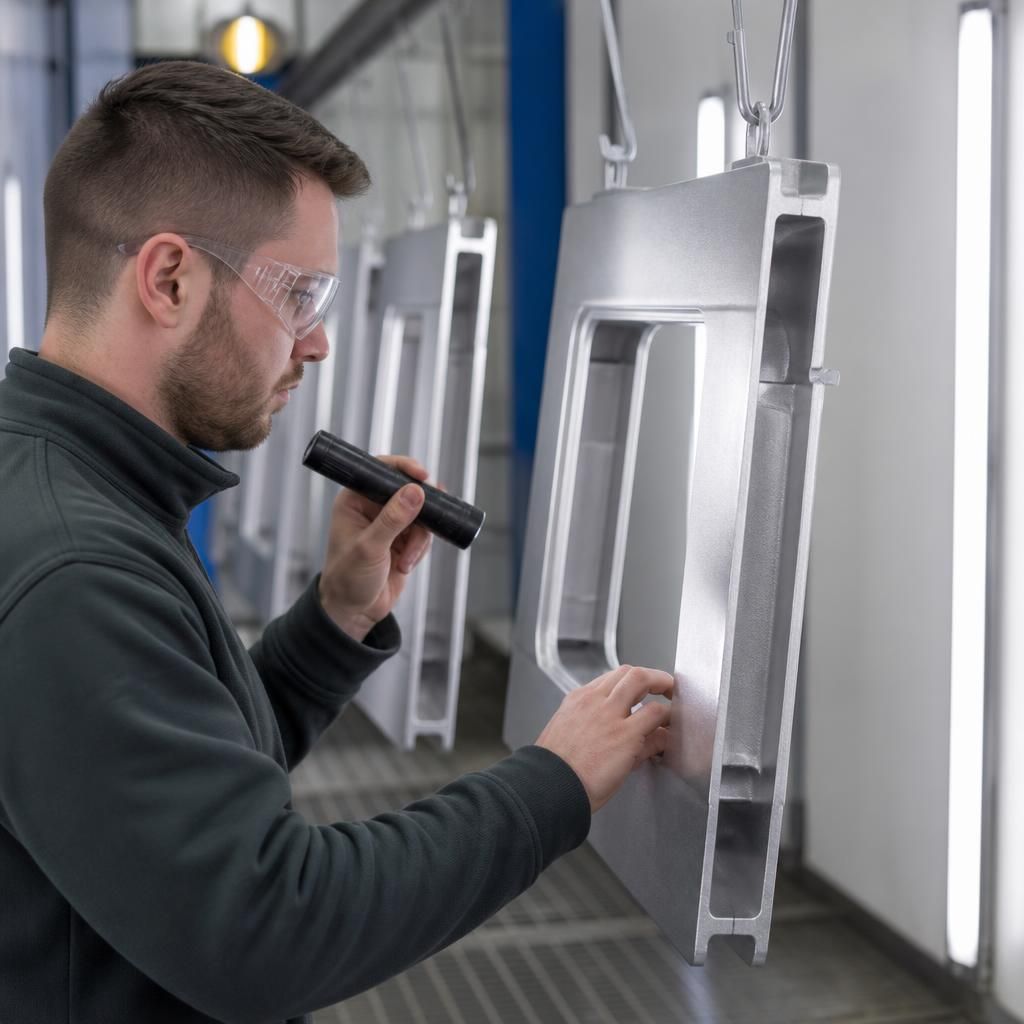
Maintenance requirements should form part of the value assessment for powder-coated aluminium, particularly where components are difficult to access or costly to remove. Before selecting a coating specification, consider how the finished parts will be cleaned, inspected and repaired in service. Include relevant labour, access equipment, removal, reinstallation and disposal costs when comparing options. A higher-specification finish is not automatically better value; the appropriate choice depends on the exposure conditions and the consequences of maintenance work. Asking for suitable care guidance and a clear approach to assessing local damage can make future maintenance costs easier to plan.