

What are the specific benefits of using zinc primer powder coating over traditional liquid primers?
Zinc primer powder coating can provide zinc-based corrosion protection alongside a tough, uniform film, while avoiding the solvent emissions associated with many traditional liquid primers. It also offers efficient application, strong adhesion when surfaces are correctly prepared and a durable foundation for subsequent powder topcoats.
Zinc primer powder coating offers several practical advantages over traditional liquid primers, particularly where manufacturers need repeatable film quality, controlled processing and a corrosion-protection layer that can withstand industrial handling. Its main distinction is that the primer is supplied as a dry powder and fused to the prepared metal substrate, rather than being deposited as a wet liquid film that must release its carrier during drying.
One important benefit is improved process consistency. Powder can be applied using controlled electrostatic equipment, allowing the coating operator to regulate gun settings, line speed and film build. This reduces variation caused by liquid primer viscosity, solvent evaporation, dilution or changes in ambient conditions. A consistent primer layer gives subsequent coating stages a more predictable surface, provided the specified curing conditions are achieved.
The dry application method can also reduce common wet-paint defects. Liquid primers may be affected by runs, sags, solvent entrapment, uneven drying and contamination during the drying stage. Powder does not form a wet film in the same way, so these particular risks are reduced. It can also be recovered from suitable application systems, which may limit material waste compared with liquid overspray. Recovered powder must still be managed according to the coating system and applicable waste controls; it is not automatically suitable for reuse.
Zinc primer powder coating can provide a form of protection that differs from a conventional organic liquid primer. When the coating system is correctly formulated, zinc particles can support sacrificial protection at exposed points in the film, while the surrounding binder helps provide a physical barrier. A standard liquid primer may rely more heavily on its barrier properties unless it is itself a zinc-rich formulation. The comparison should therefore be made between equivalent zinc-rich systems rather than between zinc powder primer and every type of liquid primer.
Powder systems can be advantageous for components that are handled, transported or assembled after coating. Once the coating has been correctly cured and cooled, there is no wet primer film requiring further air-drying or solvent release. This can simplify movement between production stages and reduce the possibility of marks caused by handling a partially dried liquid coating. The benefit depends on using the correct cure schedule for the substrate, component geometry and product specification.
There are also practical workplace and housekeeping advantages. Dry powder does not spill or drip like liquid paint, and the application area is not affected by liquid primer settling in the same way. Powder systems can reduce the need to manage liquid containers, mixing vessels and cleaning solvents. These advantages do not remove the need for suitable extraction, personal protective equipment, housekeeping and controls for airborne powder, particularly because zinc-containing materials must be handled responsibly.
For production environments, powder primer can support repeatable automated coating of batches of similar components. This is useful when parts have defined racking points, consistent geometry and a coating specification that can be validated through inspection. Liquid primers can remain preferable for some repairs, complex masking requirements, low-volume work or components that cannot tolerate the required curing temperature. Powder is not a universal replacement, and the choice should account for the metal substrate, component size, heat sensitivity, required film thickness and intended topcoat.
The quality of the result still depends on factors that apply to both technologies. Oil, rust, mill scale, moisture and residues must be removed before coating; otherwise, neither a powder primer nor a liquid primer can be expected to perform reliably. The zinc primer must also be compatible with the selected topcoat, cured within its technical limits and inspected for coverage, film build and defects. Excessive thickness, poor grounding, unsuitable masking or incorrect curing can undermine the benefits of the powder system.
In summary, the strongest case for zinc primer powder coating is its combination of controlled application, reduced wet-film defects, dry-process handling, recoverable overspray potential and zinc-assisted protection when compared with a conventional non-zinc liquid primer. It is most suitable where the component and production process can support electrostatic application and heat curing, and where the complete primer-and-topcoat system has been selected and tested as a compatible specification.
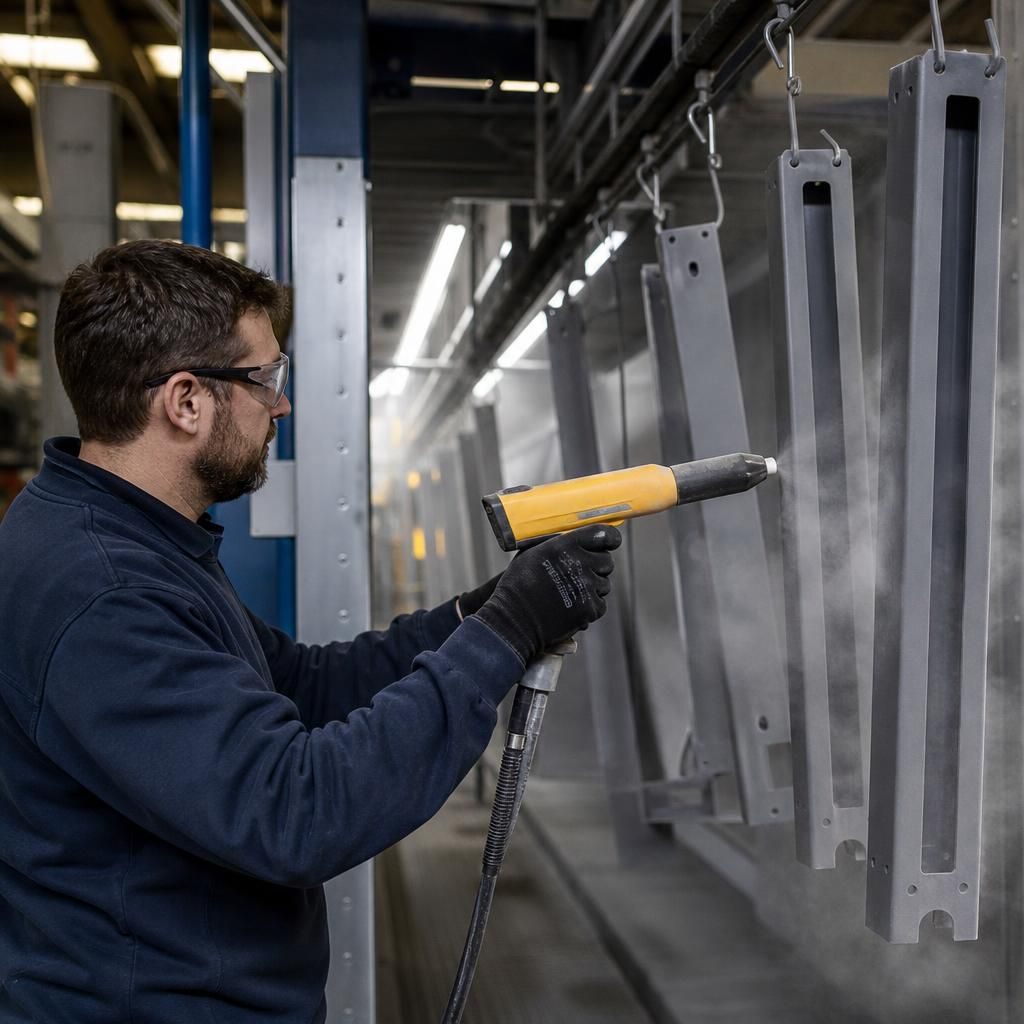
A further benefit of zinc primer powder coating is that it can provide a defined corrosion-control layer within a multi-coat specification. The primer is applied to prepared steel before the finishing coat, so the zinc-rich layer can be selected for its role beneath the topcoat rather than treated as the complete decorative finish. This helps separate the functions of each layer: the primer supports corrosion protection, while the topcoat provides the required colour, appearance and additional barrier protection.
This approach is particularly useful for fabricated parts that need a documented coating sequence. The specification can identify the required surface preparation, primer type, topcoat compatibility and curing conditions, allowing the finished system to be assessed as a complete assembly rather than judging the primer in isolation. It also makes clear why a zinc primer powder coating should be chosen as part of a tested system, not simply substituted for a liquid primer without checking the substrate, topcoat and application requirements.