

How can the application technique of zinc primer powder coating influence its effectiveness in corrosion control?
The application technique directly affects how evenly the zinc primer powder coating covers the metal and whether it develops the intended protective properties. Consistent powder deposition, adequate coverage of edges and recessed areas, and a controlled curing cycle help create a continuous primer layer that supports both barrier protection and zinc-based sacrificial corrosion control.
Application technique influences zinc primer powder coating effectiveness by determining whether the primer forms a sound, continuous and well-bonded corrosion-control layer without defects that allow moisture or contaminants to reach the metal. The result depends not only on the powder formulation, but also on how the coating is deposited, controlled during application and assessed before any subsequent topcoat is applied.
Substrate condition and electrical continuity. The metal must present a clean, suitably prepared surface, and the workpiece must be properly connected to earth during electrostatic spraying. Effective earthing allows the charged powder to transfer consistently to the component. Poor contact, contaminated hooks or excessive coating build-up on hanging equipment can reduce transfer efficiency and create areas with weak or inconsistent deposition. Contact points should therefore be planned so that they are accessible for later treatment without compromising the protected surface.
Spray-gun control. Gun-to-part distance, traverse speed, powder output and voltage or current settings should be matched to the component’s geometry and the powder manufacturer’s technical guidance. Excessive charge can make powder repel itself or accumulate unevenly, while insufficient charge can reduce transfer to the surface. Moving the gun at a steady speed and maintaining a consistent angle helps avoid stripes, heavy overlap and thin passes. Complex components may require changes in gun position rather than simply increasing powder output.
Managing difficult geometries. Recesses, internal corners, perforations and deep channels can create a Faraday-cage effect, where the electric field makes it difficult for powder to reach the most enclosed areas. A controlled approach may include reducing the electrostatic effect, adjusting the spray angle, using a suitable manual pass or applying powder to the recessed areas before coating more exposed faces. The objective is not to build excessive powder on accessible faces to compensate for areas that have received little or none.
Film build control. A zinc primer layer needs sufficient material to provide the intended barrier and zinc-based protection, but excessive build can increase the risk of cracking, solvent or gas-related defects, poor intercoat performance and curing difficulties. Operators should use a coating-thickness gauge appropriate to the substrate and coating system, checking representative areas rather than relying only on visual appearance. Readings should include flat faces, edges and geometrically challenging sections, because a visually uniform finish does not necessarily indicate uniform protection.
Powder handling and equipment condition. Moisture, contamination, incorrect storage or uncontrolled mixing of powder can affect flow, charging and the final film. Application equipment should be clean and maintained, with hoses, nozzles, filters and recovery systems checked for blockages or contamination. Where reclaimed powder is used, its suitability and permitted proportion should follow the product system’s documented requirements. Inconsistent powder feed can produce variations in film build even when the operator’s gun movement is controlled.
Application sequence for multi-coat systems. When a zinc primer is used beneath a powder topcoat, the first coat must be applied in a way that supports the next layer. The primer should not be contaminated, excessively rough or under-cured before the topcoat is added. Depending on the specified system, the primer may be partially cured or fully cured before overcoating; this is a system-specific decision rather than a universal rule. The interval between coats, surface condition and any required preparation should follow the powder supplier’s technical data and the agreed coating specification.
Curing control. Curing must be based on the metal part’s actual temperature and the powder system’s cure schedule, not simply on the oven air temperature or time spent in the oven. Thick sections may heat more slowly than thin sections, while different component sizes can experience different thermal histories in the same load. Under-curing can leave the primer with inadequate chemical and mechanical properties; excessive heat exposure can affect the binder, the zinc-containing film or the performance of a later coat. Temperature recording or profiling on representative work helps confirm that the specified cure has reached the coating itself.
Inspection after application. Effective application includes checks for visible pinholes, craters, inclusions, missed areas, excessive roughness and damage around contact points. Adhesion and thickness tests may be appropriate depending on the specification, substrate and whether the primer will be overcoated. Any repair should use a compatible method and should not simply conceal a defect that indicates a wider process problem. Particular attention is needed at welds, edges, joints and areas where handling equipment has touched the component.
For industrial parts, the most reliable technique is therefore a controlled process rather than a single spraying adjustment: prepare and earth the component correctly, set the equipment for its geometry, control powder and film build, apply the primer within the specified system, verify the cure and inspect the finished layer. These controls determine whether the zinc primer can provide consistent corrosion protection in service.
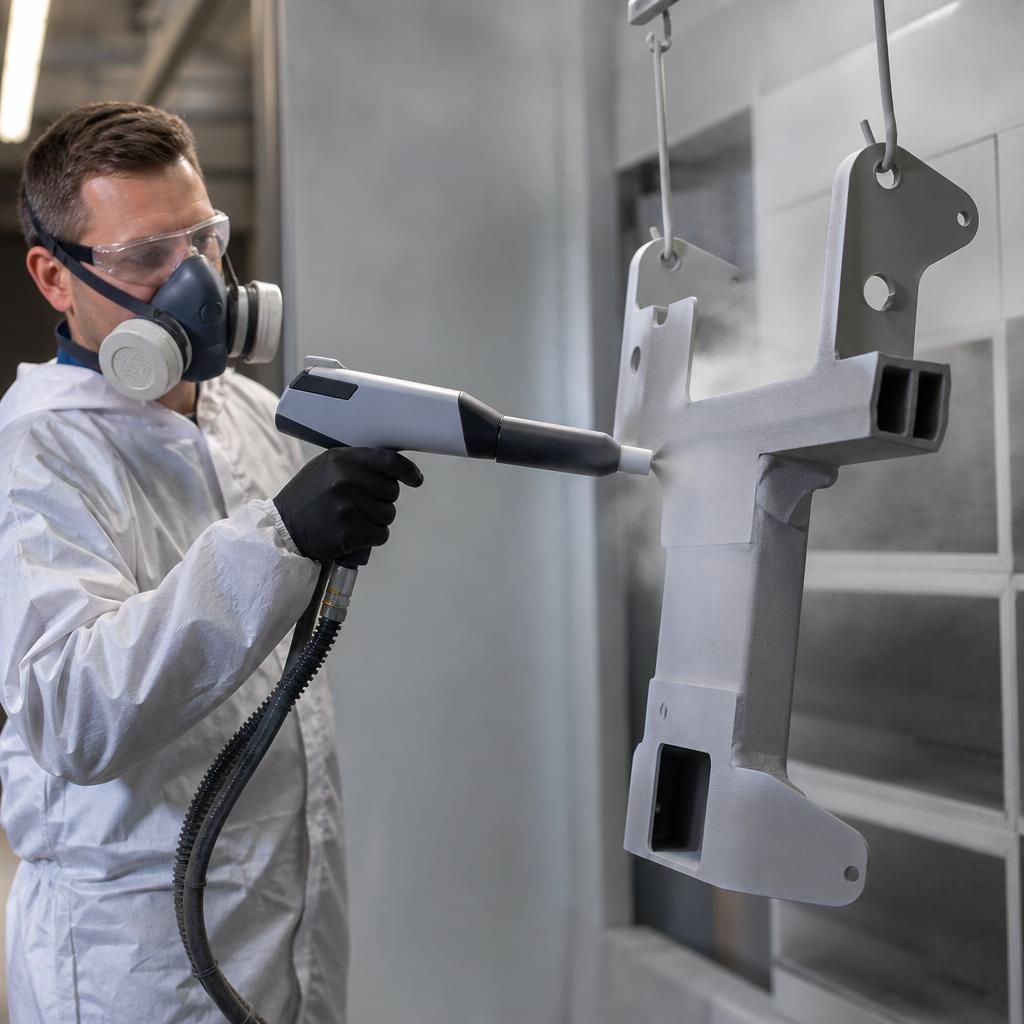
Application technique is best validated on a representative component rather than a flat test panel. A trial part reveals how the chosen spraying approach performs around the actual welds, apertures, corners and changes in section, allowing the coating process to be refined before production quantities are treated.
The trial should assess the complete zinc primer system, including the appearance and continuity of the deposited film, the condition of difficult-to-reach areas and its suitability for any specified topcoat. Recording the approved application method as part of the coating specification helps different operators reproduce the same result across a batch. This qualification step reduces the risk that a technique suited to simple panels will provide inconsistent corrosion control on more complex industrial components.
Discuss Your Zinc Primer Powder Coating Requirements
Discuss your zinc primer powder coating requirements with Powder-coatings.co.uk, including the component material, geometry, intended service environment and any specified topcoat. This information helps establish an application approach suited to the complete corrosion-control system.