

What are the key considerations when selecting between primer, epoxy, and nylon coatings for different industrial applications?
Select the coating by assessing the metal substrate, preparation requirements, exposure to moisture, chemicals and sunlight, operating temperature, expected wear, and the required finish. Primers support adhesion and corrosion control, epoxy suits applications requiring chemical and mechanical resistance, while nylon is often preferable where impact, abrasion, low friction or wear resistance are priorities.
The right choice depends on the coating’s primary job, the service conditions and the way the component will be manufactured, assembled and maintained. Primer, epoxy and nylon are not interchangeable: primer normally forms part of a wider coating system, epoxy is selected for barrier and chemical performance, while nylon is generally considered where a tough, low-friction or abrasion-resistant surface is required.
Start by defining the performance requirement. A coating specification should identify the failure it must prevent rather than simply naming a colour or resin type. Relevant requirements may include corrosion protection, resistance to oils and solvents, impact tolerance, sliding performance, electrical insulation, cleanliness, appearance or ease of release. If several requirements apply, rank them. A system that performs well in one area may involve compromises elsewhere, so the most demanding service condition should guide the selection.
Decide whether a single coating or a multi-coat system is appropriate. Primer is commonly used beneath a compatible topcoat to improve adhesion, seal the substrate and provide additional corrosion protection. It is therefore important to assess the primer and finishing coat as a complete system, including compatibility between their curing characteristics and film properties. Using a primer without confirming the intended topcoat can create adhesion, recoat or curing problems. Epoxy may be specified as a standalone coating where its barrier and chemical properties are sufficient, or as part of a system where a different outer layer is needed for appearance or service performance.
Consider how the component will be handled and assembled. Sharp edges, threaded areas, bores, slots, welds and close-fitting interfaces can affect both coverage and final tolerances. Coating build-up may need to be excluded from bearing surfaces, earth points, mating faces or threads by suitable masking. Nylon systems can be particularly relevant to components that contact other parts, but their thickness and coverage still need to be allowed for in the design. The specification should identify areas requiring masking before production rather than relying on post-coating removal.
Review the component’s geometry and size. Recesses and enclosed sections can create different coating conditions from exposed faces. Complex fabrications may also require a process that gives consistent access and coverage across the complete part. Large components, batches and mixed product sizes can influence rack positioning, handling and process control. These practical factors should be discussed before choosing a system, especially where the finish must be consistent across repeated production runs.
Match the coating to the required surface behaviour. Epoxy generally provides a hard, adherent barrier, but the finished surface may not be the best choice where repeated sliding, rubbing or direct mechanical contact dominates. Nylon can offer a resilient engineering surface with useful wear and friction characteristics, although the exact grade and application method remain important. Primer is usually chosen for what it contributes beneath the final finish rather than for exposed decorative performance. The coating should therefore be assessed against the actual contact pattern, load and movement of the part.
Account for heat and process limitations. The component must tolerate the curing conditions of the selected powder or coating system without distortion, loss of temper, dimensional change or damage to inserts and adjoining materials. Any oils, seals, adhesives, electronics or heat-sensitive components should be identified before processing. Operating temperature is also distinct from curing temperature: a part may survive the application process but still require a coating with suitable long-term thermal performance in service.
Specify appearance separately from protection. Gloss level, texture, colour consistency and visible coverage may matter in addition to technical performance. A decorative requirement should not lead to the selection of a system that is unsuitable for the working environment. Conversely, a hidden component may not need the same appearance specification as an exposed enclosure or architectural item. Where appearance is critical, agree how edges, weld areas, touch-in work and batch-to-batch variation will be judged.
Check electrical and regulatory requirements. Components used in electrical assemblies may need controlled insulation or earthing arrangements, while parts used around food, medical equipment or sensitive processes may have additional material and cleanliness requirements. These obligations can affect the permitted coating chemistry, colour, surface condition and documentation. They should be established before processing, not treated as a final inspection issue.
Assess quality requirements and verification. The specification may need to define pretreatment, coating build, cure, adhesion, visual acceptance and any relevant performance testing. For critical components, representative samples or test panels can help confirm that the proposed system is compatible with the substrate and design before a full batch is processed. Inspection should also consider areas that are difficult to coat, masked surfaces and locations where coating thickness could affect assembly.
Plan for repair and future maintenance. A coating can reduce maintenance, but damage from impact, cutting, welding or assembly may expose the substrate. The owner should know how local damage will be identified and whether repair requires removal, recoating or a compatible touch-up process. Nylon and epoxy repairs may not behave identically to the original finish, so repair compatibility should be established in the specification. Components that are difficult to remove may justify a system with a more practical inspection and repair route.
Use a structured selection process:
- Describe the component, substrate, geometry, dimensions and areas that must remain uncoated.
- Define the dominant service requirement, such as barrier protection, chemical resistance or wear performance.
- Record operating and processing temperatures, contact conditions and any regulatory constraints.
- Decide whether the requirement calls for primer and topcoat, epoxy, nylon or a combination of compatible layers.
- Confirm application, curing, masking, inspection and repair requirements with the coating provider.
- Validate the specification on representative parts or samples where the application is demanding or failure would be costly.
For manufacturers and fabricators across the Midlands, a coating specialist can help translate the component’s service conditions into a workable powder coating specification, including suitable preparation, masking and finishing arrangements. Collection and delivery options may also be relevant for larger batches or components that are impractical to transport individually, but the technical selection should remain based on the part’s function rather than the coating name alone.
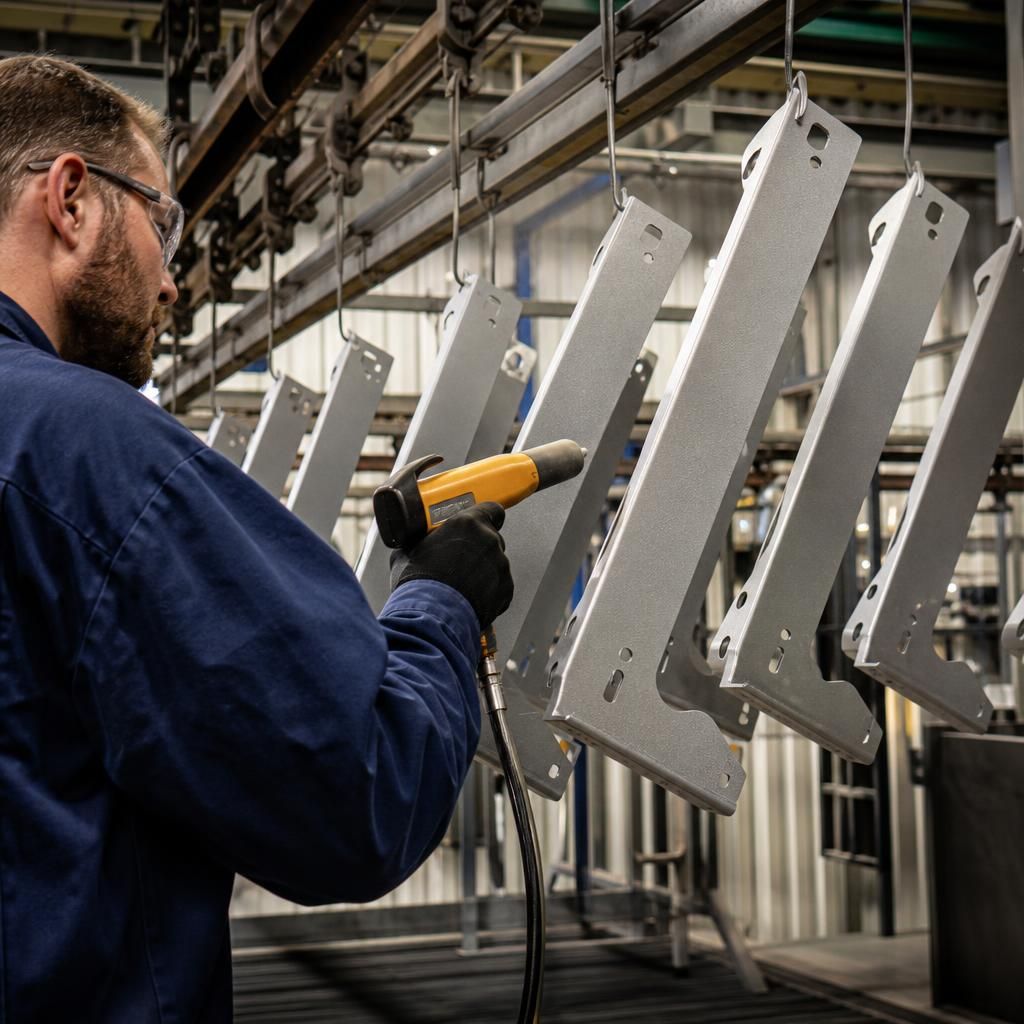
Substrate and surface preparation are decisive when choosing between primer, epoxy and nylon coatings. The same coating may perform differently on mild steel, galvanised steel, aluminium or cast components because surface chemistry, contamination, porosity and existing treatment affect adhesion and appearance.
Before selecting the coating, confirm how the metal will be cleaned and pretreated, whether weld residues or manufacturing oils are present, and whether the surface may release trapped air or contaminants during curing. A primer can improve the overall system where corrosion protection or adhesion requires additional support, but it cannot compensate for unsuitable preparation. Epoxy and nylon also depend on a clean, correctly prepared surface and a process suited to the particular substrate.
For demanding components, compare the proposed system on representative material or test panels before committing a full production batch. This can reveal adhesion, coverage, outgassing or surface-reaction issues that may not be apparent from the resin type alone.