

What are the best practices for preventing powder coat primer pinholing during application?
Prevent powder coat primer pinholing by thoroughly preparing and degassing the metal substrate, controlling powder application and avoiding excessive film thickness. Consistent oven temperature, adequate curing and checks for trapped oils, moisture or air in porous materials help prevent small holes from forming during the finish.
Preventing powder coat primer pinholing requires control of the entire coating process, not just the spray application. A consistent result depends on keeping the powder and equipment stable, ensuring the component is suitable for coating, maintaining a controlled pretreatment process and checking the finish at defined stages before production parts are released.
Control powder condition and handling. Powder that has absorbed moisture, become contaminated or partially fused in storage can produce an unstable film. Keep unopened material in the conditions specified by its technical data sheet, and protect opened boxes or bags from humid workshop air. Use clean, dry handling equipment and do not return overspray or swept-up powder to fresh material unless the powder supplier’s reclaim procedure permits it. Where the process allows reclaimed powder, control the proportion and condition consistently rather than adding it unpredictably between batches.
Screening or sieving the powder can help remove agglomerates and foreign particles that interfere with an even primer film. The screen, hopper and fluidising equipment should be cleaned between incompatible materials. Powder that is visibly lumpy, discoloured or contaminated should be isolated and assessed rather than introduced into the coating line.
Stabilise the spray equipment. Gun voltage, current, powder flow, conveying air and atomising air should be set for the component geometry and powder system. Excessive air can disturb the deposited layer or create turbulence around edges, recesses and welds; insufficient fluidisation can cause surging and an irregular deposit. Record the approved settings for each coating system so that operators are not relying on adjustment by eye alone.
Check the gun, hoses, nozzles and electrodes for wear or build-up. A damaged nozzle or dirty electrode can create an uneven electrical field, while restricted hoses can cause intermittent powder delivery. Keep the gun at a repeatable distance and angle from the workpiece, and use a suitable spray sequence for corners, returns, folded sections and recessed areas. These locations often receive a different powder deposit from broad, exposed faces and should be included in process trials.
Maintain effective grounding. The component, hooks, racks and conveyor must provide a reliable electrical path. Poor contact can cause powder to deposit inconsistently, encourage back-ionisation and make the primer film more vulnerable to voids or surface disruption. Remove coating build-up from contact points at a defined maintenance interval, use clean hooks and verify continuity when a recurring defect appears on otherwise correctly processed parts.
Review the component design before coating. Hollow sections, enclosed boxwork, overlapping plates, deep corners and fabricated assemblies can retain air or process residues. Provide suitable vent and drain holes where the design permits, and avoid enclosed pockets that cannot be cleaned, rinsed or heated effectively. Welds should be continuous where required, free from pinholes and properly dressed where sharp spatter or rough transitions could disrupt the primer film. If a part cannot be modified, discuss its orientation and coating sequence during the trial stage.
Orient components so that openings do not face in a way that encourages powder accumulation or prevents drainage during pretreatment. Use racks that support the part without masking important surfaces, and allow sufficient separation between adjacent components for the spray and oven airflow to reach them consistently.
Validate pretreatment rather than inspecting it only visually. Cleaning, rinsing and conversion stages need to be maintained within the process limits specified for the substrate and coating system. Monitor bath condition, contamination, concentration, temperature and contact time using the agreed control method. Inadequate rinsing can leave residues that interfere with the primer, while an inconsistent conversion layer can produce local variations that become visible after curing.
After pretreatment, prevent freshly cleaned parts from being handled with contaminated gloves or placed on dirty supports. Keep the time between pretreatment and powder application under control so that flash rust, dust deposition or handling contamination does not develop. Where a defect is localised to particular rack positions or handling stages, inspect those contact points before changing the powder or oven settings.
Use a controlled first-off check. Before a production batch proceeds, coat representative test pieces or the first suitable components and inspect them after curing. Check difficult features rather than examining only large flat faces. Useful observations include crater-like openings, clusters around welds, defects that follow a rack contact, and patterns that repeat at the same gun position. If available, compare film build and gloss with the approved specification, as a change in film characteristics can indicate process drift before pinholing becomes widespread.
When pinholes are found, map their location and appearance. Defects that occur across the whole part suggest a material or process-wide issue; defects concentrated at welds, edges, cavities or contact points suggest a design, fabrication, grounding or pretreatment cause. Record the powder batch, component type, rack position, application settings and oven load. Changing several variables at once makes the original cause difficult to identify.
Keep curing and cooling consistent. Measure the actual metal temperature at representative positions rather than relying solely on the oven air display. Large, dense or tightly loaded components can heat at a different rate from light parts. Maintain a repeatable loading pattern and avoid placing parts so closely together that airflow or heat transfer changes between batches. After curing, protect hot components from dust, condensation and contact contamination while they cool.
A written control plan should define powder storage, equipment cleaning, grounding checks, pretreatment monitoring, first-off approval, film inspection and corrective action. For complex fabricated parts or recurring defects, a coating specialist can review the component design and process sequence with the fabricator or manufacturer before full production. This approach usually identifies the point at which voids are introduced and prevents repeated rework rather than treating pinholes only after they appear.
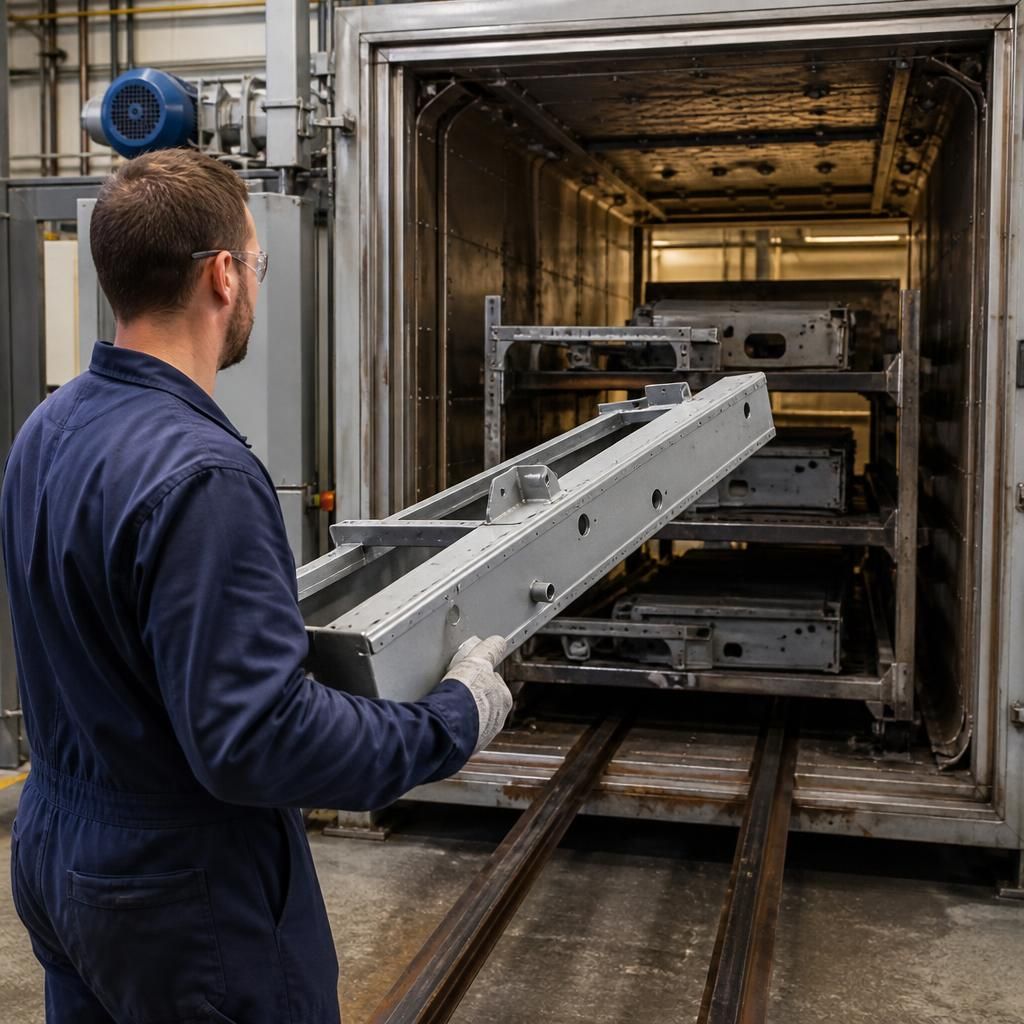
Pre-baking is an effective way to reduce pinholing where metal contains trapped air, oil or other volatile residues. Castings, porous fabrications and enclosed sections can release these materials as the powder film heats, creating small openings during curing. A controlled outgassing cycle before coating allows the substrate to release much of this contamination before the primer is applied.
After pre-baking, inspect the surface and repeat the appropriate cleaning or pretreatment step if residue, oxidation or discolouration has appeared. The cycle should be established for the specific substrate and coating system rather than applied as a universal oven setting, because excessive heat can affect the metal, pretreatment or powder performance. A trial on representative components can confirm whether pre-baking reduces recurring pinholes before it is adopted for production.
Discuss preventing powder coat primer pinholing
If recurring pinholing persists, discuss the component design and coating process with Powder-coatings.co.uk before the next production batch. A review of the substrate, fabrication details and application sequence can help identify the most appropriate corrective action.