

How does the primer system influence the longevity and performance of powder-coated finishes in industrial applications?
A primer system influences the longevity and performance of a powder-coated finish by improving adhesion between the metal substrate and topcoat, while adding an extra barrier against corrosion, moisture and chemical exposure. When correctly selected and applied to properly prepared metal, it can help the coating withstand demanding industrial conditions for longer and reduce the risk of premature deterioration.
A primer system influences the service life of a powder-coated finish by controlling how the coating stack responds to mechanical wear, thermal movement, moisture, chemicals and the condition of the metal beneath it. Its contribution is not limited to adding another coat: the primer must be compatible with the substrate, topcoat and curing process so that the complete system performs as a single, stable finish.
Film structure and load distribution
A powder-coated component is often exposed to several forms of stress at the same time. Impact, abrasion, vibration and repeated handling can gradually weaken a topcoat, particularly at edges, corners, fixings and areas subject to contact. A suitable primer can provide a more resilient intermediate layer, helping distribute local stresses through the coating system rather than leaving the topcoat to absorb them alone. This can reduce the likelihood of chips, edge breakdown and progressive underfilm deterioration.
The primer also affects the total film build. Excessive or uneven thickness can create problems such as solvent entrapment, poor flow, cracking or incomplete cure, while insufficient coverage may leave vulnerable areas in the coating system. Consistent application is therefore important: the primer should cover the prepared metal uniformly without obscuring dimensional tolerances, threads, drainage points or assembly interfaces.
Influence on curing and intercoat performance
Longevity depends on more than whether each powder layer has been applied. Primer and topcoat chemistry must be selected to work together through the specified curing cycle. If the primer is under-cured, over-cured or exposed to an unsuitable temperature profile, it may affect intercoat bonding, flexibility and resistance to impact. An incompatible system can also produce defects such as cratering, pinholing, blistering or loss of gloss.
The component’s metal temperature is particularly important because oven air temperature does not directly represent the temperature of the part. Sections with different thicknesses, enclosed areas and complex geometries may heat at different rates. The curing schedule should be established around the actual substrate temperature and verified for the complete coating system. This helps ensure that the primer develops its intended properties without compromising the topcoat.
Performance during thermal and mechanical movement
Industrial components may expand and contract as operating or environmental temperatures change. Differences between the thermal behaviour of the substrate, primer and topcoat can place stress on the interfaces between layers. A primer system with appropriate flexibility and compatibility can help the coating tolerate this movement, whereas a poorly matched system may become brittle or develop cracking and delamination over time.
This consideration is relevant to fabricated assemblies, outdoor equipment, vehicle components and parts exposed to heat from machinery or processing. The correct choice depends on the metal, coating thickness, operating temperature, geometry and expected movement rather than on the primer category alone.
Protection of edges, welds and complex areas
Edges and weld zones are common points of early coating failure because they can have irregular profiles, residual contamination or reduced coating coverage. A primer system can improve the robustness of these areas, but it cannot compensate for poor fabrication or inadequate preparation. Sharp edges may require suitable edge treatment, while weld spatter, alkaline residues, oils and scale must be removed before coating.
Recesses, overlaps and boxed sections also require careful process control. They can retain moisture or contaminants and may receive less consistent powder coverage. The design of the part, racking arrangement, spray access and curing conditions all affect whether the primer forms a continuous system across these areas.
Effects on appearance and functional performance
Primer selection can influence more than corrosion protection. It may affect the topcoat’s smoothness, colour consistency, gloss retention and resistance to marking. In applications where appearance is important, an unsuitable primer or inconsistent film can show through as texture variation, shade differences or surface defects. In functional applications, the key concern may instead be resistance to abrasion, chemicals, moisture or impact.
The topcoat remains responsible for many of the system’s surface properties, so the primer should not be treated as a substitute for choosing a suitable topcoat. The two layers should be assessed together against the expected exposure and cleaning regime. For example, a chemically resistant topcoat may still perform poorly if the underlying primer is not compatible with the chemicals reaching damaged or exposed areas.
Preparation, application and inspection
The expected life of a primer system is strongly affected by process consistency. Important controls include:
- identifying the substrate and removing oil, grease, rust, scale, oxides and other contaminants;
- using an appropriate mechanical or chemical preparation method to create a clean, suitable surface;
- protecting prepared metal from contamination or flash rust before coating;
- checking powder application for even coverage, especially on edges, corners and recessed areas;
- monitoring film thickness rather than relying solely on visual assessment;
- confirming the curing profile against the coating manufacturer’s technical requirements; and
- inspecting the finished coating for defects, missed areas, adhesion problems and damage before dispatch or assembly.
These controls help distinguish a primer system’s designed performance from failures caused by preparation or application. A high-specification primer cannot deliver its intended service life if contamination remains on the metal, the film is uneven or the coating has not reached the required cure.
Assessing long-term performance
Primer selection should be based on the complete duty cycle of the component. Consider the substrate, exposure conditions, operating temperature, chemical contact, expected abrasion, impact risk, appearance requirements, coating thickness and repair arrangements. Where a part will be cut, drilled or assembled after coating, the specification should also address how exposed edges and installation damage will be treated.
In practice, the most durable result comes from matching the primer, topcoat and preparation method to the actual use of the component, then applying them under controlled conditions. This system-based approach improves consistency and reduces the risk that a local defect, damaged edge or incompatible layer will become the starting point for wider coating failure.
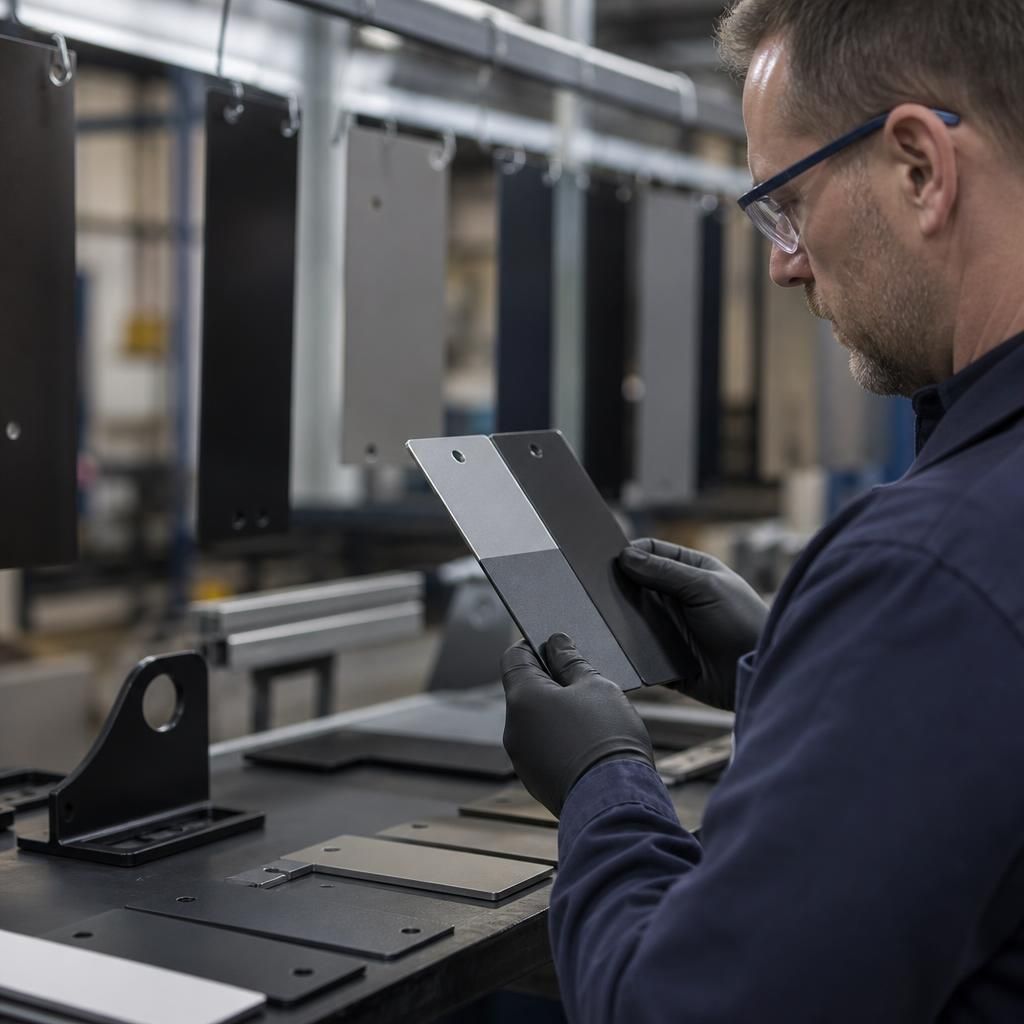
A primer system influences long-term coating performance most reliably when it is validated on a representative sample before full production. A test panel or trial component can reveal interactions between the substrate, primer and topcoat that may not be apparent from technical data alone.
Trial coating is particularly useful where parts have mixed thicknesses, complex profiles, different metal substrates or demanding end-use conditions. Assessment should consider:
- adhesion between the substrate, primer and topcoat;
- surface appearance, including texture, gloss and colour uniformity;
- the effect of the specified film build on fit and assembly;
- resistance to the mechanical or chemical exposure expected in service; and
- whether the complete coating system can be applied consistently across representative areas.
This validation stage helps identify an unsuitable primer combination before it becomes a production-wide issue. It also provides a practical basis for confirming that the selected system supports the required balance of longevity, appearance and functional performance.