

What specific properties of nylon coatings make them suitable for automotive industry applications?
Nylon coatings suit automotive applications because they provide a tough, abrasion-resistant surface that can withstand repeated contact, impact and friction on metal components. Their resistance to oils, fuels, moisture and many chemicals also helps protect parts from corrosion and supports reliable performance in demanding vehicle environments.
Nylon coatings are suitable for automotive applications because they combine low friction, electrical insulation, resilience and temperature stability in a relatively thin protective layer. This makes them useful where a metal component must operate against other parts, isolate electrical contact or retain a consistent surface finish during repeated temperature changes.
- Low-friction surface: Nylon can provide a smooth, non-galling surface for components that slide, rotate or make repeated contact. This can reduce drag and limit surface damage at interfaces such as guides, supports, bushes and linkage components.
- Electrical insulation: Nylon is non-conductive, so a coating can help separate a metal component from an electrical contact or prevent unintended current paths. This property is relevant to brackets, clips, housings and mounting hardware used near wiring, sensors and control systems.
- Resilience and flexibility: The coating can accommodate minor movement and surface flexing more effectively than a highly brittle finish. This is useful on formed or handled components where small deflections may occur during assembly or service.
- Temperature-cycle performance: Automotive parts can experience changes between cold storage, operating heat and under-bonnet temperatures. Appropriate nylon grades can maintain their functional properties through defined temperature ranges, although the coating specification must match the component’s actual operating conditions.
- Noise and vibration control: Nylon has a degree of resilience that can help reduce direct metal-to-metal contact and dampen some rattling or transmission of vibration. It can therefore be considered for contact points, retainers and supporting parts where surface interaction contributes to unwanted noise.
- Consistent surface finish: When correctly applied, nylon produces a continuous, even coating that can protect edges and contact areas while providing a repeatable appearance across batches. This consistency is important where coated parts must fit within controlled assembly tolerances.
The most suitable formulation depends on the part’s geometry, substrate, operating temperature, required coating thickness and type of contact. A coating that performs well on a protective bracket may not be appropriate for a continuously sliding component or a part exposed to concentrated heat. Surface preparation, coverage of edges and control of the application process also influence adhesion and service performance.
For automotive metalwork, nylon is therefore selected not for one property alone, but for the combination of controlled friction, insulation, resilience and stable performance. The coating specification should be based on the component’s mechanical movement, electrical function, temperature range and dimensional requirements before production coating begins.
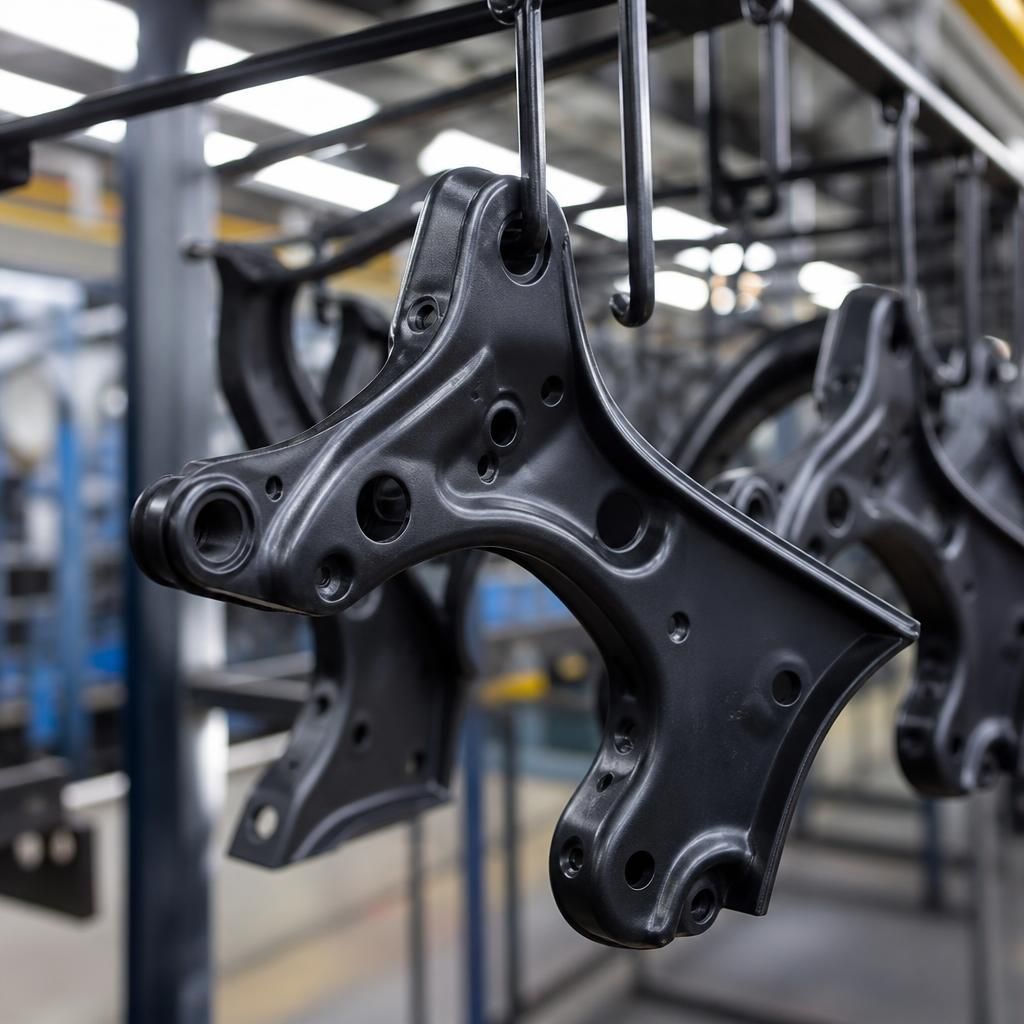
A further automotive advantage is nylon’s ability to provide a controlled interface between moving or assembled parts. Unlike an exposed metal surface, the coating can act as a sacrificial contact layer where components are pressed together, adjusted or repeatedly assembled. This can help limit scoring of the underlying metal and reduce the risk that minor surface damage develops into a fitting or alignment problem.
The coating’s performance depends on matching its hardness and thickness to the contact load. A layer that is too soft may deform under pressure, while one that is too thick can affect clearances, threads or the fit of clips and brackets. Automotive nylon coatings are therefore specified with the component’s load, contact pattern and dimensional tolerances in mind, particularly for parts that must be assembled consistently across production batches.
Discuss nylon coatings for automotive applications
If you are assessing nylon coatings for an automotive component, discuss the part’s substrate, operating conditions, contact requirements and dimensional tolerances with our coating specialists. This will help establish whether nylon is an appropriate finish and identify a suitable specification.