

How is the application process for nylon coatings carried out on metal surfaces?
Nylon coatings are applied to metal surfaces by first cleaning and preparing the substrate, then applying the nylon material evenly before using controlled heat to cure and bond the coating. The preparation and curing stages are carefully matched to the metal component and intended service conditions to produce a consistent, durable finish.
The application of a nylon coating to a metal surface is a controlled, specification-led process. It involves assessing the component, defining the required coating areas and thickness, conditioning the substrate, depositing the nylon by a suitable method, fusing the material and checking the finished coating against the intended service conditions.
Before processing begins, the component is reviewed for its material, dimensions, geometry and proposed use. Particular attention is given to edges, recesses, holes, threads, joints and areas that may be subject to impact, abrasion, chemicals or repeated movement. These details affect the choice of nylon grade, application method and handling procedure. The coating specification should also identify whether the finish is required for wear resistance, impact protection, noise reduction, electrical insulation or resistance to a particular operating environment.
Any existing coating, oxide, corrosion, oil, grease, scale or other contamination must be removed because residues can interfere with adhesion. Mechanical preparation may involve abrasive blasting or another suitable method that creates a clean, suitably keyed surface without distorting the component. The prepared metal is then handled carefully to prevent recontamination before coating.
Areas that must remain uncoated are protected with appropriate masking. This can include bearing seats, threads, electrical contact points, mating faces, drainage holes and dimensional interfaces. Masking design is important because nylon adds thickness to the surface; allowances may therefore be needed where components fit together or where tolerances are tight.
The nylon is deposited using a method suited to the component and the coating specification. Common approaches include:
- Fluidised-bed application: a heated metal component is brought into contact with finely divided nylon held in an air-suspended bed. The particles melt onto the surface and form a continuous layer.
- Electrostatic application: charged nylon powder is directed towards the prepared metal, where it is attracted to the grounded component before being fused by heat.
- Specialist dipping or spray techniques: these may be selected for particular shapes, access requirements or coating specifications where conventional powder application is unsuitable.
Application parameters are adjusted to suit the metal’s thermal behaviour, the component’s mass and geometry, and the selected nylon material. Components with deep recesses or complex profiles may require careful control to achieve even coverage. Corners and edges also need attention, as insufficient coverage can leave vulnerable areas while excessive build-up can affect fit and appearance.
After deposition, the coating is heated until the nylon particles flow and form a continuous film. The heating cycle must be controlled rather than treated as a simple surface-heating operation. The component needs to reach the required condition throughout the coated area, while avoiding overheating that could affect the nylon, the substrate or any heat-sensitive features. The appropriate cycle depends on the nylon formulation, coating thickness, metal type and component design.
Cooling is managed so that the newly formed coating is not marked, contaminated or damaged. Components should be supported at suitable points, particularly where the nylon remains warm and more susceptible to indentation. Masking is normally removed once the coating has stabilised, with care taken not to tear the finish around edges or disturb dimensional surfaces.
Inspection usually covers several separate points:
- visual continuity, including pinholes, blisters, inclusions, bare areas and excessive build-up;
- coverage of edges, corners, recesses and other difficult-to-reach features;
- coating thickness where dimensional control is important;
- adhesion or other agreed performance checks where required by the specification;
- condition of masked areas, threads, bores and mating faces; and
- overall conformity with the colour, texture and finish required for the component.
If a component does not meet the agreed requirements, the appropriate corrective action depends on the defect. Local issues may sometimes be addressed through controlled rework, while widespread contamination, poor adhesion or unsuitable build may require removal and complete reprocessing. The decision should take account of the component’s dimensions and the performance demanded from the coating.
For batch work, consistent results depend on maintaining the same preparation standards, application settings, heating approach, masking practice and inspection criteria across the run. Components should also be presented in a condition that allows them to be processed without unnecessary handling or delay between preparation and coating. Clear drawings, sample parts and defined acceptance criteria help avoid uncertainty over uncoated areas, tolerances and finish requirements.
The finished nylon coating is therefore assessed as part of the complete component, not as an isolated decorative layer. Its suitability depends on the relationship between surface preparation, coating build, fusion, component design and the conditions the metal part will encounter in service.
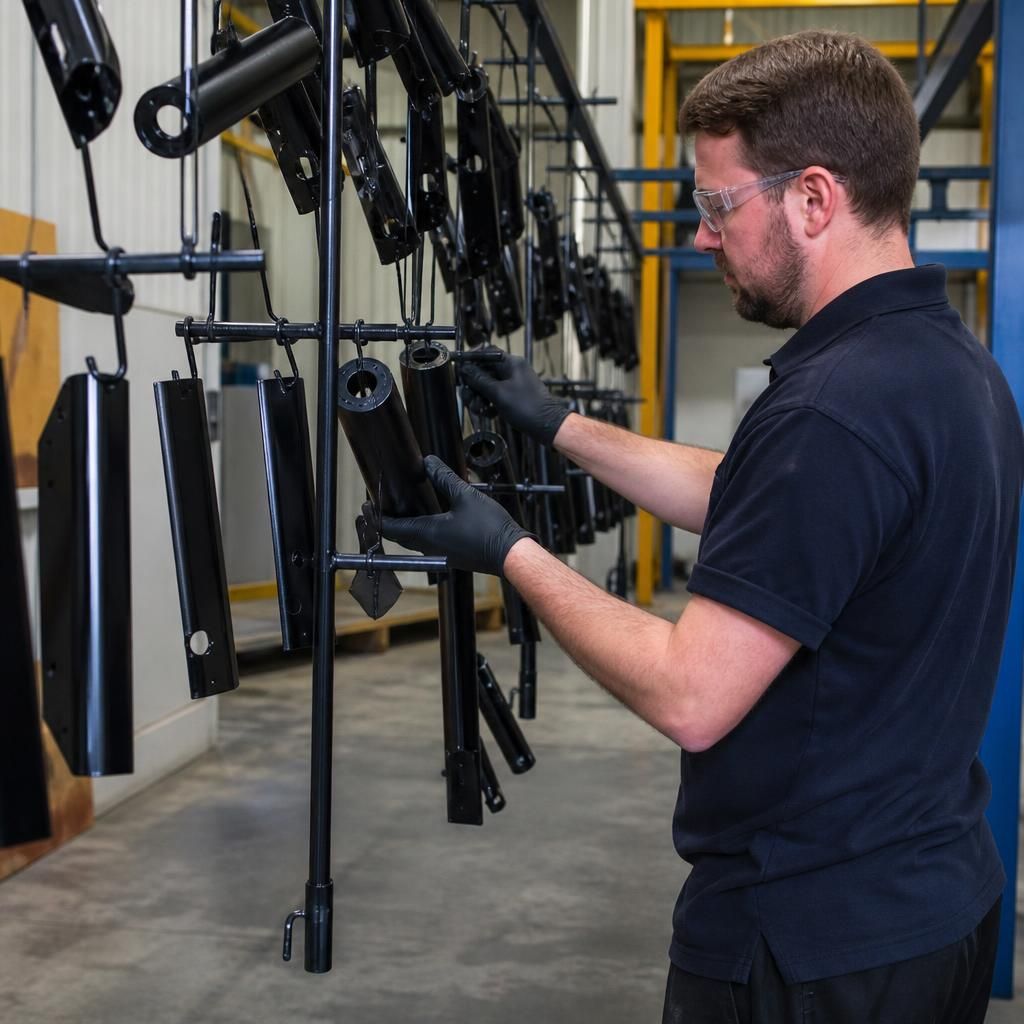
Fixturing is an important part of nylon coating application. Components must be positioned so the coating equipment can reach the required surfaces without creating contact marks or leaving areas shielded from the nylon material. The fixture also needs to support the part securely through heating, cooling and handling, while allowing coated surfaces to remain clear of surrounding equipment.
This is particularly relevant to components with irregular profiles, projecting features or several faces requiring coating. The planned orientation can affect how consistently the nylon is deposited and how easily excess material is avoided around edges, apertures and dimensional interfaces. Discussing fixture points and presentation before processing helps ensure that the finished component can be coated and handled without compromising its specified surfaces.
Discuss Your Nylon Coating Application Requirements
Provide your component drawings, material details and coating requirements so the nylon application process can be assessed against the part’s geometry, tolerances and intended use. Discuss your specification with the powder-coating team to establish a suitable preparation, application and inspection approach.