

How do primer, epoxy, and nylon coatings differ in terms of application and suitability for various industrial environments?
Primer is applied beneath a topcoat to improve adhesion and support corrosion protection, epoxy provides a hard, chemically resistant finish suited mainly to sheltered industrial environments, and nylon forms a tough, wear-resistant coating for components exposed to friction, impact or moisture. Selection depends on the metal substrate, pretreatment, application and curing requirements, plus the component’s exposure to abrasion, chemicals, weather and temperature.
Primer, epoxy and nylon coatings differ chiefly in their role within the coating system, the way they are applied and the stresses they are designed to withstand. Primer is selected to prepare and protect the substrate beneath a finish coat; epoxy is a thermosetting coating chosen for chemical and mechanical resistance; nylon is a thermoplastic coating used where toughness, low friction and resistance to repeated wear are important.
Primer is a system component rather than always being the final finish. It is applied after the metal has been cleaned and pretreated, then overcoated with a compatible powder or other specified finish where required. Its suitability depends on the type of metal, the expected corrosion exposure and the properties needed from the topcoat. A primer system is often appropriate for fabricated steelwork, components with vulnerable edges or recesses, and parts where additional protection is required beneath the visible finish.
Application control is particularly important with primer. The substrate must be free from oil, rust, scale and other contaminants, because a primer cannot compensate for inadequate preparation. The applicator must also control film build, cure conditions and the interval between primer and topcoat. If the two layers are incompatible or the first layer is not correctly cured, defects such as poor adhesion, pinholing or intercoat separation can occur. The finished specification should therefore identify the primer, topcoat and curing schedule as one system rather than selecting each layer independently.
Epoxy is generally selected for enclosed or sheltered industrial conditions. It forms a hard, closely bonded film that can resist many oils, solvents, chemicals and cleaning agents. This makes it suitable for machinery parts, cabinets, brackets, frames and other metal components exposed to industrial contaminants but not sustained outdoor weathering. It may be used as a standalone powder finish where its performance characteristics are sufficient, or as part of a primer-and-topcoat arrangement.
The main limitation of epoxy is its behaviour under prolonged ultraviolet exposure. Direct sunlight can cause colour and gloss changes, so an epoxy-only finish is usually less suitable for components that remain outdoors or receive substantial daylight. Where outdoor exposure is unavoidable, the specification may require a weather-resistant topcoat over the protective layer, subject to compatibility and the required appearance. Epoxy is also not automatically the best option for severe sliding wear: its hardness can be valuable, but repeated abrasion or impact may favour a tougher coating type.
Nylon is suited to components where wear, impact and movement are dominant considerations. As a thermoplastic coating, it can provide a resilient surface with useful resistance to abrasion, impact, moisture and many commonly encountered substances. It is often considered for chutes, rollers, guides, trays, brackets, handling equipment and other parts that experience rubbing, contact or repeated loading. Its relatively low-friction surface can also be beneficial where components move against one another.
Nylon application differs from a conventional thin decorative powder finish. The part and the powder must be prepared so that the coating melts and bonds consistently, and the specified application method must be suitable for the component’s geometry. Electrostatic application may be used for appropriate parts, while preheating and fluidised-bed techniques can be used where a heavier, more continuous coating is required. Corners, holes, welds and enclosed sections need particular attention because they can affect coverage and heat transfer.
Compared with a hard epoxy film, nylon is normally considered where resilience and surface wear matter more than a rigid, high-hardness finish. It should not be selected solely because a component is exposed to moisture or chemicals: the exact chemical, its concentration, contact time and operating temperature all influence compatibility. Dimensional tolerances must also be checked because a nylon coating can be thicker than a typical decorative finish and may affect fits, threads, clearances or moving interfaces.
The operating environment should determine the priority in the specification.
- Corrosion-prone steelwork: consider a compatible primer and topcoat system when the substrate requires additional protection, particularly around fabricated details and areas vulnerable to coating breakdown.
- Sheltered plant and machinery: epoxy can be appropriate where chemical contact, contamination and firm adhesion are more important than resistance to prolonged sunlight.
- Outdoor components: assess ultraviolet exposure, rain, temperature changes and the required colour retention. An epoxy-only specification may not provide the desired long-term appearance in these conditions.
- High-wear assemblies: nylon is worth assessing for repeated friction, impact or contact with other parts, provided its temperature and chemical limits suit the service.
- Parts requiring both protection and wear resistance: a layered system may be more suitable than treating primer, epoxy or nylon as interchangeable alternatives. The substrate, base protection and exposed working surface may each require different properties.
Component design also affects the choice. Sharp edges, deep recesses, narrow gaps and weld spatter can reduce coating consistency regardless of the powder selected. Drainage and ventilation holes may be needed for hollow fabrications, while masking may be required for bearing seats, threads and electrical contact points. These details should be agreed before coating so that the required coverage does not conflict with dimensional or assembly requirements.
Temperature is another selection factor. The relevant question is not only the temperature during curing but also the temperature reached in service, including short-term peaks. A coating that performs well at ordinary plant temperatures may be unsuitable near hot equipment, ovens or exhaust systems. Chemical exposure should be assessed in the same practical way: identify the substance, concentration, frequency of contact and cleaning process rather than relying on a general description such as “industrial use”.
For a reliable specification, provide the coating applicator with the metal type, component dimensions, areas that must remain uncoated, expected film build, service temperature, exposure to weather or chemicals, contact or abrasion conditions and any appearance requirements. The decision can then be based on the complete service environment: primer where the coating system needs added substrate protection, epoxy where a hard sheltered-environment finish is required, and nylon where a resilient, wear-focused surface is the stronger fit.
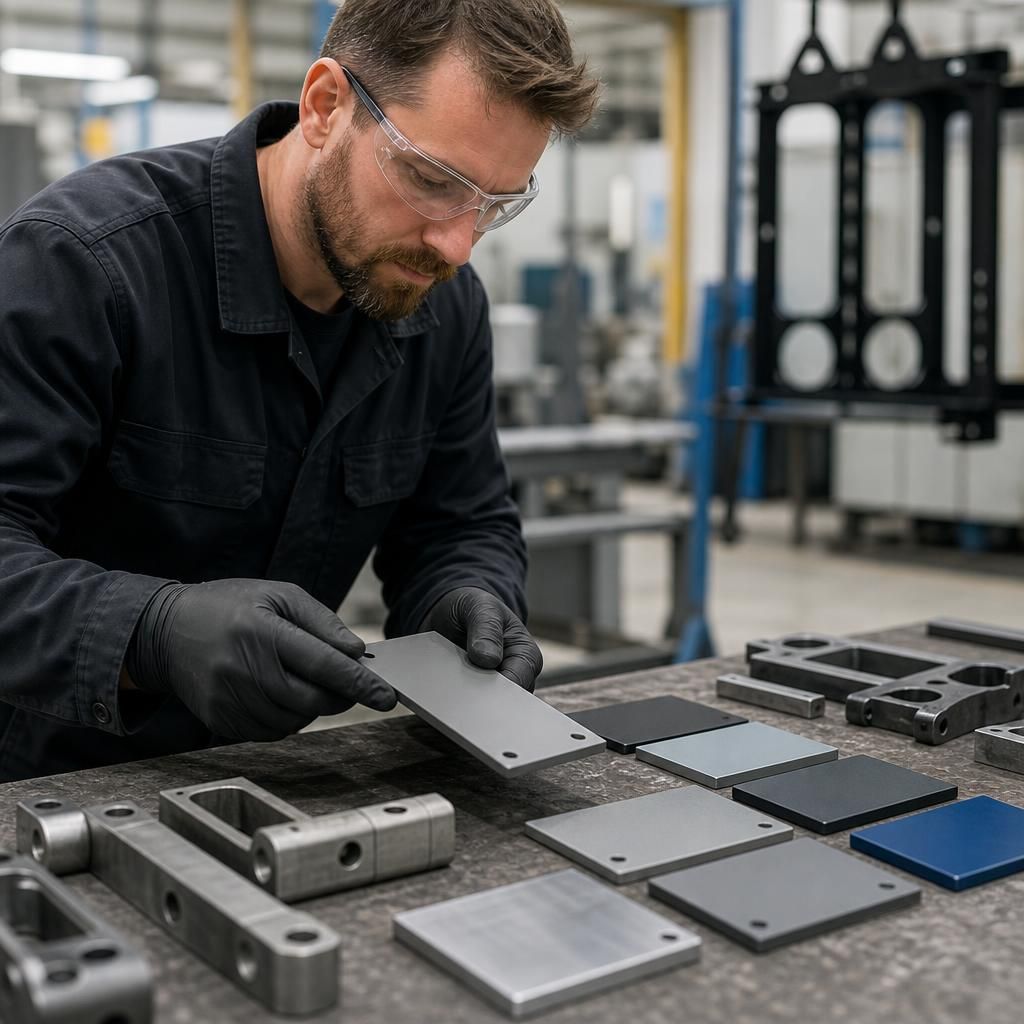
The suitability of primer, epoxy or nylon coating should be confirmed against the actual component and service conditions, rather than selected from the coating name alone. A representative test panel or sample part can reveal whether the proposed system achieves the required adhesion, coverage, finish and dimensional fit before a production batch is processed.
- Primer systems: check that the primer bonds effectively to the prepared substrate and that the specified topcoat forms a sound, continuous interface.
- Epoxy coatings: assess the finished surface after exposure to the relevant cleaning agents, oils or chemicals, particularly where appearance and film integrity are important.
- Nylon coatings: examine coverage around edges, holes and contact areas, while confirming that the additional film thickness does not interfere with assembly or movement.
Inspection should also consider areas that cannot be judged from appearance alone, including concealed faces, threaded features, contact points and locations subject to repeated wear. Recording the substrate preparation, coating materials, film build and processing conditions gives the applicator and end user a clear basis for comparing the result with the original specification.
Discuss your primer, epoxy or nylon coating requirements
Discuss your component drawings, substrate and operating conditions with the powder-coating team to identify the most suitable primer, epoxy or nylon coating system. Include any dimensional, masking and finish requirements so the specification can be assessed before processing.