

What are the key factors to consider when selecting high gloss and specialty powder coatings for outdoor applications?
Selecting high gloss and specialty powder coatings for outdoor applications requires assessing the metal substrate, pre-treatment, UV and weather exposure, moisture, temperature changes, abrasion risk and the required gloss or colour retention. The coating chemistry, film specification, application method and any relevant performance or regulatory requirements should then be matched to the component’s environment and expected service life.
Choosing a high gloss or specialty powder coating for outdoor use means specifying more than a colour and sheen. The coating system should be selected according to the required appearance, resin performance, component design, film specification, anticipated handling and the consequences of coating failure. A technically suitable finish must also be practical to apply consistently across the complete batch.
Start with the required level of appearance. High gloss finishes reflect light strongly, so they can make minor surface imperfections, weld marks, pinholes, inclusions and uneven preparation more visible than a matt or textured finish. If a smooth, reflective appearance is required, the underlying metal and fabrication quality need to be suitable for that result. Where the component will be viewed from close range, agree how much visual variation is acceptable before production begins.
Colour should be assessed in the lighting conditions in which the finished component will normally be seen. The same colour can appear different under daylight, artificial lighting and shade. Metallic, pearlescent and other special-effect powders can be particularly sensitive to application direction, overlapping spray passes and recovery of overspray. For these finishes, a sample panel or approved reference piece is useful for confirming colour, gloss and visual effect before coating the full production batch.
Select the resin technology for the exposure. Not all powder coatings intended for outdoor use offer the same resistance to long-term environmental exposure. Standard exterior polyester systems may be appropriate for some applications, while super-durable or other specialist chemistries may be more suitable where retention of colour and gloss is a major requirement. The specification should identify the expected performance class rather than relying only on the description “outdoor powder coating”.
High initial gloss does not by itself indicate superior long-term performance. A coating can leave the oven with a bright, reflective surface but lose gloss or show colour change if its chemistry is not suited to the environment. Ask for technical information covering the relevant durability properties, including resistance to chalking, fading and loss of gloss. These properties should be considered alongside the visual requirement: a very high gloss may be inappropriate if a small amount of surface change would be unacceptable or difficult to maintain.
Check the film specification. Film thickness affects coverage, appearance, edge protection and the way specialist finishes develop. Too little material can result in incomplete coverage or reduced protection, while excessive build may alter the colour, gloss or texture and create problems around corners, recesses and mating faces. The target thickness should therefore be defined for the particular powder and component rather than treated as an interchangeable value.
Gloss should be specified using a recognised measurement method and an agreed tolerance. Terms such as “shiny”, “satin” and “high gloss” can be interpreted differently, particularly when comparing samples produced by different processes. A written specification should identify the intended gloss range, colour reference, texture, acceptable defects and any areas that must remain uncoated.
Consider the component’s geometry and use. Deep recesses, narrow channels, sharp edges, folded sections and internal corners can affect powder deposition and curing. Electrical conductivity and the movement of charged powder can also make recessed areas more difficult to coat evenly. Parts that will be assembled after coating may need masked bores, earth points, threads, bearing seats or close-tolerance faces. These requirements should be identified on the drawings before the finish is selected.
Handling and service conditions matter as well. Components exposed to contact, impact, repeated cleaning, road debris or rubbing against adjacent parts may need a finish chosen for greater resistance to mechanical wear rather than appearance alone. A textured or fine-textured specialty coating can sometimes disguise minor handling marks more effectively than a smooth high gloss surface, although it will produce a different visual result and may be harder to clean in heavily profiled areas.
Assess compatibility with adjoining materials. Outdoor assemblies often combine coated steel or aluminium with seals, plastics, fasteners, adhesives and untreated metal. The coating specification should be checked against these materials, particularly where moisture can remain trapped between contacting surfaces. Consider whether the finished parts will be bolted, folded, bonded or assembled under pressure, since these operations can damage a decorative surface or expose small uncoated areas.
Specialty finishes should be selected with their limitations understood. Metallic and multi-stage effects may require tighter process control to maintain a consistent appearance. Textured coatings can influence how dirt is retained and how scratches are perceived. Decorative finishes with unusual visual effects may also be less straightforward to repair invisibly if a component is damaged during installation. Where replacement or touch-up is likely, establish the approved repair method before production.
Confirm curing and production controls. Powder coating performance depends on the coating reaching the correct cure throughout the component, not merely on the oven temperature displayed on the control panel. Part thickness, loading arrangement, metal mass and line speed can all affect the heat received by the coating. The powder supplier’s technical data should be used to establish the appropriate cure window, and the applicator should be able to control the process consistently across the component.
For batch work, consistency is especially important. The powder batch, application settings, film build, oven conditions and inspection criteria should be controlled so that parts produced at different times remain visually compatible. This is significant for replacement panels, modular assemblies and projects where components are installed next to one another.
Define testing and acceptance requirements in advance. Depending on the application, the specification may include adhesion, impact, flexibility, hardness, abrasion or corrosion-related testing. These tests do not replace a proper coating selection, but they provide a way to verify that the finished work meets the agreed requirements. Acceptance should also cover visual inspection from an agreed distance and under agreed lighting, because minor variation that is acceptable on a functional bracket may not be acceptable on a prominent architectural component.
A practical selection brief should therefore record the substrate, component geometry, colour reference, gloss level, texture, required film range, resin or durability class, masking points, assembly interfaces, inspection method and any applicable industry standard. Providing this information before quotation and production reduces ambiguity and helps the coating specialist recommend a finish that balances outdoor performance with the required appearance.
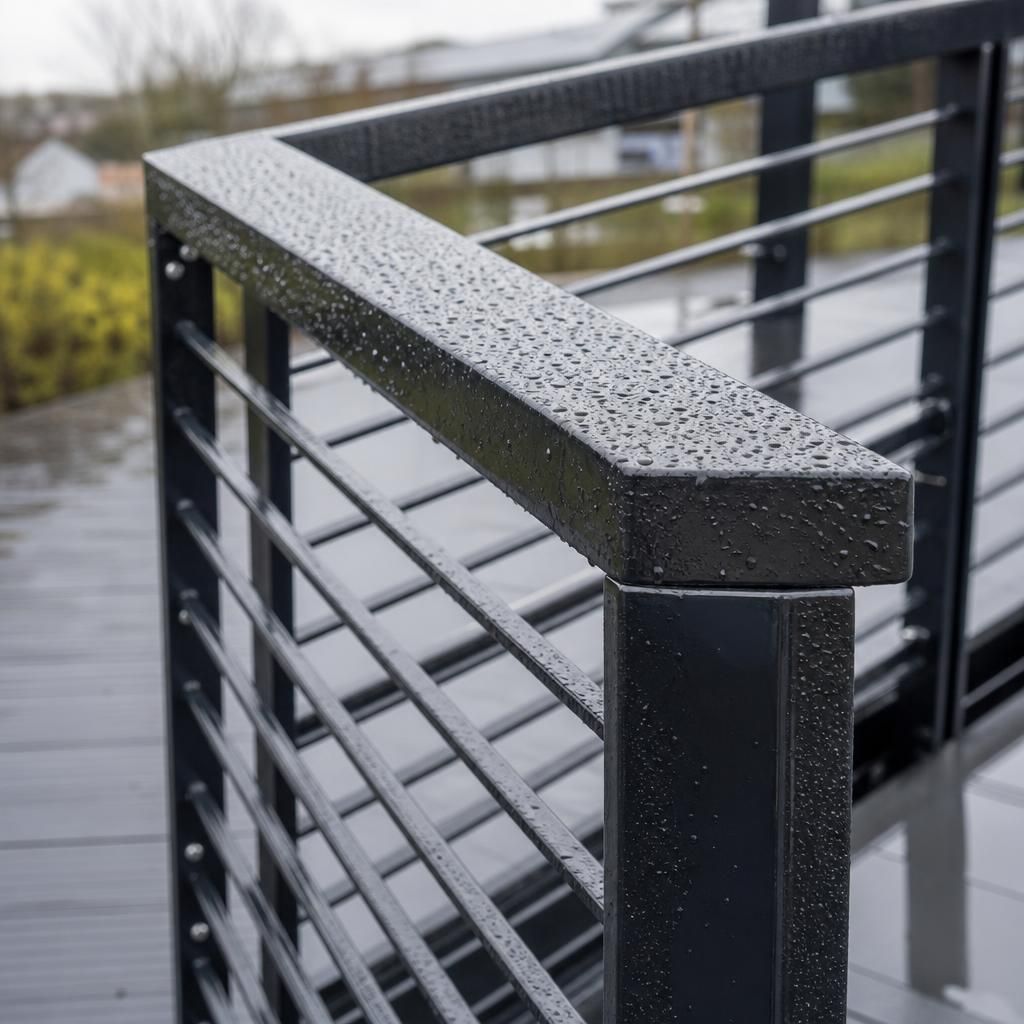
Outdoor exposure assessment should account for contaminants and water retention as well as sunlight and rain. Coastal salt, road de-icing residue, industrial pollutants, airborne dirt and prolonged condensation can place greater demands on a powder-coated component than a clean, well-drained installation. A part sheltered beneath a canopy may experience less direct weathering but can remain damp for longer, while exposed horizontal surfaces may collect deposits that affect the finish.
Component design is therefore part of coating selection. Crevices, overlapping sections, unsealed hollow profiles and poorly drained recesses can retain moisture and contaminants, increasing the risk of corrosion at vulnerable areas. Drainage paths, sealed joints and suitable detailing should be considered before coating, particularly for fabricated assemblies used outdoors. Where cut edges, welds or dissimilar metals are present, the coating specification should address those locations specifically rather than treating the visible faces as the only performance requirement.
For projects in marine, roadside or industrial environments, provide the coating specialist with the intended location, orientation, surrounding contaminants and cleaning arrangements. This information helps determine whether a standard exterior system is appropriate or whether a higher-performance protective specification should be investigated.