

What factors should be considered when choosing a filler primer for powder coating applications?
When choosing a filler primer for powder coating, consider the metal substrate, the size and type of surface defects, the required corrosion protection, and compatibility with the powder coating system. Also check the primer’s application method, recommended film thickness, curing requirements, service environment and ability to provide a smooth, stable base for the final finish.
Choosing a filler primer for a powder coating application is a specification exercise: the product must work as part of the complete coating system, fit the production process and meet the finished component’s mechanical, visual and service requirements. The most suitable option is therefore not necessarily the primer with the highest individual performance claims, but the one whose properties remain reliable from application through to final use.
Check the primer chemistry and system design. Filler primers are formulated differently, and their chemistry affects how they bond to the prepared component and interact with the subsequent powder layer. Confirm that the primer is intended to be overcoated with the selected type of powder rather than treating it as a general-purpose undercoat. The technical documentation should state the approved coating sequence, any restrictions on overcoating and whether the primer requires a particular preparation before the powder is applied.
It is also important to establish whether the primer and topcoat form a chemically stable system after processing. A primer that remains too soft, reacts with the powder or releases material during the finishing cycle can contribute to blistering, loss of adhesion or visible surface defects. These risks should be assessed using the complete proposed system, not by evaluating the filler primer in isolation.
Consider the performance required after finishing. The finished coating may need to withstand more than general handling. Components used in manufacturing equipment, construction assemblies or automotive applications can be exposed to impact, abrasion, vibration, repeated temperature changes, cleaning chemicals or outdoor contaminants. Compare the primer’s contribution to properties such as:
- impact resistance and flexibility during assembly;
- resistance to abrasion where components are handled or moved;
- hardness and resistance to indentation;
- stability during thermal cycling;
- resistance to oils, detergents, fuels or other chemicals relevant to the application; and
- the ability to retain adhesion when the component is formed, fastened or subjected to service movement.
A very hard primer may not be the best choice where the component flexes, while a more flexible formulation may be unsuitable where heavy abrasion is expected. The selection should reflect the dominant failure risks for the finished part.
Assess dimensional and assembly implications. A filler primer adds material to the component, which can affect close-fitting parts, threaded features, bearing seats, slots, hinges and masking points. The specification should identify areas where coating build must be controlled or excluded. Consider whether the primer can be applied consistently without interfering with tolerances, and whether the coating sequence requires additional masking or post-coating finishing.
This is particularly relevant for fabricated components that join to other parts. A coating system that looks acceptable on an open panel may be unsuitable if it prevents correct assembly or changes the fit of a precision interface. The primer specification should therefore be reviewed alongside engineering drawings and allowable coating build, rather than selected solely from a sample panel.
Match the product to the production method. The application equipment, line arrangement and component geometry can influence which filler primer is practical. Confirm that the product can be applied evenly to the relevant shapes, including recesses, internal corners and areas that are difficult to access. Where the primer is powder-applied, its charging and transfer characteristics must be suitable for the equipment and component configuration. Where a liquid product is used, the documentation should define handling, flash-off and overcoat requirements clearly.
Production control is another consideration. Review the product’s usable life after opening or mixing, storage requirements, batch identification and tolerance to normal process variation. A primer that performs well only within a narrow operating range may create avoidable inconsistencies on larger or repeat batches. The supplier’s technical data should provide enough information to establish a controlled process rather than relying on visual judgement alone.
Review appearance requirements separately from basic surface levelling. The primer can influence the final colour, gloss, texture, edge definition and appearance of the powder coating. This matters where parts are visible, where a consistent finish is required across multiple batches or where a light-coloured topcoat could reveal variation beneath it. Check whether the primer’s colour and opacity are appropriate for the intended finish, and whether it can contribute to defects such as pinholing, cratering or uneven texture.
Where appearance is critical, use representative components or test panels rather than relying only on a product description. Include the same preparation, primer, powder, equipment and processing sequence intended for production. Inspect the result after coating and, where relevant, after mechanical or environmental testing.
Examine technical documentation and compliance information. A suitable filler primer should be supported by a current technical data sheet and safety data sheet. These documents should identify the recommended system, storage conditions, application limits, processing requirements, handling precautions and relevant performance information. Check that the product is appropriate for the intended workplace controls and any sector-specific requirements applying to the component.
Traceability is also valuable for industrial work. Record the product name, batch reference, application conditions and powder system used during trials and production. This makes it easier to investigate variation and reproduce an approved finish. If the primer is being introduced into an established process, obtain written confirmation of compatibility rather than assuming that similar-looking products are interchangeable.
Validate the choice before committing to production. A small controlled trial should reproduce the important features of the real job, including the component material, geometry, preparation, primer application, powder application and full processing sequence. Evaluate adhesion, appearance, dimensional effects and the relevant mechanical or chemical exposures. If the component is safety-critical or subject to formal customer specifications, testing should be agreed against those requirements before approval.
In practice, the final decision should balance system chemistry, finished-part performance, dimensional control, production practicality, appearance, documentation and test evidence. A filler primer is appropriate when it performs consistently within the complete powder coating process and supports the requirements of the finished component, rather than simply offering good results under unrelated test conditions.
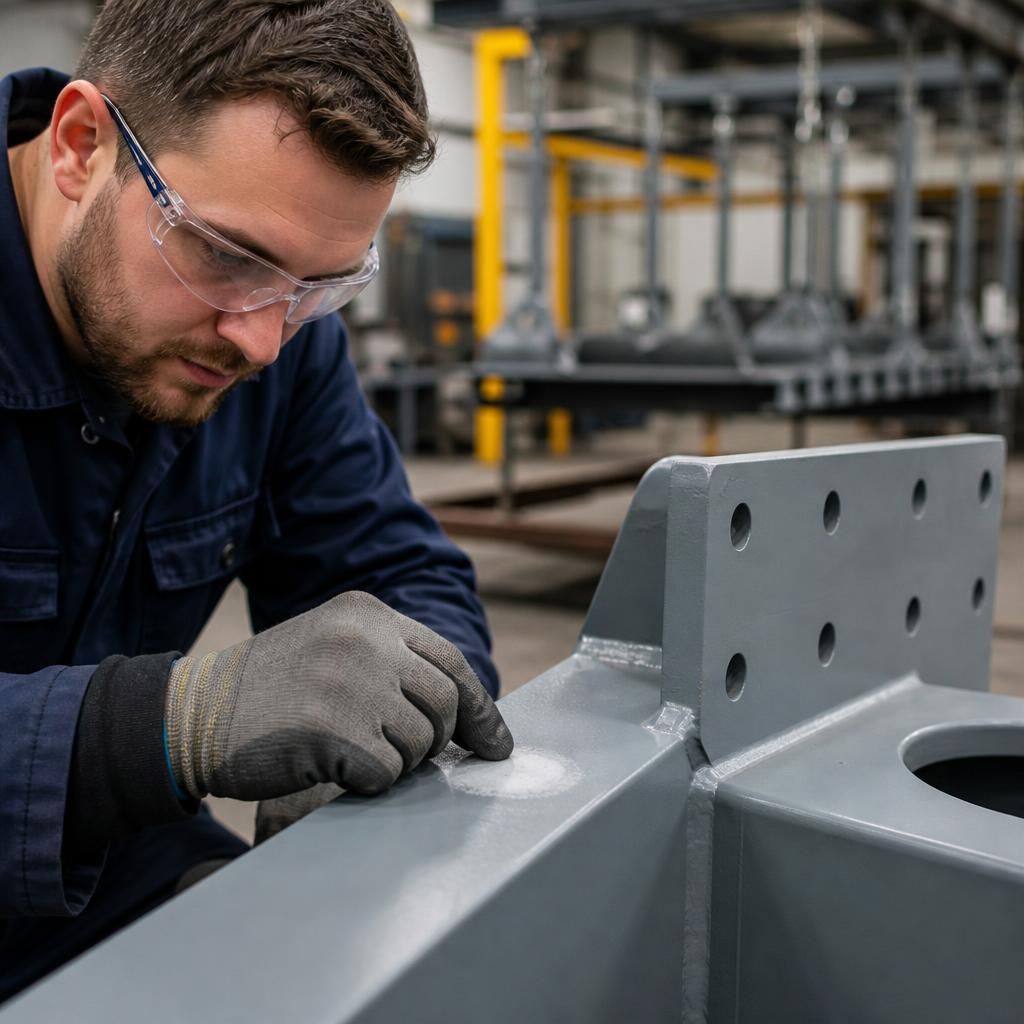
A filler primer should be chosen according to the type and cause of the surface imperfection it is expected to correct. Shallow grinding marks, minor dents and small surface irregularities may be suitable for levelling, but contamination, weld spatter, sharp edges, deep porosity and movement in the substrate require correction before priming. Filler primer is not a substitute for sound fabrication or cleaning.
Consider the transition between the repaired area and the surrounding metal. The product should be capable of producing a stable, feathered surface without leaving a visible step that the powder coating will reproduce. Where defects are deep or concentrated, confirm the permitted build and whether multiple applications, additional preparation or a different repair method are required. Selecting the primer in this way helps prevent excessive coating thickness and reduces the risk of an apparently smooth surface concealing an underlying defect.
Discuss Your Filler Primer Selection
Discuss your filler primer selection with Powder-coatings.co.uk to review the requirements of your metal components and proposed powder coating system. Sharing details of the substrate, finish and service conditions will help establish a suitable route for further evaluation.