

What are the potential pitfalls of incorrectly applying an epoxy primer on metal substrates, and how can they be avoided?
Incorrectly applying epoxy primer to metal can cause poor adhesion, blistering, uneven coverage and premature corrosion protection failure. These problems are avoided by properly preparing and drying the substrate, controlling contamination and film thickness, following the specified mixing and curing requirements, and inspecting the coating before applying subsequent layers.
The main pitfalls of incorrectly applying an epoxy primer to metal arise from using an unsuitable primer system, creating defects at edges and joints, applying the next coating outside the permitted recoat window, or exposing the primer to conditions it was not designed to withstand. Avoidance depends on confirming compatibility with the substrate and topcoat, controlling the application across the whole component, and verifying the finished primer against the requirements of the service environment.
Choosing a primer that does not suit the substrate
Epoxy primers are not interchangeable across all metals. A formulation suitable for carbon steel may not be the right choice for aluminium, galvanised steel or a component containing mixed metals. Differences in surface chemistry, thermal expansion and expected corrosion exposure can affect the performance of the coating system. The primer specification should therefore identify the permitted substrates, the intended exposure conditions and the compatible finishing system.
Particular care is needed where the component will later receive a powder coating. The epoxy primer must be able to withstand the powder-coating process and bond with the specified powder system. If the primer softens, reacts, loses adhesion or releases volatile material during heating, defects may appear in the finished coating. Compatibility should be confirmed from the relevant technical data and, for critical work, by applying the complete system to a representative test piece.
Neglecting edges, corners and concealed areas
Flat faces are generally easier to coat consistently than sharp edges, weld toes, recesses, holes and internal corners. These areas can receive too little material, develop runs, or be missed by the spray pattern altogether. Sharp edges can also act as points of concentrated stress and are often the first locations where protection becomes vulnerable.
The component design and application plan should be reviewed before coating begins. Where permitted by the specification, sharp edges may need suitable edge treatment, while recessed areas may require a change in spray angle or a separate pass. Fixtures should be positioned so that contact points do not leave unprotected patches. Drainage and vent holes must also be considered, particularly on hollow fabrications, because trapped liquid or air can interfere with the coating system.
Applying the primer over an unsuitable surface profile
Surface preparation is essential, but an excessive or unsuitable profile can also create problems. Deep mechanical marks may remain visible through a thin primer layer, while an overly rough surface can leave peaks with inadequate coverage and valleys that retain air or moisture. Conversely, a surface that is too smooth for the specified system may provide insufficient mechanical keying.
The required surface condition should be established from the primer and project specification rather than judged by appearance alone. Weld spatter, sharp burrs and fabrication defects should be dealt with before coating, since primer will not reliably correct poor metalwork. If the substrate has been treated by blasting, chemical conversion or another process, the resulting surface should be suitable for the selected epoxy system and the process should be kept consistent across the batch.
Ignoring the overcoating window
Epoxy primers normally have a defined interval in which the next coat can be applied. Overcoating too soon can trap solvents or interfere with the primer’s developing film. Waiting beyond the specified interval can leave the surface too hard or chemically inactive for reliable intercoat bonding, meaning additional treatment may be required before the next layer.
The permitted recoat window should be recorded for the actual product, substrate and application conditions. A change in component temperature or surrounding humidity can alter the practical timing even where the nominal product data remains the same. If the interval is exceeded, the correct remedy should come from the coating specification; simply applying another layer over an aged surface can conceal rather than resolve the problem.
Allowing solvent entrapment or outgassing
Porous castings, zinc-rich surfaces, weld areas and complex fabrications can release air or vapour during application or subsequent heating. This may produce pinholes, craters, bubbles or small blisters in the primer or the powder-coated finish. Applying a heavy wet film in an attempt to seal the component more quickly can make the issue worse by slowing the release of solvent.
The risk can be reduced by allowing the component to reach a stable temperature, selecting an application sequence suited to the geometry, and using any specified flash-off or preheating procedure. Cast or porous parts may need a trial application to establish whether the selected system produces outgassing. Any visible pinholes or craters should be assessed before the next layer is applied, since powder coating will not necessarily hide them.
Failing to account for movement and service conditions
Epoxy provides useful barrier protection, but it is not automatically the correct final finish for prolonged direct exposure to sunlight. Some epoxy films can lose colour or develop surface chalking under ultraviolet exposure. This may not immediately indicate loss of the underlying barrier, but it can affect appearance and the suitability of the surface for an exposed application.
The complete coating system should be selected for the actual service environment, including ultraviolet exposure, immersion, chemicals, abrasion, temperature changes and outdoor weathering. A compatible topcoat may be required where the epoxy primer is being used as a foundation rather than as the visible finish. The specification should also allow for differences in expansion between the metal, primer and subsequent coating during thermal cycling.
Using appearance as the only acceptance check
A smooth-looking primer is not necessarily a correctly applied primer. Defects can be hidden in recesses, at fixing points or beneath later layers. Quality checks should be proportionate to the component’s importance and may include visual examination under suitable lighting, dry-film measurement, checking edge coverage and testing a representative sample against the agreed coating requirements.
Records should link the primer batch, substrate, application method, environmental observations, recoat timing and inspection results to the component or production batch. This makes recurring defects easier to trace and helps distinguish an application problem from an unsuitable product or design detail.
For industrial metalwork, the safest approach is to treat epoxy primer as one part of a complete coating system rather than an isolated protective layer. Confirm the substrate and product compatibility, address difficult geometry, manage the recoat interval, assess outgassing risks and select the final finish for the intended exposure. These controls reduce the likelihood that an apparently sound primer will fail once the component enters manufacture or service.
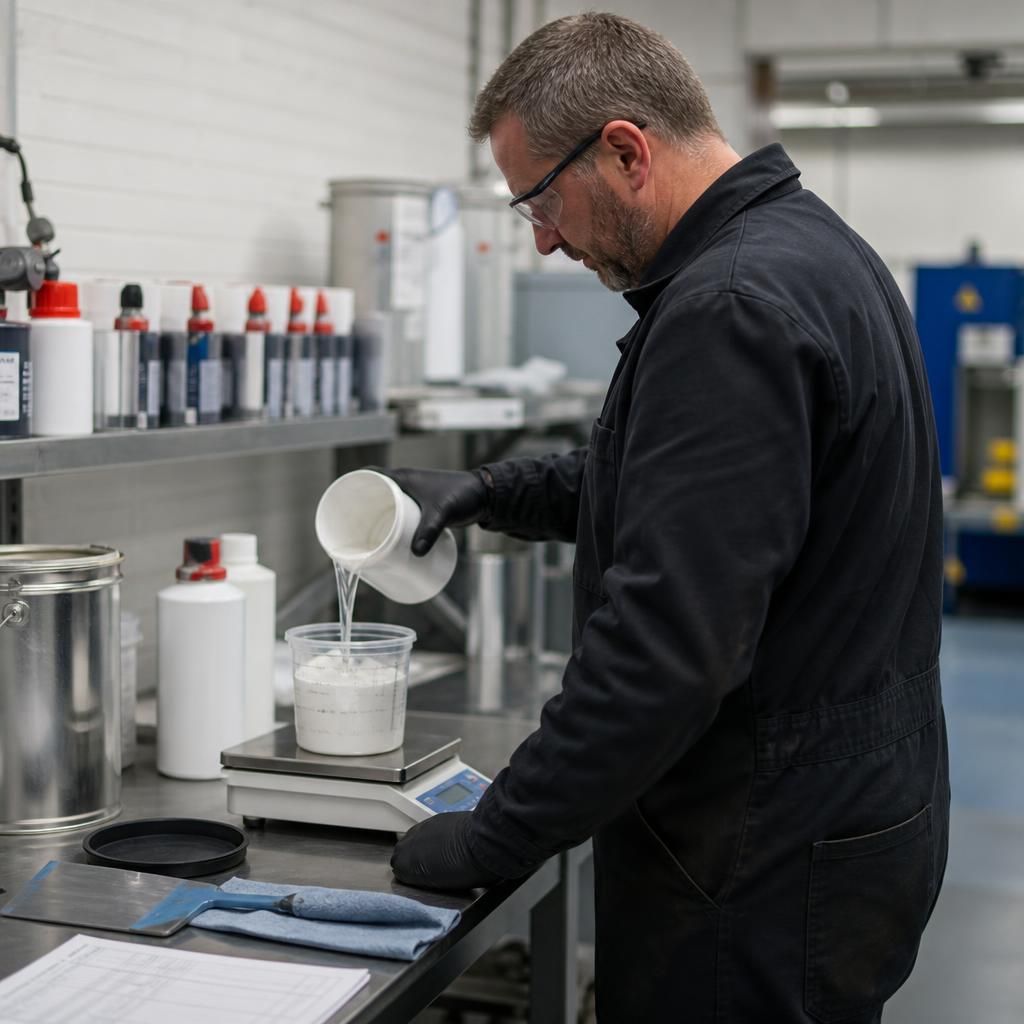
Incorrect mixing is a frequent cause of epoxy primer failure because the resin and curing agent must react in the specified proportion. Adding extra hardener does not make the coating cure faster; it can leave an unreacted component in the film, causing softness, poor chemical resistance or weak adhesion. Too little hardener can similarly prevent the primer from developing its intended properties.
- Use the manufacturer’s stated mix ratio by weight or volume, rather than estimating the quantities.
- Mix complete kits where possible. If a kit must be divided, measure each component accurately with clean equipment.
- Scrape the sides and base of the container while mixing, then transfer the material if the product instructions require it to avoid unmixed material at the edges.
- Observe any induction period and pot life specified for the product and application temperature. Do not dilute or use material that has begun to gel unless the technical instructions expressly permit it.
These controls should be documented for each coating batch, particularly where the primer will later receive a powder coating. A primer that appears smooth but has been incorrectly proportioned may still fail during curing, recoating or service.
Discuss your epoxy primer requirements
Discuss your epoxy primer requirements with the powder-coating team, providing details of the metal substrate, component geometry, service environment and any follow-on powder coating. This information helps establish a suitable coating specification before work begins.