

What environmental and safety standards should be considered when selecting an aluminium powder coating provider?
When selecting an aluminium powder coating provider, assess their controls for powder handling, ventilation, COSHH, personal protective equipment, waste disposal and emissions, alongside documented quality and process controls. They should also be able to explain how pretreatment, curing and inspection are managed safely and consistently, with collection and delivery arrangements suited to your project.
The right aluminium powder coating provider should demonstrate compliance with UK environmental and workplace-safety law, use controlled systems for chemicals and combustible powders, and provide evidence that its processes are monitored. Certification can support this assessment, but a certificate alone is not enough: the provider should explain how legal duties, environmental impacts and project-specific risks are managed in practice.
Environmental standards and legal controls
Ask whether the provider has an environmental management system aligned with ISO 14001 or an equivalent documented approach. This should cover the identification of environmental aspects, objectives for reducing waste and energy use, incident response, staff responsibilities, supplier controls and periodic review. ISO 14001 certification is not mandatory for every coating business, so the important point is whether the underlying controls are active, documented and relevant to powder coating.
The provider should also be able to explain which environmental permissions apply to its premises and processes. Depending on the equipment and scale of operation, this may involve local authority or Environment Agency requirements relating to industrial emissions, surface treatment or waste activities. The business should know which requirements apply to it rather than relying on a general statement that its process is environmentally friendly.
Useful questions include:
- How is overspray collected, stored and dealt with?
- Is reusable powder segregated and managed in a controlled way?
- How are contaminated powders, filters, masking materials and treatment residues classified?
- Are waste contractors authorised for the relevant waste streams?
- Can the provider supply waste transfer or consignment records where these are required?
- How are spills, leaks and accidental releases reported and contained?
Under the waste duty of care, waste must be stored, transferred and documented appropriately. A responsible provider should be able to identify whether a waste stream is hazardous and explain its disposal route. It should not treat all coating residues as ordinary general waste.
Chemical information and material compliance
Request current safety data sheets and technical information for the powders, pretreatment chemicals and cleaning products used on the project. These documents help establish the hazards, storage requirements, incompatible materials, first-aid measures and disposal considerations. They also provide a basis for checking that the proposed coating system is suitable for the intended aluminium component and end use.
UK REACH and the GB Classification, Labelling and Packaging regime are relevant when chemicals and coating materials are supplied or used in Great Britain. The provider should have a process for reviewing supplier information, identifying restricted or hazardous substances and communicating relevant controls to employees and customers. Where a customer specification restricts particular substances, obtain written confirmation that the proposed system meets it rather than assuming that all powder coatings have the same composition.
For imported components, projects involving export, or supply chains with specific substance requirements, clarify who is responsible for checking regulatory information. The coating provider may not be responsible for every material in the finished product, but it should identify the information it can verify and any checks that remain with the customer or original manufacturer.
Workplace health and fire safety
Powder coating facilities should assess the risks associated with airborne particles, cleaning chemicals, manual handling, heated equipment and electrical plant. A provider with a structured occupational health and safety system, such as one aligned with ISO 45001, should be able to show how risks are identified, controls are assigned and incidents or near misses are reviewed.
Powder is also a combustible dust. The provider should therefore have considered fire and explosion risks under the Dangerous Substances and Explosive Atmospheres Regulations, commonly known as DSEAR. Depending on the materials and equipment, this may include controlling dust accumulation, assessing ignition sources, managing extraction systems, earthing equipment and defining any hazardous areas. Where applicable, equipment used in those areas should be suitable for the identified risk. Fire risk assessment and emergency arrangements should be consistent with the premises and the processes carried out there.
Do not judge safety solely by the presence of protective clothing. Look for evidence of a hierarchy of controls: suitable enclosure or extraction first, safe operating procedures and maintenance next, and personal protective equipment as a supporting measure. Staff should understand the risks of the specific powders and chemicals they handle, and visitors or drivers entering operational areas should receive appropriate instructions.
Process control and traceability
Environmental and safety performance is closely connected to process discipline. Ask how the provider records powder and chemical usage, equipment maintenance, extraction checks, waste movements, incidents and corrective actions. Clear records make it easier to investigate a problem and demonstrate that controls were operating when the work was completed.
For batch aluminium work, traceability should link the finished parts to the agreed specification, coating material and relevant process records. Confirm how the provider controls colour or product changes, prevents cross-contamination, identifies rejected work and handles rework. These controls reduce unnecessary stripping, recoating and waste, while also helping the customer establish what was applied to a particular batch.
Where the coating is being specified for an architectural or other regulated application, ask whether the provider can work to the required product or industry specification and provide the associated evidence. Standards concerned with coating performance are not substitutes for environmental or safety compliance, but they can be important where durability, appearance and documented conformity are part of the project requirement.
How to compare providers
Use a consistent pre-qualification checklist rather than comparing certificates alone. Request copies or summaries of relevant policies, insurance and risk-control arrangements; confirmation of applicable environmental permissions; examples of waste documentation; safety data sheets; and details of staff training and equipment maintenance. You can also ask whether the provider accepts customer or third-party audits and how it deals with non-conforming work or environmental incidents.
A suitable provider should answer these questions specifically for its own aluminium powder coating operation. Vague claims about being compliant, green or safe are less useful than current records, defined responsibilities and an explanation of how risks are controlled. This evidence allows a manufacturer, fabricator, construction firm or automotive business to assess both regulatory exposure and the reliability of the proposed coating supply chain.
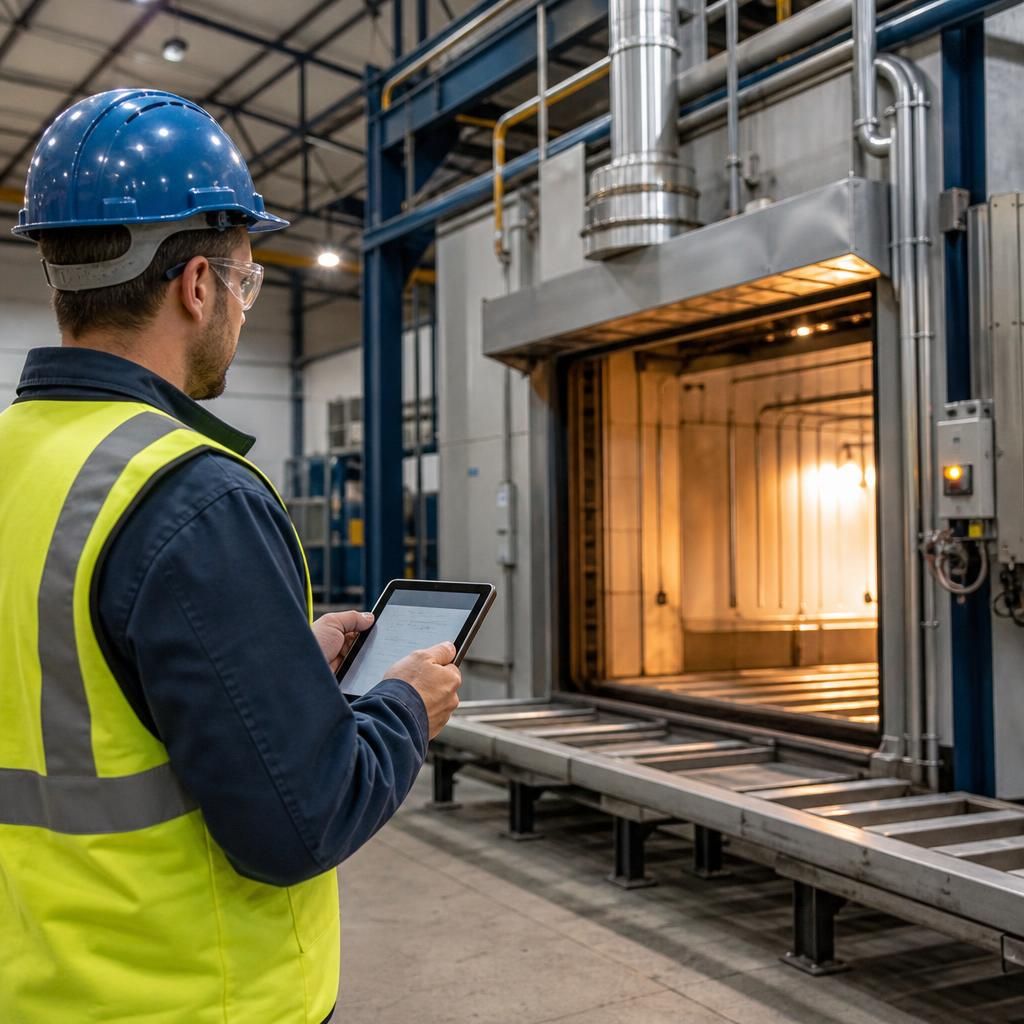
Energy management is an important environmental and safety consideration when selecting an aluminium powder coating provider because curing relies on heated ovens and controlled process conditions. Ask how the provider verifies oven temperature, maintains heating and extraction equipment, and prevents unnecessary energy use without compromising the powder manufacturer’s required cure schedule.
A lower-temperature or shorter cure is not automatically more sustainable if it produces under-cured parts that require rework or replacement. The provider should be able to explain how cure settings are selected for the specified powder and aluminium component, how temperature records are checked, and how faults are handled. Oven access, hot-surface protection, ventilation, combustion systems and electrical equipment should also be covered by documented risk assessments and maintenance procedures.
Ask about environmental and safety controls for your aluminium coating project
Contact the team to discuss your aluminium components, coating specification and the environmental and safety evidence required for your project. They can help clarify which process records and compliance information should be reviewed before work begins.