

What are the best practices for ensuring consistent quality in powder coating for aluminium sections?
Consistent quality in powder coating aluminium sections depends on controlled preparation, uniform application and carefully managed curing. Inspecting the aluminium, using compatible pre-treatment, maintaining consistent coating thickness and checking the finished surface at each stage helps produce a durable, even finish across every section.
Consistent quality in powder coating for aluminium sections is achieved by controlling the complete production system, not simply by applying powder to a clean surface. A clear coating specification, repeatable part handling, stable environmental conditions, calibrated equipment, controlled materials and documented inspection criteria are essential for producing sections that match one another in colour, coverage, appearance and service performance.
Agree the coating specification before production. The specification should identify the required colour, gloss level, coating type, intended environment, finish class, masking requirements and acceptance criteria. It should also state which faces are visible, which areas must remain uncoated and whether the sections will later be cut, drilled, assembled or exposed to chemicals, moisture or abrasion. This prevents assumptions that can lead to different interpretations between the customer and coater.
Assess the aluminium section design and handling method. Extrusions with deep channels, narrow returns, sharp transitions or enclosed areas can be more difficult to coat consistently than open, accessible profiles. The racking method should support the section without creating avoidable contact marks or obstructing important surfaces. Contact points need to be positioned where they will have the least visual and functional effect, particularly on architectural or visible components.
Keep material identification and storage under control. Powder should be stored in the conditions recommended for that product and protected from contamination, moisture and damage. Each batch should remain identifiable throughout the job. Mixing powders from different batches, finishes or product types without approval can create differences in colour, gloss or surface texture, even where the nominal colour reference is the same.
Control the production environment. Dust, airborne contamination, humidity and temperature can affect the appearance and reliability of a finish. The coating area, equipment and handling routes should be kept suitably clean, with procedures to prevent residues from previous colours or materials entering the next batch. Environmental conditions should be monitored where they could influence the coating system or the interpretation of inspection results.
Use a defined colour and appearance reference. A physical approved sample or agreed reference panel is more useful than relying only on a colour name. Evaluation should take account of the viewing angle, lighting and surface orientation, since gloss and texture can appear different on long aluminium sections than on a small flat sample. For repeat work, retaining an agreed reference supports consistent decisions between batches.
Separate colours and finishes methodically. Changes between colours, gloss levels and textures require suitable line-clearance and cleaning procedures. The order of production can also be planned to reduce the risk of carryover from a dark or strongly contrasting powder into a lighter finish. Any first-off section should be reviewed against the agreed specification before the full batch proceeds.
Calibrate and maintain production equipment. Powder delivery equipment, spray guns, measuring instruments, ovens and environmental monitors should be maintained according to a documented schedule. Calibration records help identify whether a variation is caused by the material, the equipment or the production conditions. Preventive maintenance is particularly important where worn components could alter powder flow or produce inconsistent coverage along a long section.
Use representative samples for approval. A sample should reflect the actual aluminium alloy, profile shape, racking arrangement and intended finish wherever possible. Approving a small flat test piece alone may not reveal issues associated with recesses, edges, contact points or the length of the production section. For larger or technically important projects, a first-off inspection provides an opportunity to resolve appearance and masking details before the remaining parts are processed.
Inspect more than the centre of the batch. Quality checks should include sections from relevant stages and positions in the production run rather than relying on a single item. Examine visible faces, ends, recesses and areas near racking points for colour variation, inclusions, pinholes, runs, impact marks and other defects. The inspection method should be agreed in advance so that decisions are based on consistent criteria rather than subjective preference.
Record traceability information. Useful records include the job reference, aluminium identification where supplied, powder product and batch details, equipment settings, sample approvals, inspection findings and any permitted rework. Traceability makes it easier to investigate a deviation and to reproduce an accepted result on a later order. It also helps distinguish a coating issue from a defect or variation originating in the aluminium itself.
Protect the finish after inspection. Aluminium sections can be damaged after coating through stacking, sliding, strapping or contact with unsuitable packing materials. Parts should be separated and supported in a way that avoids rubbing and concentrated pressure on visible faces. Handling instructions should be passed to the parties responsible for collection, fabrication and installation, especially where the coated sections will be cut or assembled after finishing.
For a repeatable result, the most effective approach is a written specification supported by an approved reference sample, controlled production records and agreed inspection standards. This gives manufacturers, fabricators and other commercial users a practical basis for comparing batches and addressing variation before coated aluminium sections move into assembly or installation.
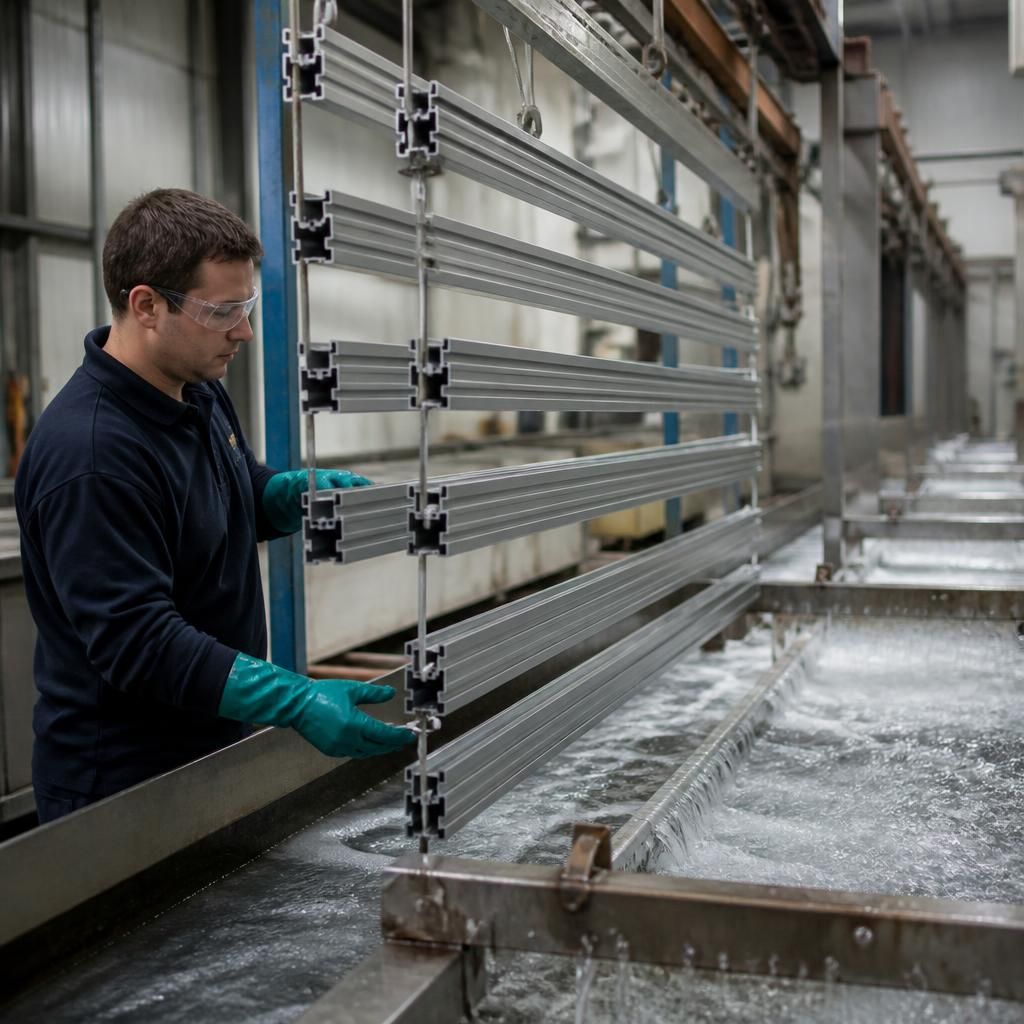
Aluminium sections need a preparation process suited to the alloy and the coating system. Oils, extrusion residues, oxide layers and handling contamination can interfere with adhesion, so cleaning should be followed by the appropriate etching, rinsing and conversion treatment before powder application. The prepared surface should then be kept free from further contamination while it moves to the spray stage.
Preparation quality is best checked before coating rather than judged only after curing. Inspectors should look for water-break behaviour, visible residue, staining and untreated areas, while also confirming that rinse stages and drying are effective. Consistent pre-treatment across the full length of each section is particularly important where profiles include recesses or difficult-to-reach faces, as localised preparation defects can lead to early adhesion failure even when the powder has been applied evenly.