

How does the thickness of powder coating applied to aluminium sections affect their performance and lifespan?
The thickness of powder coating on aluminium sections affects coverage, corrosion protection, appearance and resistance to wear. A coating that is too thin may leave the aluminium less protected, while excessive thickness can cause surface defects, dimensional problems and reduced performance; the correct specification depends on the section’s use, environment and coating system.
Powder coating thickness affects the service life of an aluminium section by determining whether the cured film provides continuous, well-bonded protection without interfering with the section’s fit, function or appearance. The correct result is not the thickest possible coating; it is a controlled film build within the range specified for the powder coating system and the intended service conditions.
Film thickness and protective performance
A cured powder coating forms a barrier between the aluminium and its surroundings. Its performance depends on the film being continuous and properly bonded to the pre-treated surface. If the specified build is not achieved in exposed areas, the coating may provide less resistance to handling damage, moisture and environmental attack. This is particularly important on edges, corners, joints and profile features where powder deposition can be less uniform than on broad, accessible faces.
Increasing thickness does not automatically compensate for poor surface preparation or uneven application. Contamination, inadequate pretreatment, incorrect curing or poor adhesion can shorten service life regardless of the measured film build. Thickness therefore needs to be considered as one part of the complete coating system rather than as an isolated measure of quality.
How thickness affects mechanical durability
A correctly specified film gives the aluminium a consistent surface that can withstand normal handling, assembly and service contact. Film build influences how much coating remains after minor abrasion or contact, but resistance to impact and scratching also depends on the powder formulation, cure, substrate preparation and the nature of the contact. A coating that is too heavily applied can be more prone to defects such as orange peel, runs, sags or uneven texture, especially where powder accumulates around profile features.
For sections that slide into channels, accept seals, fit into brackets or connect with other components, excess coating can alter clearances. It may make assembly more difficult, affect the seating of gaskets or interfere with moving interfaces. Masking may be required on threads, machined faces, electrical contact areas or other surfaces where coating is not wanted. These requirements should be agreed before processing so that the target thickness applies to the correct areas of the component.
Influence on appearance and profile geometry
Thickness variation is often visible as a change in texture, gloss or colour between different parts of the same aluminium section. Deep recesses, internal corners and closely spaced features may receive a different film build from outward-facing surfaces. The profile’s shape, orientation during coating and the way it is suspended can all influence deposition.
Consistent thickness is especially important where sections are joined together or installed side by side. A localised heavy build can make edges look rounded, reduce the definition of detail and change the apparent alignment of adjoining parts. Where dimensional tolerances are tight, the coating specification should identify critical surfaces and acceptable build limits rather than relying on a general thickness target for the whole section.
Relationship with curing
Powder coating must be heated sufficiently for the material to flow, bond and cure as intended. The relevant condition is the temperature reached by the aluminium and the time it remains at that temperature, not simply the temperature of the oven air. Section mass, wall thickness and the way components are loaded can affect this heating pattern.
Thickness does not replace correct curing. A heavier application may take longer to heat through and can make defects more apparent if the system is not processed correctly, while insufficient film build may expose the effects of incomplete coverage even when the coating has cured. The powder manufacturer’s technical data and the project specification should therefore be used together when setting application and curing requirements.
How thickness is checked in practice
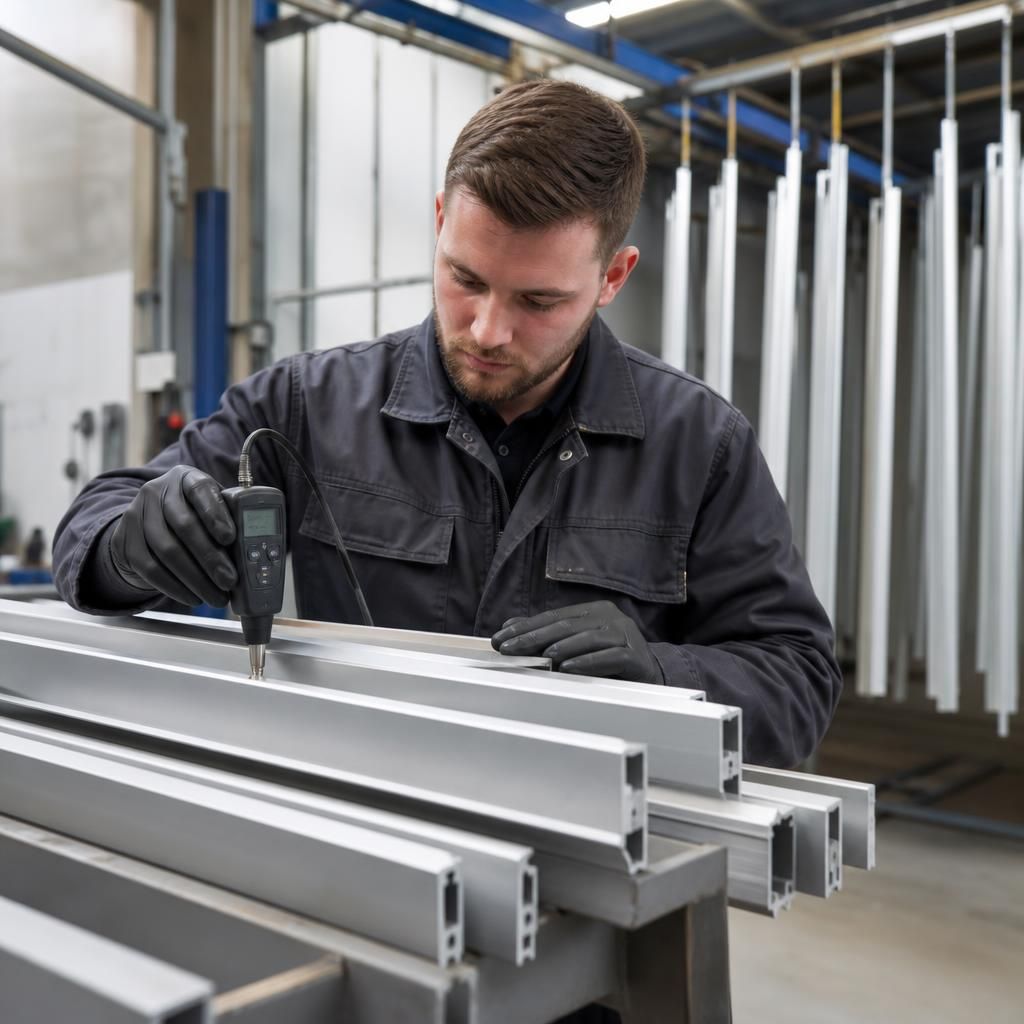
Dry film thickness is normally assessed after curing using a suitable non-destructive gauge for coated aluminium. Readings should be taken at representative positions rather than at one convenient point, because the ends, edges, recesses and accessible faces of a long section may not receive the same amount of powder. A suitable inspection plan will define the measurement locations, the target range and how isolated high or low readings are treated.
For repeat production, recording thickness results helps identify variation between batches and highlights problems with gun settings, part positioning, grounding, powder recovery or profile geometry. Visual inspection should accompany measurement because a reading within range does not by itself confirm sound pretreatment, adhesion, cure or freedom from pinholes and other defects.
Choosing the appropriate specification
The required film build should be selected from the coating system’s technical requirements and the section’s intended use. Considerations include exposure to weather, contact with chemicals, handling during installation, abrasion, dimensional tolerances and whether a primer and topcoat are being used. Where a multi-coat system is specified, the total build and the contribution of each layer need to be controlled, along with the compatibility and adhesion between coats.
For aluminium sections, provide the coater with drawings or samples that identify critical dimensions, masking requirements, areas subject to wear and any surfaces that must remain uncoated. This allows thickness targets to be assessed against the finished component’s function, rather than applied uniformly where a uniform build would create fit or assembly problems. The most reliable lifespan is achieved when substrate preparation, powder selection, application, curing and thickness inspection are treated as one controlled process.
The effect of powder coating thickness is closely linked to the way aluminium sections are cleaned and used. Where components face repeated washing, abrasive deposits or contact with chemicals, the coating specification should account for the exposure and the properties of the chosen powder system. Increasing film build alone will not make an unsuitable coating resistant to a particular cleaning agent or service condition.
Cleaning methods can also affect the coating over time. Abrasive tools, harsh chemicals and concentrated cleaning action may wear or damage the cured film, particularly at edges and contact points. For long-term performance, the required thickness should therefore be considered alongside the powder formulation, surface preparation and maintenance requirements. This approach helps ensure that the coating remains protective without introducing unnecessary build that could affect fit or appearance.
Discuss the Right Thickness for Your Aluminium Sections
If you are specifying powder coating for aluminium sections, share the drawings, critical dimensions, exposure conditions and required finish with our team so the target film build can be assessed against the component’s function. Contact us to discuss a suitable coating specification or request a quotation for your sections.