

How do environmental factors influence the selection of powder coatings for aluminium sections?
Environmental conditions determine the powder coating system required for aluminium sections, because coastal salt, moisture, ultraviolet exposure, temperature changes and industrial chemicals can affect corrosion resistance, colour stability and adhesion. Selection should therefore consider the section’s location, expected exposure and service conditions, alongside the required finish and performance.
Environmental factors influence powder coating selection by defining the level of protection, chemical resistance and colour retention required throughout an aluminium section’s intended service life. The correct specification depends on where the section will be installed, what it will be exposed to, how it will be cleaned and the consequences of coating failure.
Start with the exposure category
An internal architectural section in a dry, controlled environment generally faces less demanding conditions than an external section exposed to driving rain, airborne pollutants and repeated wetting. Sections used in sheltered locations may need a different coating system from those installed on exposed façades, transport infrastructure, industrial buildings or near the sea. The specification should record whether the aluminium is indoors or outdoors, sheltered or fully exposed, and whether moisture can collect at joints, recesses or horizontal surfaces.
Coastal locations require particular care because salt-laden moisture can remain on the surface and accelerate attack at weaknesses in the finish or around cut edges. A suitable system may require more robust pre-treatment, a coating designed for enhanced durability and closer attention to the section’s design. Powder coating protects the accessible surface, but it cannot compensate for unsealed joints, damaged areas or water traps that allow contaminants to remain in contact with the aluminium.
Match the coating chemistry to the exposure
Powder coatings are formulated for different performance characteristics. A system intended mainly for interior use may not be appropriate for prolonged external exposure, while an exterior-grade system can be selected where resistance to weathering and appearance change is more important. Epoxy-based coatings are valued for chemical and corrosion resistance but are generally not selected as the sole finish where long-term sunlight exposure and colour retention are primary requirements. Polyester systems are commonly considered for external applications because they can provide a balance of weathering performance, appearance and protection. The exact choice should be based on the required specification rather than on resin type alone.
Where the section will encounter oils, solvents, detergents, process fluids or other chemicals, the coating must be checked for compatibility with those substances and with the expected concentration, temperature and contact time. A finish that performs well in ordinary atmospheric exposure may soften, stain, blister or lose adhesion when exposed to an aggressive chemical. Occasional splashes, immersion, vapour exposure and repeated cleaning should be treated as different service conditions.
Consider sunlight and appearance requirements
Ultraviolet exposure can gradually alter a coating’s colour, gloss and surface condition. This matters particularly for visible aluminium sections, where adjacent components need to remain visually consistent. The choice should take account of the colour, gloss level and whether the section receives direct sunlight for much of the day. Dark or highly saturated colours can make changes more noticeable, while a matt or textured finish may have different appearance and cleaning characteristics from a smooth gloss finish.
Colour matching also needs an environmental context. A finish selected for a shaded entrance or internal frame may not be suitable for a fully exposed elevation. Where sections are installed in different orientations, the most exposed position should guide the specification. Samples and agreed reference standards can help define acceptable colour and gloss variation before production, particularly for large batches or components that will be viewed together.
Account for temperature and movement
Temperature affects both the aluminium substrate and the coating system. External sections may experience repeated heating and cooling, while industrial applications can involve elevated operating temperatures or contact with hot equipment. Aluminium expands and contracts with temperature changes, so the coating must remain sufficiently bonded and flexible for the design and service conditions. The expected temperature range, heat sources, duration of exposure and any thermal cycling should be provided when selecting the finish.
Temperature is also relevant during manufacture. Correct curing depends on the coating reaching its specified metal temperature for the required time. Sections with substantial differences in wall thickness, enclosed areas or complex geometry may heat unevenly, so process control is important when consistent performance is required. A coating that has not cured correctly may show reduced hardness, poor chemical resistance or weak adhesion, even if its appearance initially seems acceptable.
Review the aluminium section and its surrounding construction
Environmental performance is affected by the design of the section as well as the powder itself. Sharp edges, narrow recesses, threaded features and inaccessible faces can be more difficult to pre-treat and coat consistently. Cut ends, drilled holes and areas damaged during assembly may need suitable protection because they can become points where moisture enters beneath the finish.
Contact with other metals should also be considered. In a damp or contaminated environment, dissimilar metals can create conditions that promote galvanic corrosion. Insulating materials, suitable fixings and careful joint design can reduce this risk. Sealants, gaskets and adjacent materials must be compatible with the coating and should not trap water or release substances that stain or attack the finish.
Do not overlook cleaning and maintenance
The intended cleaning regime forms part of the environmental specification. A section cleaned with mild detergent presents a different requirement from one exposed to abrasive pads, high-pressure washing, alkaline cleaners or solvent-based products. Frequent cleaning can gradually affect gloss or surface texture if the method is too aggressive. The coating supplier or applicator should be given details of the proposed cleaning agents, equipment and frequency so that resistance can be assessed before the system is chosen.
Maintenance planning should also consider the type of contamination likely to accumulate. Salt, cement dust, metal particles, oil and industrial deposits may require different cleaning approaches. Prompt removal of deposits can help preserve the finish, but cleaning cannot restore a coating that has been mechanically damaged or chemically degraded. Any maintenance instructions should be followed consistently across the installation.
Use a specification based on the complete service environment
A practical environmental assessment should document:
- the installation’s location, exposure and degree of shelter;
- likely contact with salt, moisture, pollutants, chemicals or industrial deposits;
- direct sunlight, required colour stability and acceptable gloss change;
- normal and maximum operating temperatures, including thermal cycling;
- the cleaning products and methods that will be used;
- section geometry, joints, fixings, cut edges and contact with other materials; and
- the required appearance, durability and inspection criteria.
This information allows the coating system, pre-treatment, application controls and quality checks to be considered together. For aluminium sections, environmental selection is therefore not simply a choice of colour. It is a decision about the coating’s chemistry, preparation and application in relation to the conditions the finished component will actually face.
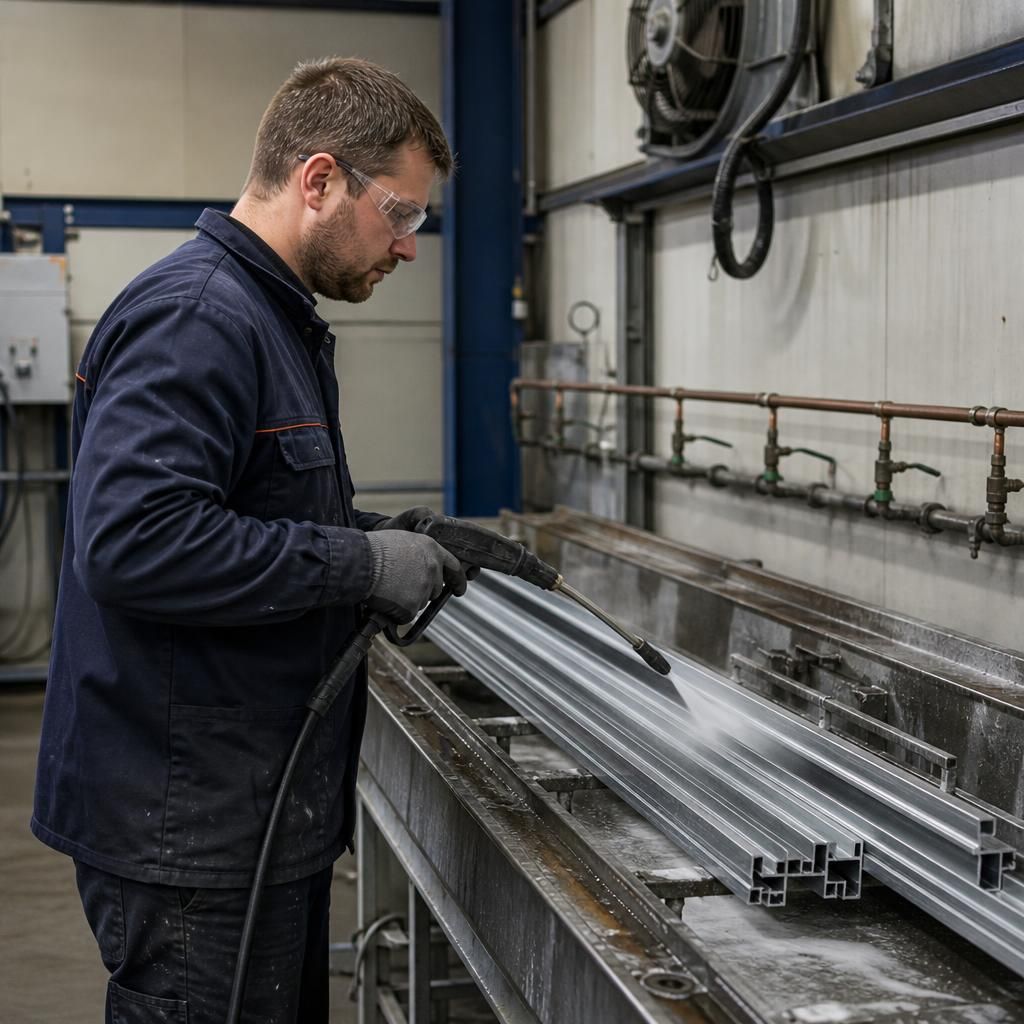
For aluminium sections, environmental durability depends on surface preparation as well as the powder coating itself. Aluminium quickly forms a natural oxide layer, and residues from fabrication, handling or previous treatments can prevent the coating from bonding consistently. Cleaning and suitable pre-treatment create a stable surface for application, helping the finish withstand moisture and other exposure conditions more reliably.
This is particularly important where sections will be installed outdoors or in contaminated environments. If preparation is inadequate, moisture can exploit weak areas and lead to loss of adhesion, blistering or corrosion around vulnerable points. The environmental specification should therefore identify the required preparation standard, not only the coating colour and finish.
Discuss your aluminium section coating requirements
Discuss your aluminium section coating requirements with our team, including the expected exposure, operating conditions, finish and maintenance regime. This information helps establish a coating specification suited to the component’s intended environment.