

How does the powder coating process contribute to achieving electrical insulation?
Powder coating contributes to electrical insulation by forming a continuous, cured dielectric layer over a conductive metal component, separating it from surrounding parts and reducing unwanted current flow. Electrostatic application, thorough surface preparation and controlled curing help achieve consistent coverage, including around edges and complex profiles where the specified coating system is suitable.
Powder coating contributes to electrical insulation by converting a conductive metal surface into a controlled dielectric barrier. The insulating performance comes from the cured coating formulation, the continuity and thickness of the finished film, and the way the coated component is designed, processed and tested for its intended electrical duty.
The coating material is the first consideration. Not every powder coating is suitable for insulation. An appropriate system must have electrical properties that match the component’s requirements, including insulation resistance, dielectric withstand and resistance to the expected temperature, moisture, chemicals and mechanical contact. The resin and additives influence how well the film resists current leakage and maintains its properties during service.
Film formation creates the physical barrier. During processing, the applied powder particles form a consolidated polymer film rather than remaining as separate particles. A sound film prevents direct contact between the metal substrate and adjacent conductive parts. It can therefore reduce the risk of leakage paths, accidental contact and short circuits, provided that the coating remains intact and the design does not rely on uncoated areas for insulation.
Uniform coverage is important because electrical failure can begin at a local defect. Areas that are too thin, porous, contaminated or mechanically damaged may have substantially lower insulating performance than the surrounding surface. Edges, corners, recesses, threaded areas and interfaces with brackets or fasteners require particular attention. The component specification should identify which surfaces need insulation and which areas must remain exposed for earthing, electrical contact or assembly.
- Specified thickness: the film must be thick enough for the required electrical duty, without creating dimensional problems at mating faces, holes or threads.
- Continuity: the finished surface should be free from pinholes, bare patches, blisters, cracks and inclusions that could provide a leakage route.
- Adhesion: the coating must remain attached when the component is handled, assembled or exposed to vibration, impact, moisture and temperature changes.
- Surface condition: oil, scale, corrosion and other contaminants can interfere with the integrity of the insulating film and may also promote failure beneath it.
Process control turns the material specification into repeatable insulation. Powder application and oven conditions need to be matched to the powder manufacturer’s technical requirements and to the component’s mass and geometry. A heavy metal section may behave differently from a thin fabricated part, while recesses and shielded faces can receive a different coating build from open surfaces. Monitoring these variables helps prevent under-processed areas, excessive build and inconsistent results between batches.
Testing should be selected according to the component’s electrical function rather than treated as a general quality check. Coating thickness and visual inspection can identify some process defects, while insulation-resistance and dielectric-withstand tests assess how the finished part performs under electrical stress. Where relevant, pinhole or holiday detection can help locate small discontinuities. Test voltage, duration, conditioning and acceptance limits should come from the product design, applicable industry requirements or the customer’s specification.
Powder coating is not a substitute for the complete electrical design. Clearances, creepage distances, earthing arrangements, masking requirements and the performance of adjoining insulating materials still need to be considered. A coated enclosure, busbar support or metal bracket may provide useful surface insulation, but exposed fasteners, cut edges, joints and damaged areas can remain conductive. Designers should also consider whether the coating will be drilled, bent, abraded or removed during assembly, since any such operation can interrupt the intended barrier.
For manufacturers and fabricators, the coating specification should therefore state the substrate, required coated surfaces, target film characteristics, areas to mask, acceptable finish and electrical tests required. Supplying representative drawings or sample components helps the coater assess difficult features before production. This approach links the powder formulation and application process to the actual insulation function, rather than assuming that a standard decorative finish will provide the necessary protection.
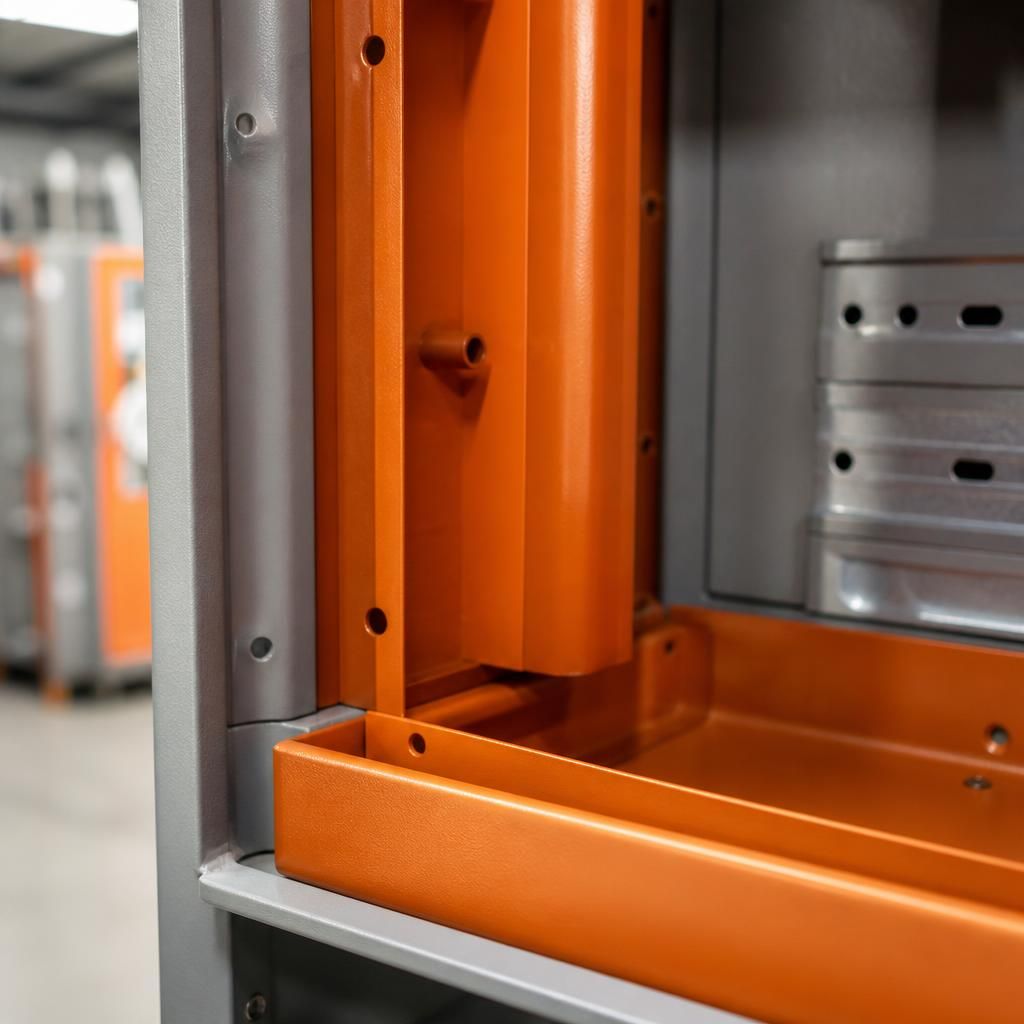
Electrical insulation is also influenced by the shape of the coated component. Sharp edges, narrow gaps and abrupt changes in profile can concentrate electrical stress, even where the surrounding powder film appears sound. A suitable coating design therefore considers edge geometry alongside the required film properties, helping maintain separation between conductive parts and reducing the likelihood of a local breakdown path.
This is particularly relevant for enclosures, brackets and fabricated assemblies with close-fitting components. The powder coating provides the dielectric surface layer, while the component design determines how effectively that layer separates conductive areas under operating conditions. Coating requirements should consequently identify critical edges, interfaces and clearances rather than specifying colour and overall appearance alone.
Discuss Your Electrical Insulation Requirements
Discuss your electrical insulation requirements with our team to identify the appropriate coating specification and verification approach for your component. Include details of the intended electrical duty and service environment so the assessment reflects the complete application.