

How does powder coat pretreatment improve the adhesion and longevity of aluminium?
Powder coat pretreatment improves aluminium by removing contaminants and preparing the surface so the powder coating bonds consistently rather than relying on adhesion to untreated metal. It also helps protect the aluminium from corrosion beneath the coating, supporting a more durable finish and longer service life.
Powder coat pretreatment is the controlled sequence of cleaning, etching, rinsing and chemical conversion used to condition aluminium before powder is applied. Its main purpose is to create a chemically active, uniform interface between the aluminium and the cured coating, so adhesion remains dependable when the component is exposed to moisture, temperature changes, handling and service conditions.
Why aluminium needs controlled pretreatment
Aluminium develops a thin oxide film almost immediately after exposure to air. This film is not necessarily a suitable bonding surface, particularly where it is mixed with residues from extrusion, machining, forming or storage. Oils, drawing compounds, fingerprints, polishing residues, dust and weld contamination can also interfere with the coating interface. Pretreatment controls these variables rather than relying on the appearance of bare metal alone.
Aluminium alloys and component types can behave differently during treatment. Extrusions may carry lubricant residues from manufacture, castings can have porous or irregular surfaces, and fabricated assemblies may contain weld zones with different oxide characteristics from the parent metal. The treatment sequence therefore needs to suit the alloy, surface condition, geometry and intended service environment.
Typical stages in the process
- Pre-cleaning and degreasing: Alkaline or specialist cleaners loosen oils, process residues and handling contamination. The cleaner must be strong enough to work effectively without causing excessive attack on the aluminium.
- Rinsing: Intermediate rinses prevent cleaner carry-over into later tanks. Poor rinsing can leave alkaline residues that affect the conversion stage and contribute to coating defects.
- Etching or controlled surface activation: This can remove a thin, inconsistent surface layer and produce a more even condition across the component. Excessive etching is undesirable because it can alter dimensions, mark the surface or create an uneven appearance.
- Deoxidising and desmutting: These stages address oxide films and alloying-element residues that may remain after cleaning or etching. They are particularly relevant where the alloy contains elements that form insoluble surface deposits.
- Conversion treatment: A very thin conversion layer is formed on the aluminium. Depending on the specification and environmental requirements, this may use a chromate or chrome-free chemistry. The layer provides a more receptive interface for the powder coating and supports resistance to underfilm degradation.
- Final rinse and drying: Thorough rinsing removes soluble chemical residues, while controlled drying prevents trapped moisture from affecting powder application or curing.
How the treatment supports adhesion
Good adhesion depends on both chemical compatibility and consistent surface texture. A conversion layer can provide sites for interaction with the coating binder, while controlled surface conditioning gives the powder a stable base during melt and cure. This is more reliable than treating every aluminium surface as chemically identical.
Pretreatment also reduces the risk of localised adhesion loss. A component may appear well coated overall while small areas around welds, recesses, edges or handling points remain vulnerable. Uniform chemical exposure, effective drainage and complete rinsing are therefore as important as the choice of pretreatment chemistry.
How it improves longevity
A powder coating is a continuous protective film, but service life is influenced by what happens at any damaged edge, cut end, joint or coating imperfection. A suitable conversion layer helps limit the movement of moisture and corrosion products beneath the surrounding film. This reduces the likelihood that a small defect will develop into wider lifting, blistering or flaking.
The benefit is especially important for aluminium used outdoors, in humid locations, near roads, or where cleaning chemicals and industrial contaminants are present. The correct pretreatment does not make the coating immune to damage; rather, it gives the coating system a stronger and more stable foundation.
Factors that determine pretreatment quality
- Surface condition: Heavy oxidation, embedded dirt, lubricant residues and previous coatings may require additional preparation or a different sequence.
- Chemical control: Cleaner strength, bath condition, temperature, contact time and solution contamination must be monitored. Under-treatment can leave residues or inactive areas, while over-treatment may attack the substrate.
- Rinse quality: Inadequate rinsing can transfer chemicals between stages or leave soluble deposits on the part.
- Water quality: Dissolved salts and other impurities can remain on the surface after drying and undermine consistency.
- Component design: Hollow sections, blind recesses, overlaps and complex fabrications need suitable drainage and handling to prevent retained treatment liquid.
- Time before coating: Treated aluminium should be kept clean and protected from recontamination before powder application.
Checking the finished result
Visual inspection can identify staining, patchiness, residue, water marks and missed areas, but it is not sufficient on its own. Process records, chemical-bath checks and adhesion testing provide a more meaningful assessment. Testing may include a cross-hatch adhesion assessment, while corrosion-performance testing can be specified where the component has demanding environmental exposure.
When investigating poor adhesion, the powder and curing cycle should not be considered in isolation. Common causes include incomplete cleaning, incompatible treatment for the alloy, poor rinsing, retained moisture, recontamination between stages and damage during handling. Reviewing the entire preparation sequence usually gives a more accurate diagnosis than simply changing the powder.
For batch or fabricated aluminium work, the pretreatment specification should be agreed alongside the coating requirement. The relevant alloy, component use, exposure conditions, appearance expectations and any testing standard all influence the appropriate process. A powder coating provider with suitable aluminium preparation capability can use this information to select and control a pretreatment system that supports consistent adhesion and long-term coating performance.
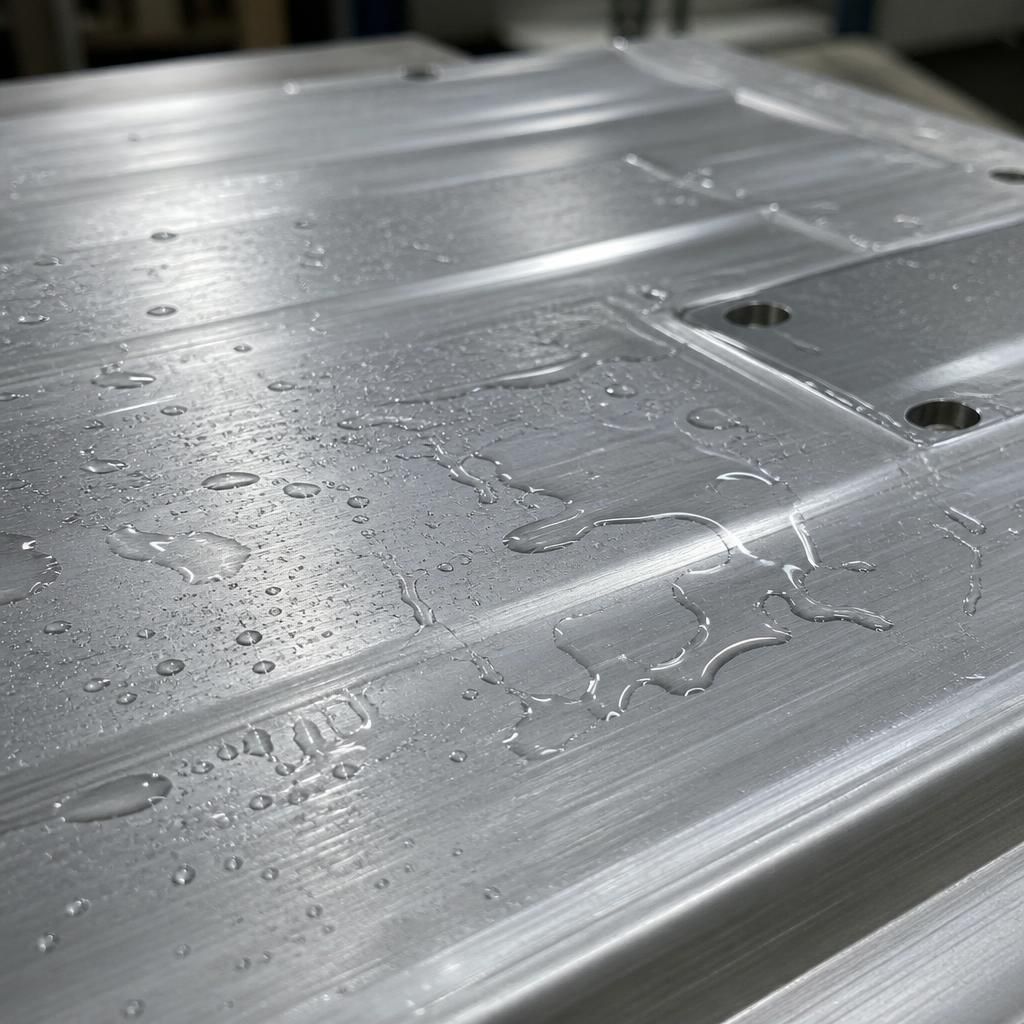
A water-break test provides a practical check that aluminium has been cleaned evenly before conversion treatment. When water forms a continuous film across the surface, the metal is generally free from oily contamination; beads, gaps or areas where water retracts can indicate residual grease, handling marks or other substances that may interfere with adhesion.
This check is useful because a component can look clean while still carrying a thin contaminant layer. Testing representative areas, including weld zones, recesses and edges, helps identify incomplete cleaning before powder is applied. It does not replace control of the full pretreatment process, but it can highlight problems early and reduce the risk of localised coating failure caused by an inconsistent surface.