

How does curing impact the quality and durability of powder-coated aluminium?
Curing melts and chemically bonds the powder into a continuous coating film on the aluminium. Correct control of the curing temperature and time develops the finish’s adhesion, hardness, appearance and resistance to corrosion, while insufficient or excessive curing can reduce performance and durability.
Curing determines whether powder-coated aluminium develops its specified mechanical and protective performance. The coating must receive the correct combination of metal temperature and dwell time for the powder chemistry; the oven air temperature alone is not a reliable measure of whether the part is fully cured.
During the process, the powder first flows across the aluminium surface and then cross-links to form a stable polymer film. This cross-linking affects the coating’s resistance to impact, abrasion, chemicals, moisture and weathering. A correctly cured finish remains more stable in service, whereas a coating that has not reached its required cure may remain comparatively soft or vulnerable.
Why aluminium requires careful control
Aluminium conducts heat differently from heavier steel components, and sections with varying wall thicknesses, hollow profiles, folded edges or attached fixtures may heat at different rates. The oven may reach its set temperature before the coldest part of a component has reached the temperature required by the powder manufacturer. Cure calculations therefore need to consider the temperature of the aluminium itself and the time it remains at that temperature.
Part size, loading density, hanging arrangements and airflow can all influence heat transfer. A densely loaded oven or a large assembly may take longer to reach the correct metal temperature than a small, open component. Treating every aluminium part as though it has the same thermal behaviour can produce inconsistent results between batches.
Effects of insufficient curing
- Reduced hardness, allowing the surface to mark, scratch or wear more readily.
- Lower resistance to impact and handling damage.
- Poorer resistance to solvents, cleaning products, oils or other chemicals.
- Inferior adhesion or reduced resistance to moisture reaching the metal interface.
- Variation in gloss, colour or surface texture compared with the approved finish.
Under-cured powder may look acceptable immediately after coating, so visual inspection alone cannot confirm performance. Problems can become apparent only when the part is assembled, transported, exposed to cleaning chemicals or placed in an outdoor or industrial environment.
Effects of excessive curing
More heat or more time is not automatically safer. Excessive curing can discolour some finishes, alter gloss or texture, embrittle the coating and reduce the intended appearance of the aluminium. It may also be particularly noticeable with light colours, bright finishes or components where colour matching matters. The applicable powder data sheet should therefore be followed rather than extending the oven cycle as a general precaution.
How the cure schedule is selected
The powder manufacturer’s technical data normally specifies a cure schedule based on the temperature reached by the metal, often allowing alternative combinations of temperature and time. The selected schedule must also suit the component’s thickness, geometry and intended service environment. Powder type, required finish, substrate preparation and any previous thermal exposure may affect the acceptable process window.
For repeat production, the coating process should be controlled consistently from batch to batch. Useful checks include:
- Confirming that the powder is suitable for aluminium and the required end use.
- Monitoring the actual part temperature rather than relying solely on the oven display.
- Allowing enough dwell time after the coldest area has reached the specified temperature.
- Checking film thickness and appearance after curing.
- Investigating changes in colour, gloss, adhesion or hardness instead of accepting visual consistency as proof of cure.
Part temperature monitoring is especially important for large aluminium sections, complex assemblies and loads containing components of different thicknesses. Where the design permits, representative test pieces or instrumented parts can help establish how the load heats and whether the slowest-heating areas receive the required cure.
Curing also works in conjunction with the earlier stages of powder coating. A sound cure cannot compensate for contamination, unsuitable pretreatment, poor rinsing, incorrect film build or inadequate application. Conversely, a well-prepared aluminium surface still needs the powder to be correctly cured if the finished coating is to provide its intended durability.
For a coating specification, the key requirements are the powder system, approved cure schedule, target appearance, film-thickness range, substrate condition and service environment. Defining these points before processing gives the coater clear acceptance criteria and makes it easier to identify whether a defect results from curing, preparation, application or the component itself.
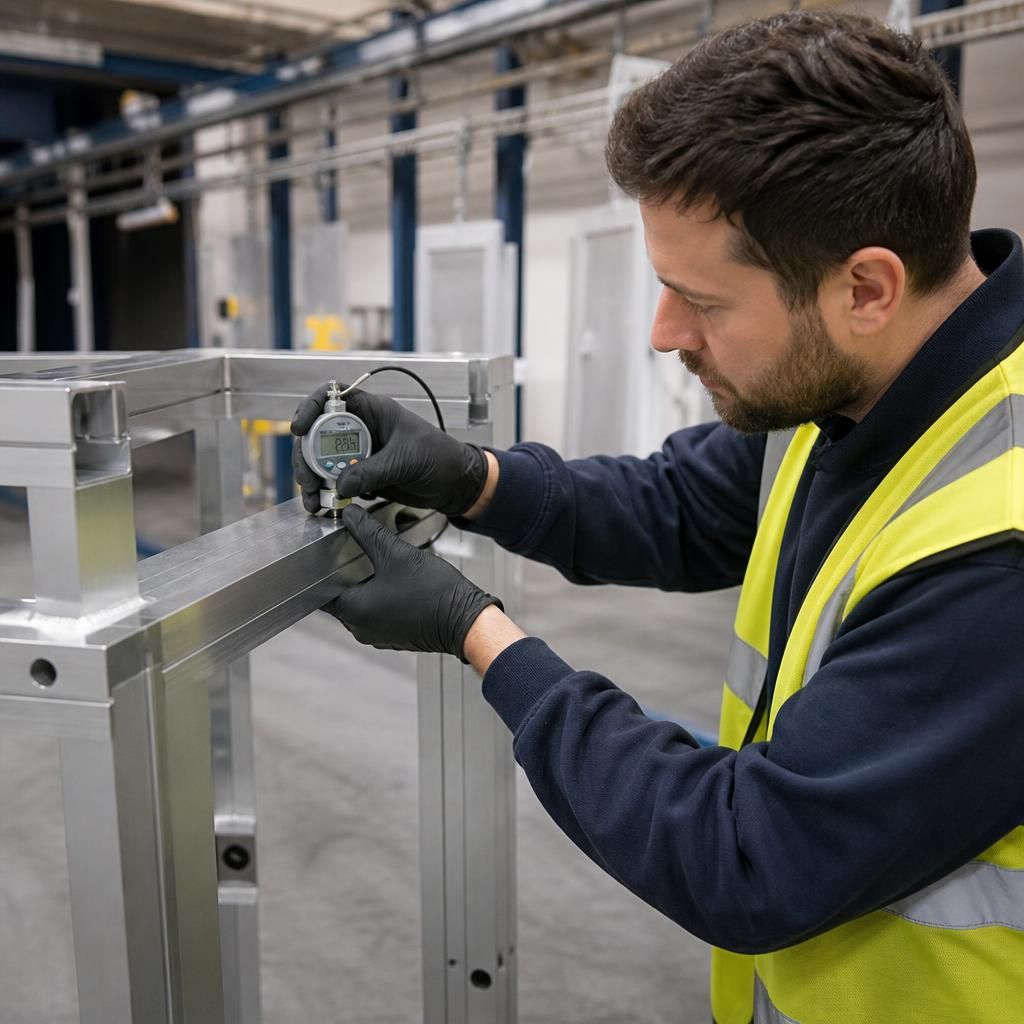
Curing quality should be assessed across the complete aluminium component, not only on its most accessible surface. Corners, recesses, joints and areas close to hanging points can experience different airflow and heat transfer from exposed faces. These locations may therefore show changes in gloss, hardness or adhesion before a defect becomes obvious elsewhere.
For critical components, the finished coating should be checked against the agreed specification using appropriate assessments of appearance, film thickness and coating performance. Comparing results from representative areas helps identify localised curing variation and supports consistent quality across repeat batches.