

What types of finishes can electrostatic powder coating achieve?
Electrostatic powder coating can produce smooth gloss, satin and matt finishes, as well as textured, metallic and specialist protective finishes. The selected powder formulation and curing process determine the coating’s appearance, texture and functional performance.
Electrostatic powder coating can be specified to achieve a particular colour, reflectance, surface profile, visual effect and level of functional performance. The final finish is determined not only by the powder itself, but also by the metal substrate, preparation, application technique, coating thickness and curing conditions.
Colour is usually the first part of the specification. Powder systems are available in a broad range of standard colours, with options for solid, translucent and effect-based appearances. A colour should be agreed using a physical sample or an appropriate colour reference, because the same nominal colour can appear different when applied over different substrates or viewed under different lighting. The selected colour can also look different according to the coating’s surface profile and degree of light reflection.
Finish specification can also include the way light is reflected from the surface. Rather than describing appearance by colour alone, a coating may be selected for a particular level of reflectivity, from a highly light-reflective surface through to one that diffuses light. This distinction is important where components must match existing painted, coated or manufactured parts.
Surface profile affects both appearance and practical performance. A finely raised surface can help disguise minor visual variation in the underlying metal, while a more pronounced profile changes the way the component looks and feels. These effects must not be used to compensate for poor preparation: oil, rust, mill scale, weld contamination and other defects can remain visible or interfere with adhesion if they are not dealt with before coating.
Special-effect powders can create visual variation within the surface, including flecked, mottled, pearlescent or other decorative appearances. These finishes are more sensitive to application technique than a straightforward single-colour coating. Powder recovery, spray direction, film thickness and the orientation of the component can all influence how consistently the effect appears across a batch.
For industrial parts, the finish may be selected primarily for its function rather than its decorative appearance. Different powder chemistries can be chosen to provide combinations of:
- resistance to weathering and ultraviolet exposure;
- resistance to chemicals, oils or cleaning agents;
- hardness and resistance to abrasion;
- reduced friction or easier release from the surface;
- electrical insulation where the coating system is suitable for that application; and
- additional resistance to impact, wear or handling damage.
Nylon powder coating is one specialist option where a tougher, low-friction or more wear-resistant surface is required. It is often considered for components exposed to repeated contact, sliding, abrasion or noise reduction requirements. The correct suitability depends on the component’s operating environment, dimensional tolerances and service conditions.
The metal itself places limits on the result. Welds, sharp edges, drilled holes and areas with different surface roughness can accept powder differently from broad, even faces. Hollow sections and tubular components also require suitable access, drainage and masking so that the coating reaches the intended surfaces without obstructing holes, threads or mating faces.
Curing converts the deposited powder into a continuous coating. Insufficient or uneven curing can affect hardness, adhesion, colour and final appearance, while excessive heat or an unsuitable cure schedule can alter the finish or affect the substrate. The specified powder therefore needs to be compatible with the metal, the component’s dimensions and the available curing process.
For a production batch, the finish specification should identify the colour reference, visual appearance, acceptable variation, required coating chemistry, areas to be left uncoated and any performance requirements. Samples or an approved first-off component can help establish expectations before the full batch is processed, particularly where colour consistency, complex geometry or a special-effect appearance is important.
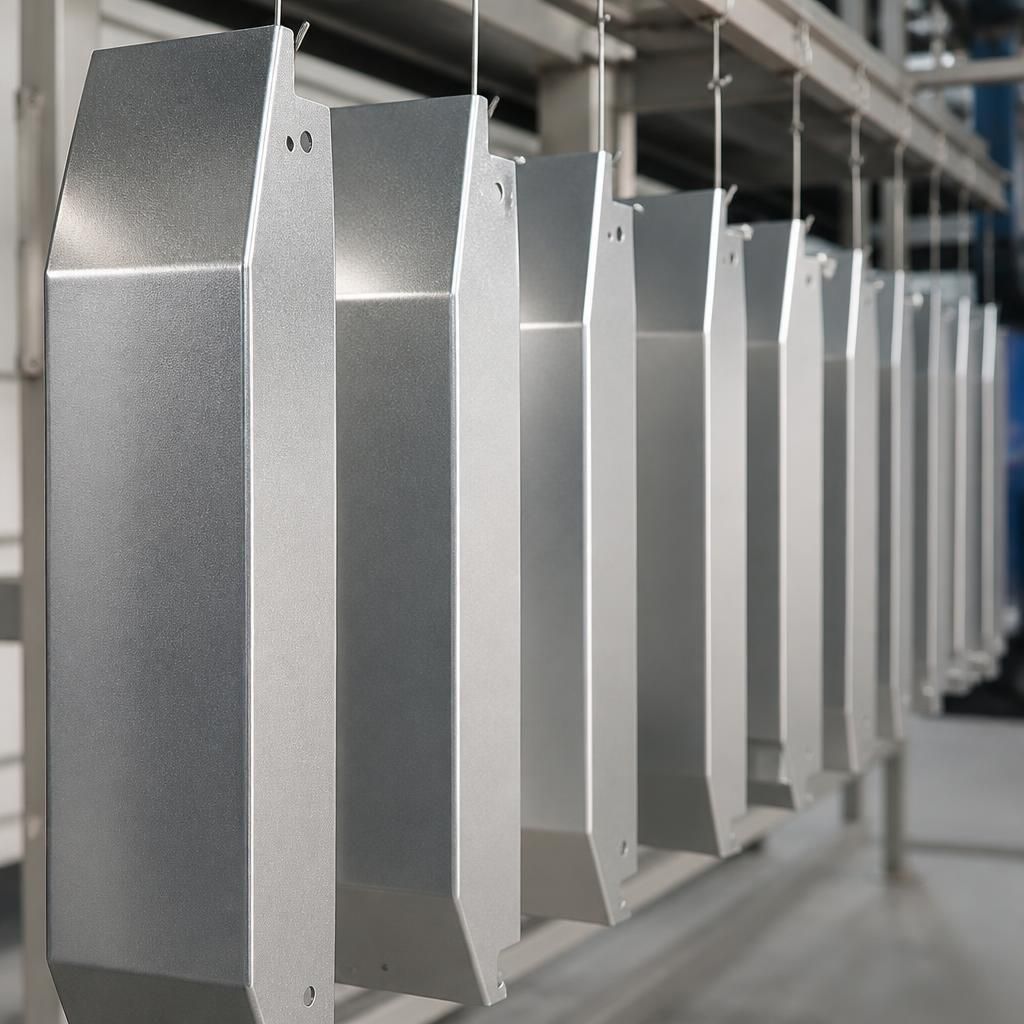
Metallic powder coatings create finishes with a reflective, aluminium-like or sparkle effect rather than the uniform appearance of a standard solid colour. They are available in different visual styles, from subtle metallic tones to more pronounced effects, and can be used where a component needs additional visual depth without resorting to liquid paint or metal plating.
Consistency is particularly important with metallic finishes. The orientation of the part, spray direction, film build and curing conditions can influence how the metallic particles present at the surface. For this reason, the finish should be assessed on a representative sample or first-off component, especially when coating panels, enclosures or batches of components that will be installed next to one another.
Discuss your electrostatic powder coating finish requirements
Discuss your electrostatic powder coating finish requirements with Powder-coatings.co.uk, including the component’s intended use, appearance and performance criteria. Share your drawings, specifications or sample requirements so the suitable finish can be assessed for your application.