

What criteria should be used to evaluate the environmental impact of electrostatic powder coating compared to other coating methods?
Evaluate electrostatic powder coating against other methods by comparing volatile organic compound (VOC) emissions, hazardous waste, overspray recovery, material efficiency, curing energy, surface-preparation impacts, coating lifespan and end-of-life recyclability. A fair assessment should use the same functional requirements and consider the full lifecycle, since a coating requiring more energy to apply may still have a lower overall impact if it lasts longer and needs less maintenance or replacement.
Environmental performance should be evaluated across the coating’s complete life cycle, not by application emissions alone. The most useful comparison considers the same component, required film performance and service life, then examines raw materials, surface preparation, application, curing, maintenance and disposal. This avoids favouring a process simply because it performs well at one stage while creating greater impacts elsewhere.
Define the comparison before collecting data. A suitable functional basis might be the protection and appearance provided to a specified metal component for its intended service period. Compare like with like: coating thickness, corrosion category, colour, gloss, durability, repair requirements and expected replacement interval should be equivalent. Comparing one coat of powder to a multi-coat liquid system without accounting for the different performance requirements can produce a misleading result.
The assessment should also state its system boundary. A narrow boundary may cover only coating application and curing, whereas a broader life-cycle assessment includes powder or paint manufacture, packaging, transport, pre-treatment chemicals, wastewater, energy generation, maintenance, stripping and end-of-life treatment. Both approaches can be useful, but the boundary must be consistent for every method being compared.
Assess the composition and hazard profile of the coating materials. Powder coating is supplied as a dry formulation rather than a liquid containing a solvent carrier, so solvent-related emissions during application are generally a different consideration from those associated with conventional solvent-borne paint. This does not mean that every powder formulation has the same environmental profile. Resin chemistry, pigments, additives and curing requirements can affect embodied impacts, worker controls and disposal arrangements. A proper review should examine safety data sheets and technical data sheets rather than treating all powder as one material.
Liquid coatings should be assessed on the same basis. The relevant questions include the type and quantity of solvent or water carrier, emissions during spraying and drying, hazardous constituents, cleaning solvents and the treatment of contaminated wipes, filters and containers. Water-based products may reduce some solvent emissions, but their manufacture, drying energy, additives and wastewater implications still need to be considered.
Measure material efficiency at the point of application. Record the quantity of coating purchased, the quantity deposited on the component and the quantity that becomes waste. Electrostatic attraction can help powder adhere to suitably prepared metal, while unused overspray may be collected where the equipment and formulation permit. The calculation should nevertheless allow for reclaim losses, contamination, colour changes, fines, booth residues and material that cannot be reused. Liquid systems should similarly account for spray losses, mixed material that exceeds the job requirement, gun and line cleaning, and containers that retain residues.
Recovery is not automatically equivalent to recycling. Recovered powder may have restrictions on blending, colour consistency or performance, and material that cannot be reused may require controlled disposal. Evidence should therefore distinguish between material captured, material returned to the process and material ultimately discarded.
Include surface preparation rather than assessing the topcoat in isolation. Degreasing, abrasion, blasting, conversion treatments and rinsing can consume water, chemicals and electricity. They may also produce spent abrasives, sludge, contaminated rinse water and wastewater-treatment residues. A coating that appears favourable at the application stage may have a larger overall burden if it requires a particularly intensive preparation regime for the substrate or service environment.
Preparation should be compared according to the finish actually required. The review can record chemical consumption, bath life, drag-out, rinse-water demand, waste classification, extraction and the energy used for drying. It should also check whether the chosen preparation reduces later failures; premature coating breakdown can create additional stripping, rework and replacement impacts.
Calculate curing and drying energy using real operating conditions. The relevant measure is not simply the nominal oven temperature. Energy use depends on component mass, line loading, air movement, insulation, heat recovery, warm-up cycles, curing time and the energy source. Record energy per batch or per coated surface area where possible, and ensure that comparisons include flash-off, drying or multiple heating stages required by alternative systems.
Electricity and fuel should be reported separately where this affects the result, with the assessment dated because the emissions associated with energy supply can change. An oven running below capacity may have a very different impact per component from the same oven operating with a well-filled batch. This makes production pattern and loading important parts of the comparison.
Give durability a measurable role in the evaluation. The coating with the lowest application impact is not necessarily the lowest-impact option over the asset’s life. Consider adhesion, resistance to corrosion, chemicals, abrasion, ultraviolet exposure, impact and temperature, according to the component’s actual environment. Use relevant test results, specifications and field requirements rather than assuming that a thicker or harder finish will always last longer.
Maintenance should be modelled as part of the service period. Include washing, touch-up, recoating, removal of failed material, transport and any component downtime or replacement. If a coating system lasts longer or avoids an additional coating cycle, that benefit should be credited only when supported by comparable performance evidence.
Evaluate end-of-life according to the complete coated article. Metal can often enter established recycling streams, but the coating itself remains part of the article until it is removed or processed. The assessment should ask whether the finish interferes with sorting, shredding, melting or reuse; whether stripping is needed; and what residues are generated. A thin, well-adhered coating and a heavily layered or contaminated article may present different recycling considerations.
Recyclability should not be reduced to a simple claim that a material is recyclable. State the assumed route, the need for pre-treatment, the fate of removed coating and whether the assessment concerns reuse, remanufacture or metal recovery. If the component is likely to be refurbished rather than melted, the durability and repairability of the coating become especially relevant.
Use comparable, transparent evidence. Useful records include coating consumption, reclaim and waste records, electricity or fuel data, preparation chemicals, water use, wastewater documentation, transport distances and product safety information. Supplier data should identify whether figures cover manufacture, packaging or delivery. Operational measurements from the actual line are preferable to generic assumptions, particularly for oven energy and material losses.
Results should be presented with assumptions, exclusions and sensitivity checks. For example, test how the conclusion changes if service life, oven loading, recovery rates or the need for recoating is altered. This identifies which variables matter most and prevents a precise-looking result from concealing uncertainty.
For a business assessing an industrial coating route, the practical conclusion is to select the system that meets the required protection and finish with the lowest credible life-cycle burden. Powder coating may perform strongly where its formulation, transfer efficiency, recovery arrangements, curing system and expected durability suit the component, but the outcome depends on the powder chemistry, preparation method, production conditions and end-of-life route. A documented comparison on the same functional basis is more reliable than judging environmental impact from the coating type alone.
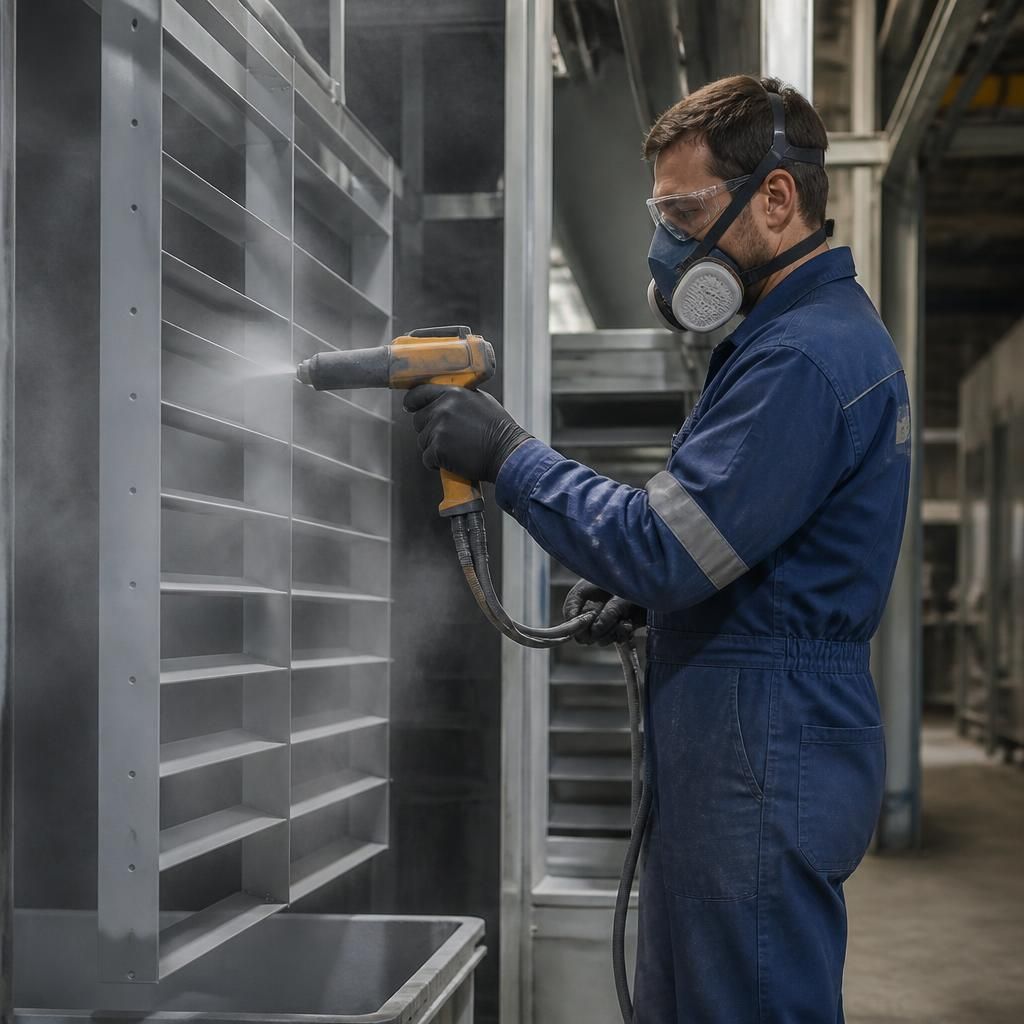
Environmental comparison should distinguish between the pollutants released during application and those produced during curing. Electrostatic powder coating avoids the solvent-carrier emissions associated with many liquid systems, but spraying can still generate airborne powder, while heating may release compounds from the resin, pigments or additives. The relevant evidence therefore includes extraction performance, dust-control arrangements, curing-oven exhaust and the formulation’s safety information.
These findings should be recorded separately rather than combined into a single claim such as “low-emission coating”. A method may have limited application emissions but still require controls for airborne particulate or oven exhaust. Comparing the type, quantity and control of each emission gives a more accurate picture of environmental performance and helps identify which improvement—such as better capture, filtration or curing control—would have the greatest practical effect.