

How can the choice of powder materials impact the performance and finish quality in electrostatic powder coating?
Powder material selection directly affects the coating’s adhesion, chemical and corrosion resistance, weatherability, hardness, flexibility and visual appearance. The resin chemistry, pigment, additives and particle characteristics must suit the metal component’s operating environment and the specified curing conditions to produce a consistent, durable finish.
The choice of powder material determines how the coating behaves during application, curing and service, and it also influences whether the finished surface is smooth, textured, matt, satin or gloss. A suitable specification must therefore match the powder chemistry and formulation to the component’s substrate, environment, geometry, required appearance and production process rather than selecting a colour alone.
Resin chemistry sets the main operating limits
Powder coatings are formulated around a resin system, with different systems intended for different conditions. Polyester powders are commonly selected for components exposed to external environments because their formulation can provide resistance to sunlight and changing weather conditions. Epoxy powders are often used where protection from chemicals and strong adhesion to prepared metal are important, particularly on components used indoors. Epoxy-polyester hybrids can provide a balance of indoor performance and appearance, while polyurethane systems may be specified where a refined surface and particular resistance characteristics are required.
These categories are not interchangeable. A powder designed primarily for interior use may not retain its intended appearance under prolonged ultraviolet exposure. Conversely, selecting an exterior-grade system for an indoor component can add unnecessary specification requirements. The correct choice depends on the actual service environment, including exposure to moisture, sunlight, cleaning agents, oils, abrasion and elevated temperatures.
Thermoset and thermoplastic powders behave differently
Most conventional industrial powder coatings are thermoset materials. During curing, chemical cross-linking changes the powder into a continuous coating that cannot simply be melted and reshaped again. This produces a stable film when the correct time and metal temperature are achieved.
Thermoplastic powders, including some nylon formulations, melt and fuse without the same cross-linking reaction. They can be useful where a thicker, resilient or low-friction coating is required, but their application and heating requirements differ from those of conventional thermoset powders. The component design, permitted coating thickness and end-use conditions must all be considered before choosing this route.
Formulation affects the visual result
Resin, pigment, matting agents, flow modifiers and texture additives all contribute to the final appearance. Gloss level is controlled by the formulation and curing behaviour, while textured finishes depend on the distribution and reaction of specific additives. A matt or fine-textured powder can disguise minor surface variation more effectively than a high-gloss finish, which tends to reveal scratches, dents, grinding marks and uneven preparation.
Pigment selection affects colour stability and can influence how consistently a batch matches an approved sample. Metallic and special-effect powders may require tighter control than standard solid colours because their visual effect can change with film thickness, spray direction, gun settings and the way the powder particles orient during application. Parts intended to match across separate production runs should be specified using an agreed sample or recognised colour reference, with the application method kept consistent.
Particle characteristics influence application quality
Powder particle size and distribution affect how the material charges, travels towards the earthed component and melts on the surface. A formulation with unsuitable particle characteristics can produce uneven deposition, excessive overspray, poor penetration into recesses or a rough surface after curing. Very fine particles may create handling and application difficulties, while coarse or inconsistent material can affect transfer and film uniformity.
Component geometry is important here. Recesses, corners, holes and closely spaced sections can create a Faraday cage effect, where the electrostatic field makes it harder for powder to reach sheltered areas. Powder selection cannot remove this physical limitation, but a formulation with suitable charging and flow behaviour, combined with appropriate gun settings and spray technique, can help produce more even coverage. The design may also require attention to masking, racking and the order in which areas are sprayed.
Additives support particular service requirements
Specialist additives can modify the coating’s resistance to ultraviolet exposure, weathering, chemicals, abrasion, impact, friction or surface marking. They can also control flow, degassing and texture. However, an additive that improves one characteristic may affect another. For example, a heavily textured formulation may offer a useful visual effect but require greater care when cleaning, while a low-gloss formulation may have different flow behaviour from a high-gloss equivalent.
Where a component will contact rubber, plastics, fuels, solvents or cleaning chemicals, compatibility should be checked against the actual substances and concentration involved. General labels such as “chemical resistant” do not replace a service-specific assessment, because resistance depends on contact time, temperature, concentration and mechanical action.
Curing compatibility is essential
Every powder has a specified curing window, normally expressed in relation to the temperature reached by the metal rather than simply the oven air temperature. If the component does not reach the required condition, the coating may not develop its intended properties. Excessive heat or prolonged exposure can also affect colour, gloss and the stability of certain formulations.
Powders with different curing requirements should not be treated as though they are interchangeable. Component mass, section thickness, oven loading and part arrangement all affect heat transfer. A material that cures satisfactorily on a thin bracket may require a different process control approach on a heavy fabricated assembly. The powder manufacturer’s technical data should therefore be matched to the coater’s oven profile and the component’s thermal characteristics.
Material choice should be made from the whole specification
Before selecting a powder, establish:
- Whether the component is for indoor, outdoor or mixed exposure.
- The likely contact with moisture, chemicals, oils, cleaning products and abrasive materials.
- The required surface appearance, including colour, gloss, texture and colour-matching needs.
- The acceptable coating thickness and whether dimensional tolerances are tight.
- The component’s size, mass, shape and presence of recessed or difficult-to-coat areas.
- The metal substrate and the preparation process available before application.
- The curing profile that the component and coating facility can achieve.
- Whether the part will be recoated, repaired, assembled against another coated surface or exposed to heat in later use.
For batch work, the same powder specification, preparation standard and curing conditions should be maintained between runs. Uncontrolled changes in powder formulation, reclaim proportion, film thickness or oven conditions can cause visible differences even when the nominal colour is unchanged. For specialist components, a trial part or representative sample can help confirm appearance and process suitability before a full production batch is coated.
For Midlands manufacturers, fabricators and other businesses commissioning electrostatic powder coating, providing the intended use, substrate, dimensions, exposure conditions and finish requirement allows the coating material to be assessed as part of the complete process. That approach gives the best basis for selecting a powder that is compatible with both the required finish and the component’s working conditions.
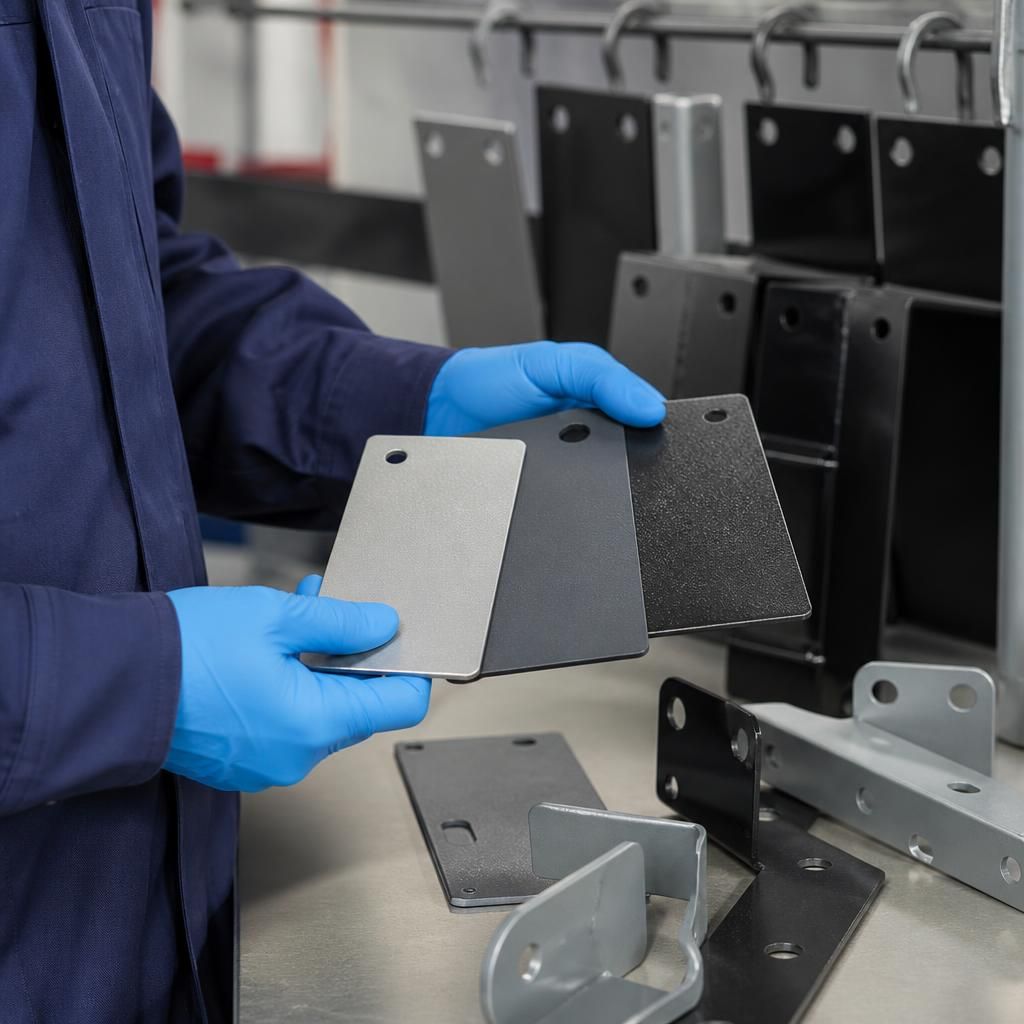
Powder material selection affects how a coated component responds to movement, impact and deformation. A flexible formulation is better suited to parts that are formed, flexed or exposed to vibration because it is less likely to crack when the substrate moves. Harder formulations can provide greater resistance to abrasion and surface marking, but may be less tolerant of bending or impact.
This balance is important for fabricated metalwork, brackets, guards and components that experience mechanical stress in service. The required performance should be assessed alongside the part’s shape, substrate and operating conditions rather than choosing a powder solely for its colour or gloss level. Where flexibility and hardness are both important, a representative coated sample can help confirm that the selected material provides the required finish without compromising functional performance.