

What factors determine the choice of powder coating type and thickness for different industrial aluminium applications?
The choice of powder coating type and thickness for an industrial aluminium application depends on the component’s exposure conditions, required durability, geometry, appearance and end use. The specification should balance chemical, corrosion and wear resistance with the coating manufacturer’s recommended film build, ensuring the finish cures correctly without affecting dimensions, edges or detailed features.
The suitable powder coating type and film thickness are determined by the performance specification for the aluminium component, the environment in which it will operate and the limits imposed by its design and production process. A coating selected for an internal machine guard will have different requirements from one used on an external architectural section, a vehicle component or an aluminium part exposed to chemicals and repeated abrasion.
Exposure is the primary consideration. External aluminium requires a system with appropriate resistance to ultraviolet radiation, moisture and changes in temperature. Internal components may instead require resistance to cleaning chemicals, oils, solvents or impact. Where the coating will be exposed to salt, industrial pollutants or persistent condensation, the complete coating specification must address corrosion protection rather than relying on thickness alone. A thicker layer of an unsuitable resin will not compensate for poor resistance to the service environment.
The resin chemistry is selected according to the dominant form of attack:
- Polyester systems are commonly considered for external applications because they can provide suitable weathering and colour retention when the grade is matched to the exposure.
- Epoxy systems are useful where chemical resistance, adhesion and corrosion protection are important, particularly in controlled internal environments. They are not normally selected as the sole finish where prolonged ultraviolet exposure is expected.
- Epoxy-polyester hybrids can suit general-purpose internal components where a balance of appearance, hardness and chemical resistance is required.
- Polyurethane and other specialist systems may be specified where particular requirements for appearance, smoothness, durability or chemical performance apply.
- Nylon coatings can be considered for components subject to sliding contact, impact or abrasion, provided the operating conditions and dimensional requirements are suitable.
The intended appearance also affects the choice. Gloss level, colour stability, texture and the acceptable degree of surface variation should be agreed before coating. Fine textures, matt finishes and metallic effects can respond differently to application and curing conditions, while a smooth, high-gloss finish may show substrate marks or handling defects more readily. Aluminium sections with visible faces therefore need a specification that considers both functional performance and visual acceptance.
Thickness is specified as a controlled film build rather than simply making the coating as thick as possible. The powder manufacturer’s technical data and the required performance tests establish the appropriate target range. The selected range must allow the coating to form a continuous protective layer while remaining compatible with the section’s dimensions, assembly interfaces, apertures, threads, sliding surfaces and other close-tolerance features.
Too little coating can leave weak coverage at edges, corners and recessed areas, reducing protection and producing inconsistent appearance. Excessive build can cause runs, heavy edges, orange peel, loss of detail, poor fit between assembled parts and difficulty achieving the intended cure. It can also make the finish more vulnerable to defects if the powder is applied beyond the system’s recommended limits. Film build should therefore be controlled across the component, not judged only from an easily accessible flat face.
Component geometry has a direct effect on the practical specification. Long aluminium sections, thin walls, folded edges, deep recesses and areas with limited access can produce different deposition levels during spraying. The electrical behaviour of aluminium, the position of the part in the booth and the arrangement of the spray equipment also influence how powder accumulates. A design with tight tolerances may need a lower or more closely controlled build, whereas a component exposed to substantial wear may require a specialist system or a defined multi-layer approach.
Part preparation and curing must be considered alongside the powder type and thickness. The aluminium surface needs a suitable pre-treatment so that the coating can bond reliably and resist underfilm corrosion. The applied film must then receive the heat required for the specified cure. Oven settings should be assessed against the metal temperature reached by the section, not just the air temperature, because section mass, wall thickness and loading affect heat transfer. A film that is correctly applied but under-cured may lack the intended hardness and chemical resistance; excessive heat can affect colour, gloss or the substrate.
The application’s operating cycle is another selection factor. Components exposed to repeated impacts, rubbing, bending, washing or contact with process fluids need a coating system tested for those conditions. For electrical enclosures or heat-sensitive assemblies, the coating’s insulating properties and the temperature limits of the finished part may also matter. Areas intended for earthing, welding or electrical contact should be identified before coating so that they can be masked or treated as part of the component specification.
A practical specification should record:
- the aluminium alloy and condition of the substrate;
- the internal or external service environment;
- expected exposure to ultraviolet light, moisture, salts, chemicals, abrasion and impact;
- required colour, gloss, texture and visual acceptance criteria;
- the target film-build range and the locations where measurements are required;
- dimensional limits, masking requirements and areas that must remain uncoated;
- the required pre-treatment and curing conditions; and
- the inspection and performance tests appropriate to the end use.
For a production batch, the final choice is normally confirmed by reviewing the component drawing, service conditions, powder technical information and any relevant project or industry specification. Sample parts or an initial controlled batch can help identify problems with coverage, appearance, fit and curing before the process is applied to the full production quantity. This approach is particularly useful for complex aluminium sections, where a nominal coating thickness may not describe the variation between exposed faces, edges and recessed areas.
In practice, the correct specification is the one that provides the required protection and appearance at a controlled, achievable film build. Powder coating specialists can use the part geometry, intended service and production requirements to select a suitable system and define how thickness should be measured and checked throughout the coating process.
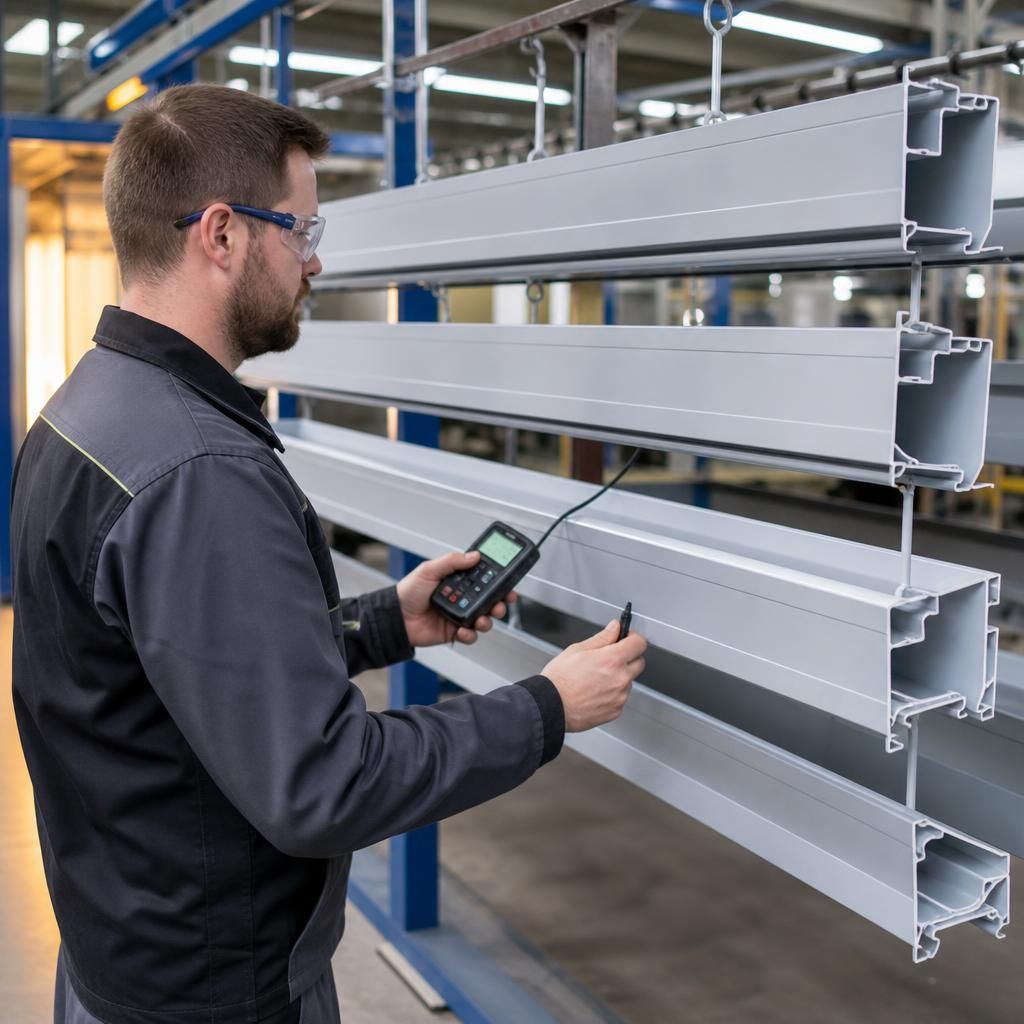
For aluminium applications with defined performance classes, the powder type and film build should be selected from the governing project or industry specification rather than from appearance alone. The specification may set requirements for weathering, adhesion, corrosion resistance, hardness, flexibility or chemical exposure, as well as defining how the finished coating is to be assessed.
Compatibility with adjoining materials can also affect the choice. Powder coating may need to work alongside sealants, gaskets, fasteners or joining methods without reducing adhesion, creating excessive build at joints or interfering with assembly. Reviewing these interfaces before finalising the resin and target thickness helps ensure that the coating performs as part of the complete aluminium component.