

What are the key safety considerations during the aluminium powder coat pretreatment process to ensure compliance and protect workers?
Safe aluminium powder coat pretreatment depends on a documented risk assessment, COSHH controls, correct chemical storage and handling, suitable PPE, effective ventilation, and training for everyone involved. Operators should also control access to treatment equipment, follow chemical manufacturers’ instructions and safety data sheets, maintain emergency washing and spill procedures, and dispose of contaminated waste in line with UK requirements.
Safety during aluminium powder coat pretreatment depends on controlling the process as a complete system: the chemical reactions, treatment plant, movement of components, and possible exposure to fumes, splashes, heat and mechanical hazards. In addition to chemical controls, a compliant operation needs suitable equipment safeguards, controlled working methods, competent supervision, and records showing that controls remain effective.
Assess the chemistry before selecting the process. Aluminium can react differently to alkaline cleaners, acid etches and conversion treatments than steel. A highly caustic or acidic solution may attack the substrate, generate heat or produce hazardous vapours. In particular, alkaline contact with aluminium can release hydrogen, creating a potential fire or explosion hazard where gas is allowed to accumulate. The chosen chemistry, concentration, temperature and tank design should therefore be reviewed together, rather than treating the chemicals as interchangeable products.
Where a formulation can create a flammable atmosphere, the assessment should consider the Dangerous Substances and Explosive Atmospheres Regulations (DSEAR). This may require suitable ventilation design, ignition-source control, equipment selection and documented arrangements for preventing gas accumulation. The assessment should also identify whether a treatment contains substances with specific workplace exposure limits or additional controls.
Guard tanks, conveyors and other moving equipment. Pretreatment lines can expose operators to rollers, pumps, lifting mechanisms, spray nozzles and automated transfer systems. Guards should prevent access to dangerous moving parts during normal operation, while interlocked doors or covers should stop the relevant equipment when opened. Emergency stop controls need to be clearly identifiable, accessible from operating positions and tested as part of planned maintenance.
Maintenance and cleaning require a separate safe system. Equipment should be isolated from electrical, hydraulic, pneumatic and stored chemical energy before anyone enters a tank area or reaches into machinery. Isolation points should be identifiable, and the person carrying out the work should be able to verify that movement, pressure and flow have stopped. Operators should never rely solely on an emergency stop button as an isolation method.
Prevent contact with hot or pressurised process media. Heated cleaning stages, spray systems and pumps can cause burns or injection injuries as well as chemical harm. Tank covers, insulation and guarding can reduce accidental contact, while pressure should be released before opening pipework, filters or spray equipment. Temperature, pump and level controls should be maintained so that an abnormal condition, such as an empty tank being heated, cannot develop unnoticed.
Control slips, falls and manual-handling risks. Rinsing and chemical transfer can leave floors, platforms and access routes wet. Bunded areas, suitable drainage, slip-resistant surfaces and prompt removal of contamination help reduce falls. Walkways should remain clear of racks, hoses and trailing cables. Aluminium components and hanging fixtures may also be awkward or heavy; lifting aids, stable racking and agreed handling methods can reduce crushed fingers, dropped loads and musculoskeletal injuries.
Design safe loading and unloading practices. Racks and hooks must support the component weight and keep parts secure as they pass through the line. Operators should be protected from swing, sharp edges and unexpected movement, particularly where overhead conveyors or lifting equipment are used. Defective hooks, racks and lifting accessories should be removed from use and inspected under a planned system.
Prevent contamination and unintended chemical reactions. Separate process stages should be arranged so that concentrated chemicals, dirty rinse water and treated components do not contaminate one another. Mixing incompatible residues can create heat, fumes or unexpected reactions. Dosing equipment, transfer lines and containers should be clearly identified, and only the specified substance should be introduced into each tank. Changes to chemical formulation, operating temperature or sequence should be reviewed before implementation rather than made informally on the shop floor.
Use monitoring and inspection to verify controls. Safety is not demonstrated simply because the line was safe when installed. Operators and supervisors should check tank levels, temperatures, pumps, extraction performance, guards, interlocks, alarms, floors and access routes at defined intervals. Results, defects and corrective actions should be recorded. Trends such as repeated low fluid levels, blocked spray nozzles, unusual odours or corrosion around equipment can indicate that a control is deteriorating.
Provide suitable occupational health arrangements. Repeated low-level exposure may not be obvious immediately, particularly where contact occurs through contaminated surfaces or clothing. The need for health surveillance should be considered where the risk assessment identifies a relevant exposure or health effect. Workers should know how to report symptoms, skin problems, respiratory irritation, near misses and process abnormalities without delay. Incident and near-miss reviews should examine the underlying process failure, not only the operator’s actions.
Finally, the site should keep evidence that its arrangements are being maintained: equipment inspection records, examination and test results, monitoring data, maintenance logs, incident investigations and reviews following process changes. These records support ongoing compliance with applicable UK health and safety duties, including requirements relating to work equipment, electrical systems, dangerous substances and workplace conditions. They also make it easier to identify weaknesses before they result in worker injury or an uncontrolled chemical event.
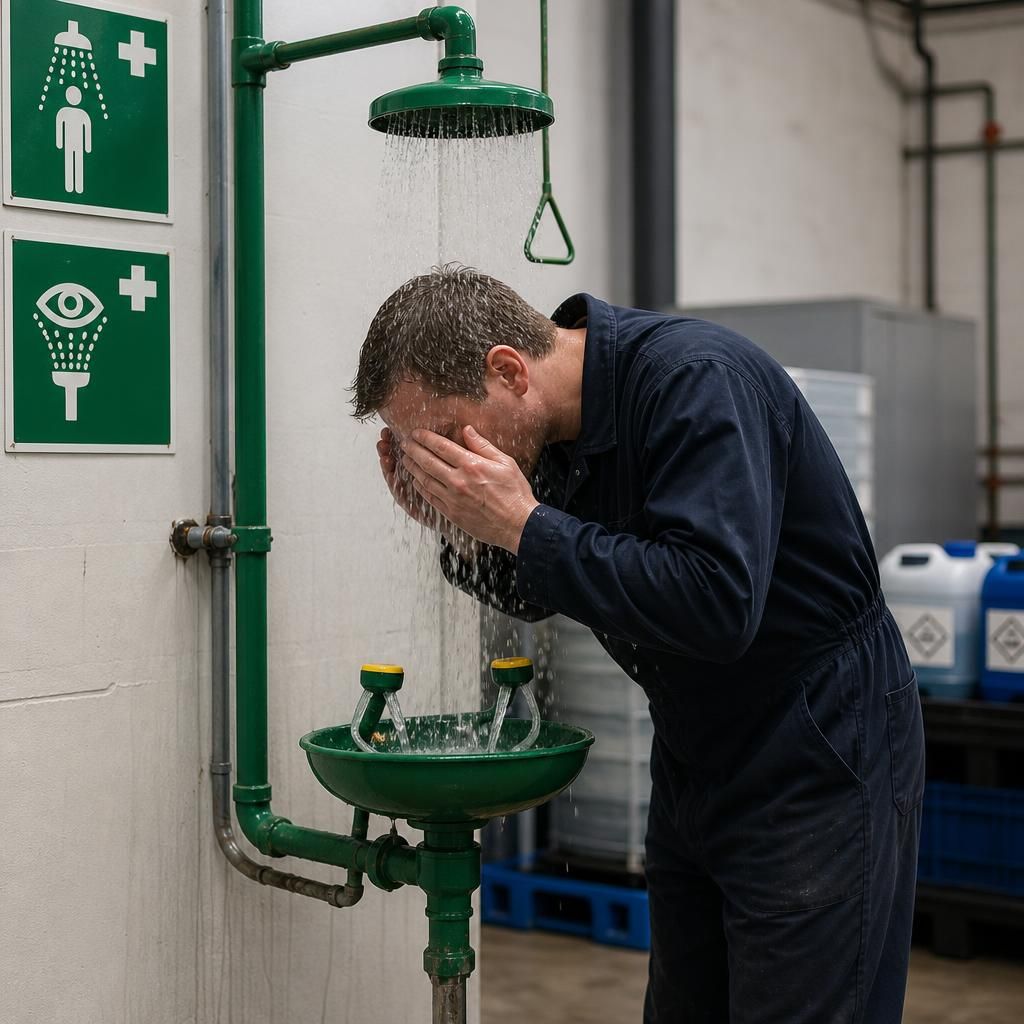
Emergency arrangements for aluminium pretreatment must cover chemical exposure as well as spills. If a splash reaches the eyes or skin, the affected person should use the designated washing facilities immediately and follow the relevant safety data sheet. Contaminated clothing should be removed safely, and workers should not attempt to neutralise chemicals on the skin or delay medical advice while investigating the cause.
First-aid instructions, emergency contact details and the identity of each process chemical should be readily available to supervisors and trained first-aiders. After an exposure or near miss, the event should be recorded and reviewed to establish whether the substance, task, equipment or working method needs additional controls. This helps prevent a recurring incident rather than treating the original response as the end of the investigation.