

How does professional pretreatment improve the efficiency and cost-effectiveness of the powder coating process?
Professional pretreatment prepares aluminium consistently by removing contaminants and creating a suitable surface for powder coating, helping reduce defects, rework and process interruptions. This improves material and labour efficiency while supporting a more cost-effective coating process through fewer rejected or repeat-finished components.
Professional pretreatment improves the efficiency and cost-effectiveness of powder coating by making the preparation stage controlled, repeatable and appropriate to the aluminium being coated. Instead of treating every component identically, a professional process considers the alloy, surface condition, intended service environment, component design and required finish. This helps the coating line operate predictably and allows costs to be assessed across the complete process rather than by powder consumption alone.
Consistent process control reduces avoidable variation. Pretreatment depends on factors such as chemical concentration, temperature, contact time, agitation and rinse quality. Professional facilities monitor these conditions and apply defined operating procedures rather than relying on visual judgement alone. Consistency makes it easier to identify the cause of a coating problem, adjust the process and maintain the same standard across repeat batches.
Correctly controlled stages also help use chemicals, water and other consumables more efficiently. Excessive treatment may waste chemical capacity or affect the aluminium surface, while insufficient treatment can leave the process unable to provide the required foundation for the coating system. Monitoring the condition of process tanks and rinses supports timely maintenance, helps prevent premature bath replacement and reduces the likelihood of an uncontrolled process change affecting a whole batch.
Professional pretreatment supports better production planning. Components can be grouped according to alloy, size, geometry and surface condition so that the treatment sequence is suitable for the work being processed. This is particularly relevant where batches contain intricate parts, heavy sections or areas that are difficult for process solutions to reach. Good planning reduces unnecessary handling, avoids unsuitable sequencing and helps the coating operation make more effective use of its equipment and labour.
- Review the aluminium grade and any previous treatment before selecting the preparation route.
- Identify recessed areas, joints, drilled holes and other features that may retain process solution or require additional attention.
- Define the required finish and service conditions before agreeing the pretreatment and powder coating specification.
- Use controlled inspection points to confirm that components are suitable to proceed to coating.
It also lowers the cost of diagnosing process problems. A professional operation is more likely to retain process records, batch details and inspection information. If an issue occurs, these records help distinguish between a substrate problem, handling issue, pretreatment variation or coating-stage fault. Without that information, investigations can involve repeated testing, unnecessary stripping or the disposal of otherwise usable components.
The financial benefit is therefore broader than the price of the pretreatment chemicals. A controlled process can reduce wasted consumables, unplanned handling, additional inspection, stripping and replacement of affected parts. It can also make production requirements more predictable, which is important for manufacturers and fabricators working to defined batch quantities or assembly schedules. The exact benefit depends on component design, alloy, specification and the condition of the incoming metal.
Professional advice is especially valuable where the specification is demanding. Components exposed to moisture, chemicals, abrasion or changing temperatures may require a more carefully selected pretreatment and coating system than items used indoors in a relatively mild environment. Selecting the process according to the intended duty avoids paying for an unnecessarily complex treatment while reducing the risk of choosing a preparation route that is unsuitable for the application.
For businesses assessing a coating supplier, useful questions include how aluminium alloys are identified, how process conditions are monitored, what inspection records are retained and how non-conforming parts are controlled. These details indicate whether pretreatment is being managed as a defined technical process rather than as a preliminary washing step. For Midlands manufacturers, fabricators, construction firms and automotive businesses, a professional approach can make powder coating more predictable and support better control of overall production costs.
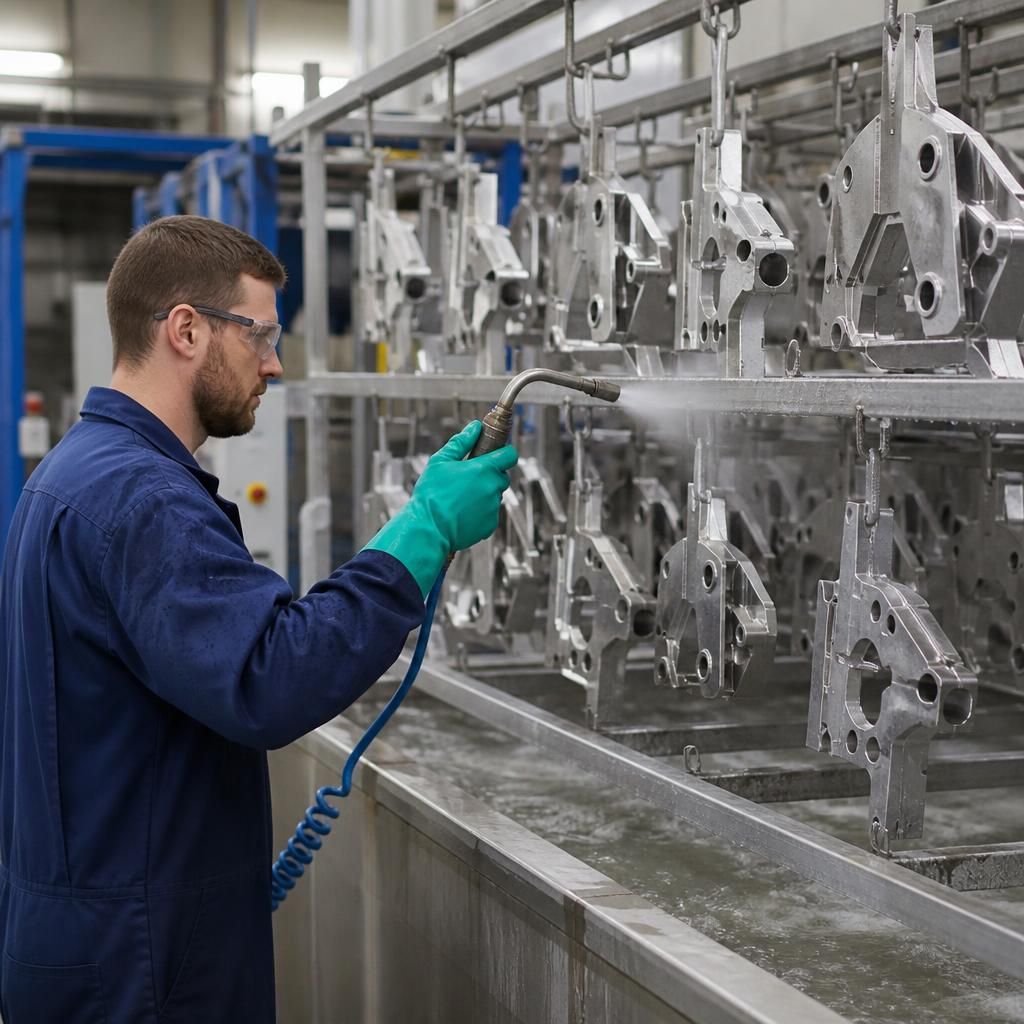
Professional pretreatment improves powder coating efficiency by ensuring that aluminium components are properly rinsed and dried before powder is applied. Residual chemicals, rinse water or moisture in joints and recessed areas can interfere with powder application and curing, causing surface defects that require additional inspection, stripping or recoating.
Controlled drying is therefore part of process efficiency, not a separate finishing detail. It helps create a stable surface for powder application, reduces contamination of the coating equipment and supports consistent oven loading. Checking that components are dry before coating is particularly important for complex parts, where retained moisture may not be obvious during a visual inspection.