

How does pretreatment affect the adhesion and durability of aluminium powder coating?
Pretreatment improves aluminium powder coating by removing contaminants and conditioning the surface so the powder bonds securely. A suitable pretreatment, including chemical conversion where appropriate, also helps protect the aluminium from corrosion and reduces the risk of flaking, blistering and premature coating failure.
Pretreatment affects aluminium powder coating by controlling the quality of the interface between the metal and the cured coating. It influences how consistently the powder wets the surface during curing, how firmly the film remains attached under mechanical stress, and how well the finished component withstands moisture, chemicals, temperature changes and outdoor exposure.
Aluminium’s natural surface presents a challenge
Aluminium rapidly forms a thin oxide layer when exposed to air. This layer is not automatically a suitable foundation for a powder coating: it may vary in composition, contain residues from manufacturing or handling, and respond differently to heat and moisture from the underlying metal. Pretreatment creates a more controlled surface condition than untreated aluminium can provide.
The result is important at the interface rather than simply on the visible face of the coating. A coating can appear smooth immediately after curing yet have weak interfacial adhesion if the preparation is inconsistent. Defects may only become apparent when the component is bent, impacted, exposed to water or subjected to repeated temperature changes.
How adhesion is improved
- Surface uniformity: A consistent pretreatment gives the powder a more predictable foundation across the whole component, including edges, recesses and less accessible areas.
- Interfacial bonding: Suitable conversion layers can provide a chemically active interface between aluminium and the powder coating. This supports adhesion beyond simple contact between two surfaces.
- Resistance to mechanical damage: Stronger adhesion helps the coating remain attached when the part is handled, assembled, drilled, fastened or exposed to minor impacts. It also reduces the chance that a small damaged area will spread beneath the surrounding film.
- Compatibility with the coating system: The pretreatment must suit the powder chemistry, the aluminium alloy and the intended service environment. An inappropriate or poorly controlled layer can interfere with coating wetting or create a weak boundary.
How durability is improved
Durability depends on more than the hardness of the cured powder. The interface must remain stable while the aluminium and coating expand and contract at slightly different rates. A properly selected pretreatment helps the system tolerate these movements without losing adhesion.
It also limits the effects of moisture and corrosive agents reaching the metal beneath the coating. This is particularly relevant at cut edges, scratches, drilled holes, joints and areas where the coating is thinner. If the interface is poorly prepared, moisture can travel under the film and cause localised lifting, staining or loss of adhesion. Pretreatment does not make the coating immune to damage, but it can reduce the consequences of exposure when the complete system is correctly specified and applied.
Why process control matters
The performance of pretreatment depends on control rather than on the name of the process alone. Factors such as solution concentration, temperature, contact time, rinsing quality and drying condition can affect the resulting surface. Carryover between stages, inadequate rinsing or over-treatment may leave residues that compromise the coating interface.
Aluminium components also vary considerably. Alloy composition, extrusion lubricant, machining fluid, previous storage conditions, cast texture and the presence of welds can all influence how the surface responds. A treatment suitable for a clean architectural extrusion may not be suitable for a heavily machined or cast component without adjustment.
Edges and complex profiles require particular attention. Liquid stages must reach the relevant surfaces, drain effectively and leave no trapped residues in joints, cavities or folded sections. Poor drainage can produce local differences in pretreatment and, consequently, inconsistent coating performance.
The relationship between pretreatment and curing
Pretreatment and curing should be considered as one coating system. The powder must reach its specified cure condition so that the resin forms the intended film properties, while the pretreated surface must remain suitable throughout application and oven processing. Under-cured powder may have inadequate chemical and mechanical resistance; excessive heat or an unsuitable process can affect the aluminium, the coating or the interface.
For this reason, the correct oven conditions, component temperature and dwell time need to be established for the powder system and the mass and geometry of the part. A sound pretreatment cannot compensate for incorrect curing, just as a correctly cured powder cannot fully overcome an unsuitable substrate preparation.
Assessing whether pretreatment is adequate
Assessment should combine visual inspection with checks appropriate to the component’s service requirements. A uniform, residue-free surface before coating is an important starting point, but finished parts may also require adhesion, thickness, appearance and resistance testing. Where the coating will face demanding outdoor, chemical or industrial conditions, testing should reflect those conditions rather than relying only on appearance.
Any failure should be investigated across the complete process. Peeling may result from pretreatment, contamination, poor rinsing, incorrect powder application or curing. Blistering can involve moisture, trapped residues or damage that has allowed exposure beneath the coating. Separating these possible causes prevents an apparent pretreatment problem from being treated in isolation.
In practical terms, effective aluminium pretreatment provides a reproducible interface, supports adhesion through handling and service, and helps the coating retain its protective and decorative properties for longer. The best process is therefore the one matched to the alloy, component design, powder system and exposure conditions, with each stage controlled consistently from preparation through final cure.
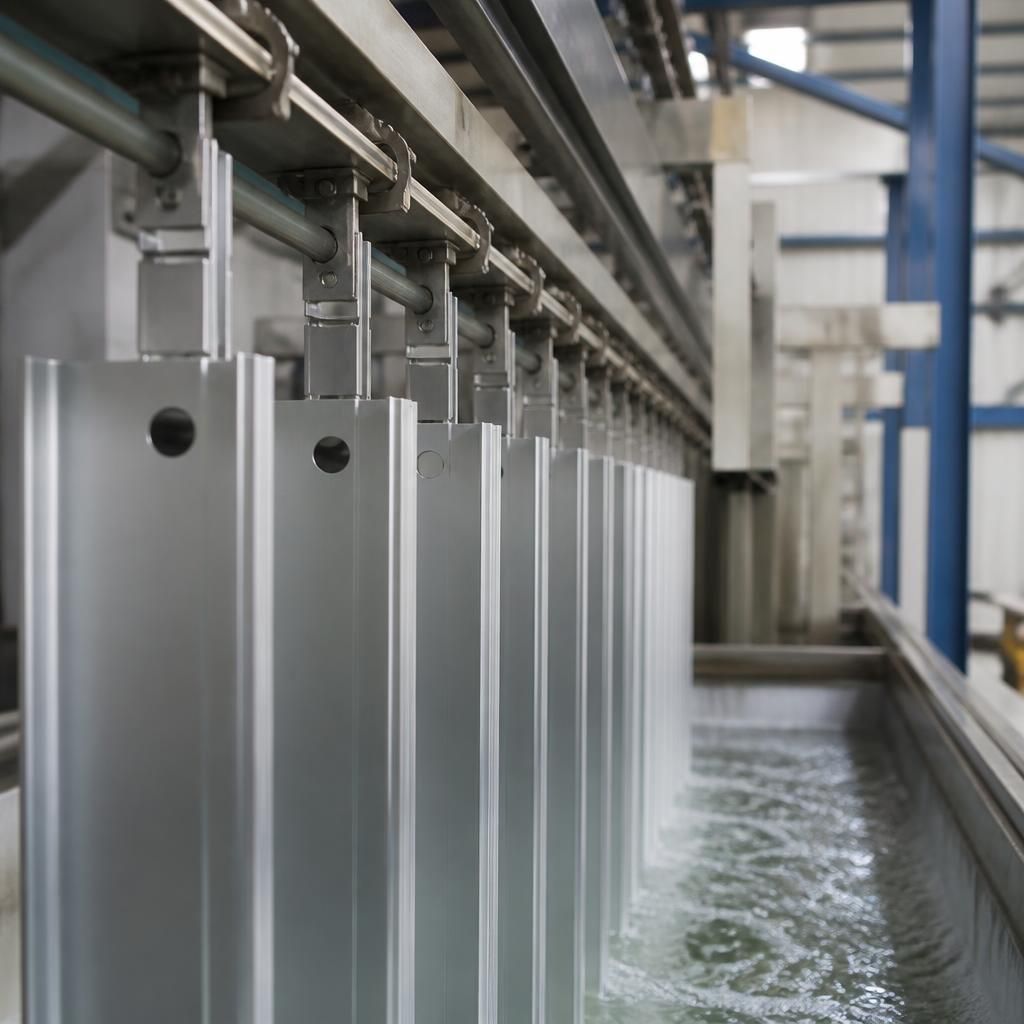
Cleaning and chemical conversion perform different functions in aluminium powder coating pretreatment. Cleaning removes oils, dust, machining residues and other contaminants, while conversion treatment modifies the surface to create a more suitable foundation for the coating. A component can therefore look clean but still lack the surface condition needed for reliable long-term performance.
The conversion layer is typically thin and is not intended to provide the visible finish. Its value lies in creating a controlled transition between the aluminium and the powder film, while helping limit corrosion at the metal–coating boundary. Coverage must remain consistent across broad faces, edges and formed areas; gaps or uneven treatment can create local weak points that are difficult to identify once the powder has been applied.