

What finish options are available for powder coated aluminium products, and which are best suited for specific industrial applications?
Powder-coated aluminium is available in matt, satin, gloss, textured and clear finishes, with the choice determined by appearance, cleaning requirements and the operating environment. Matt or textured finishes suit architectural and general industrial components where glare and minor surface variation need to be reduced, while gloss or satin finishes are suited to parts requiring a smoother, easier-to-clean surface; specialist protective coatings may be selected for more demanding applications.
The most suitable finish for a powder coated aluminium product depends on the part’s exposure, handling, cleaning regime, required appearance and the type of protection needed. For industrial work, finish selection should be made alongside the coating specification rather than treated as a purely visual decision.
Colour selection is usually based on the required colour reference, surrounding equipment and whether replacement or additional components must match existing parts. A consistent colour specification helps maintain uniformity across batches, but the perceived result can still vary with surface profile, coating texture, lighting and viewing angle. Where appearance is critical, an approved physical sample is more reliable than judging colour from a screen or printed chart.
Gloss level affects both appearance and practical use. Lower-sheen surfaces can be appropriate for enclosures, frames, panels and equipment where reflections would be distracting. Higher-sheen surfaces may suit components that need a visually clean, smooth-looking finish, although they can make handling marks, scratches or substrate imperfections more noticeable. A middle sheen is often selected where the component needs a balanced appearance without a strongly reflective or highly muted surface.
Textured finishes provide a different performance and appearance profile. They can help disguise minor visual variation in the aluminium and give covers, housings, brackets and machinery components a more utilitarian appearance. The texture should be considered alongside cleaning requirements: pronounced profiles can retain dust or residue more readily than a smoother surface and may need a cleaning method that reaches the surface pattern without damaging the coating.
Clear finishes are used where retaining the aluminium’s underlying appearance is important. They can be considered for components where the metal surface, brushed effect or other prepared appearance is intended to remain visible. The aluminium must be suitable for this approach, because a clear coating will not conceal inconsistent preparation, marks or variation in the substrate in the same way as an opaque colour coat.
For parts exposed to more severe mechanical or chemical conditions, a specialist protective coating may be more appropriate than a standard decorative specification. Nylon coatings, for example, are considered for applications where resistance to impact, abrasion or repeated contact is important. They may be relevant to industrial components, handling equipment, protective parts and items subject to friction, but the coating choice still needs to reflect the actual chemicals, temperatures and loading involved.
When selecting a finish, assess the following factors:
- Exposure: consider indoor or outdoor use, moisture, sunlight, pollutants, salt and process contaminants.
- Mechanical contact: identify whether the aluminium will be handled, rubbed, struck, assembled against another part or exposed to abrasive materials.
- Cleaning: specify whether the component will be wiped, pressure-cleaned or exposed to detergents, oils and other cleaning agents.
- Appearance: decide whether colour consistency, low reflection, surface uniformity, visible metal or a more industrial texture is the priority.
- Part design: account for edges, recesses, holes, threaded areas and masking points that may affect coverage or assembly.
- Operating conditions: provide details of temperature, chemicals and expected service conditions so the coating system can be assessed properly.
Preparation is particularly important on aluminium. Degreasing, cleaning and suitable pre-treatment help the coating adhere to the substrate and reduce the risk of defects caused by contamination or surface oxidation. Fabrication marks, weld areas, sharp edges and previous finishes should be identified before coating, as these can influence the final appearance and the protection achieved.
Finish choice can also affect assembly. Coating thickness around holes, mating faces, threads and sliding interfaces may need to be allowed for during design. Areas that must remain electrically conductive, bond to another component or meet a tight dimensional requirement may require masking or a defined uncoated zone. These requirements should be agreed before processing rather than corrected after coating.
For general industrial aluminium, a standard colour and suitable sheen may be sufficient where the part has moderate exposure and limited abrasion. Enclosures and visible panels often require careful control of colour and surface uniformity, while brackets, guards and machine components may place greater emphasis on resistance to handling and cleaning. Components used in abrasive or high-contact conditions should be assessed for a protective system, with the final specification based on the environment rather than appearance alone.
A practical specification should therefore state the colour reference, sheen or surface character, substrate condition, areas to be masked, dimensional constraints, required protective properties and expected service environment. Supplying drawings, photographs or a representative sample can help confirm whether the selected finish is suitable before a production batch is processed.
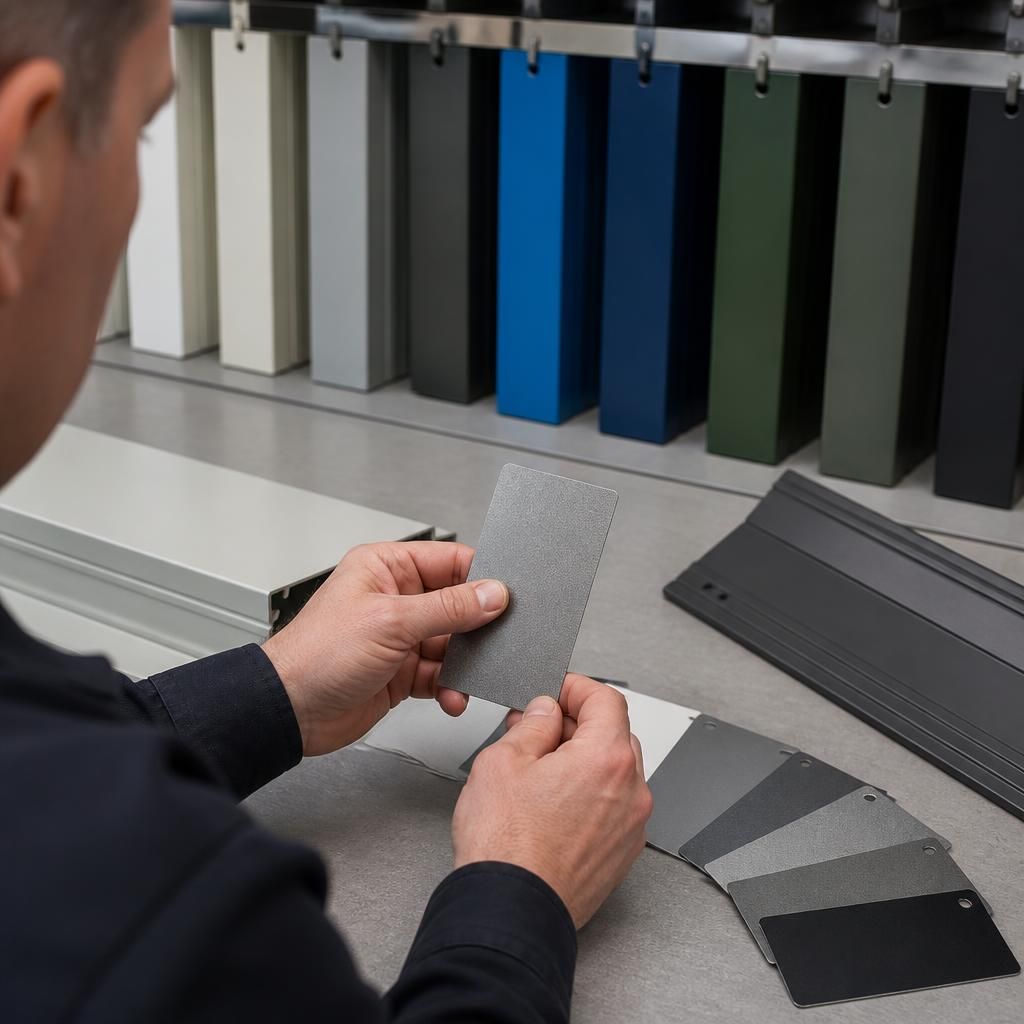
For visible aluminium products, finish approval should be based on a physical reference sample and agreed inspection conditions. Screen images and printed colour charts can misrepresent sheen, texture and metallic effects, while lighting and viewing angle can alter the perceived result. A reference sample allows the required colour, surface character and level of visual variation to be assessed more consistently before production.
The approval should also distinguish between acceptable coating texture and actual defects. Minor variation may be inherent in a textured or low-sheen finish, whereas contamination, exposed substrate, poor coverage or damage require investigation. Recording the approved reference alongside the drawing or purchase specification gives the coater and customer a clear basis for checking finished batches.